
When it comes to dressing for a formal event, the choice between sleeved and sleeveless gowns can feel harder than it should. With so many sleeve styles in circulation, and so few of them named clearly anywhere, it is easy to know what you like without knowing what to ask for. This guide names every sleeve type you will encounter on a formal dress, explains which ones suit which arms, and shows where each one belongs.
What are the main types of sleeves on formal dresses? The most common are cap, flutter, short, three quarter, and long sleeves, which describe length, plus bell, bishop, puff, juliet, kimono, off the shoulder, cold shoulder, illusion, and cape, which describe shape. Length decides how much coverage you get, and shape decides how much attention the sleeve draws.
Comfort, event context, body proportion, and personal taste all matter here, and none of them outranks the others. The sections below work through each in turn.
Sleeved or Sleeveless: What Actually Decides It
In the world of black tie events and evening affairs, deciding between sleeved and sleeveless gowns is mostly a question of conditions rather than fashion rules. Sleeved gowns offer warmth and coverage, which makes them a natural choice for cooler weather, outdoor evening ceremonies, and heavily air conditioned venues. Sleeveless gowns show the arms and shoulders and read lighter in warm weather, though some women find them exposing over a long event.
Neither is more formal than the other. A sleeveless column gown and a long sleeve lace gown can both be black tie appropriate, and a dress code almost never specifies sleeves. What it comes down to is the venue, the season, the hours you will be standing, and how you want to feel in photographs. If coverage is your priority, the covered evening dress guide works through the options beyond sleeves alone.
Comfort and Practicality
Comfort should carry real weight in this decision. Sleeved gowns provide coverage and warmth that matter in cooler climates and in venues where the air conditioning runs cold all evening. Sleeveless gowns keep you cooler through a summer reception and are easier to dance in when the room heats up.
The practical middle ground is a sleeveless gown paired with a removable layer, since that gives you both options across one evening. Our guide to evening dress layering covers which wraps, boleros, and capes work with which necklines.
Style and Elegance
Sleeved and sleeveless evening dresses each carry their own kind of elegance, and the right choice depends on what you want the gown to say. A long lace sleeve adds romance and softness to a ball gown. A short sequined sleeve reads glamorous and deliberate. A clean sleeveless neckline lets jewelry and shoulders do the work instead.
Whichever direction you take, think about how the sleeve length and the neckline work together, since those two decisions shape the whole upper half of the gown. Getting them to agree matters more than either one on its own.
Personal Preference
At the end of it, this is your call. Some women feel most themselves in a sleeved gown with a modest, covered line. Others want the openness of a sleeveless or strapless silhouette. Both are correct, and the only wrong answer is a gown you spend the evening adjusting.
Types of Sleeves on Formal Dresses
Sleeve names fall into two groups. Some describe length and some describe shape, and most gowns combine one of each, which is why a dress can be a long bishop sleeve or a short puff sleeve without any contradiction.
By length, a cap sleeve barely covers the top of the shoulder and reads as a soft finish rather than real coverage. A flutter sleeve is similar in length but cut wider so it moves, giving a light, floating effect. A short sleeve ends around mid upper arm. A three quarter sleeve stops between the elbow and the wrist and is the most flattering length for most arms, since it breaks the line at the narrowest point. A long sleeve runs to the wrist and gives the fullest coverage.
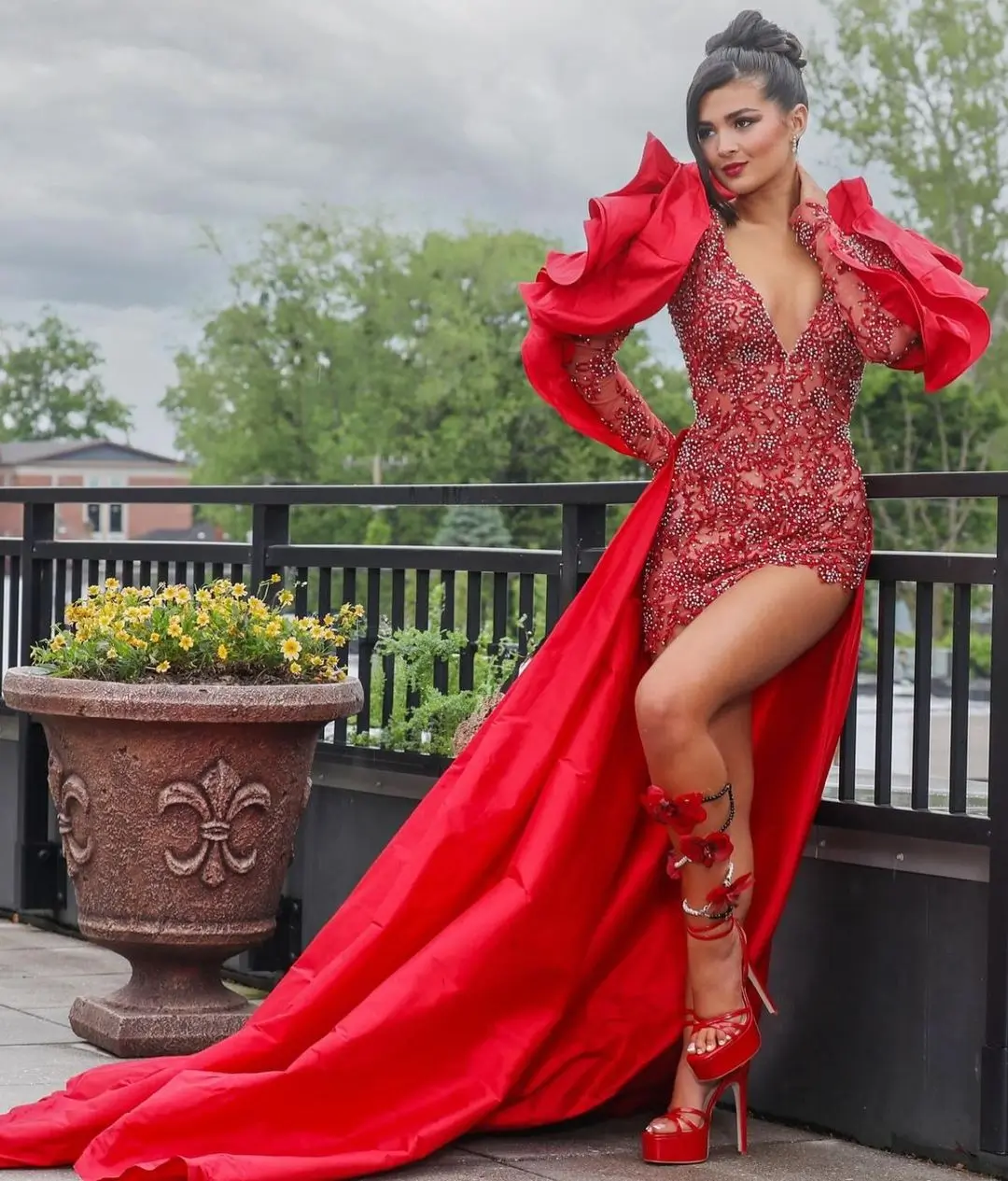
By shape, a bell sleeve is fitted at the shoulder and flares out toward the wrist. A bishop sleeve is full through the arm and gathered into a cuff. A puff sleeve gathers volume at the shoulder and can be short or long. A juliet sleeve combines a puffed shoulder with a fitted lower arm, which is the most historical of the group. A kimono sleeve is cut as one piece with the bodice rather than set into an armhole, which gives a soft, wide line with no shoulder seam.
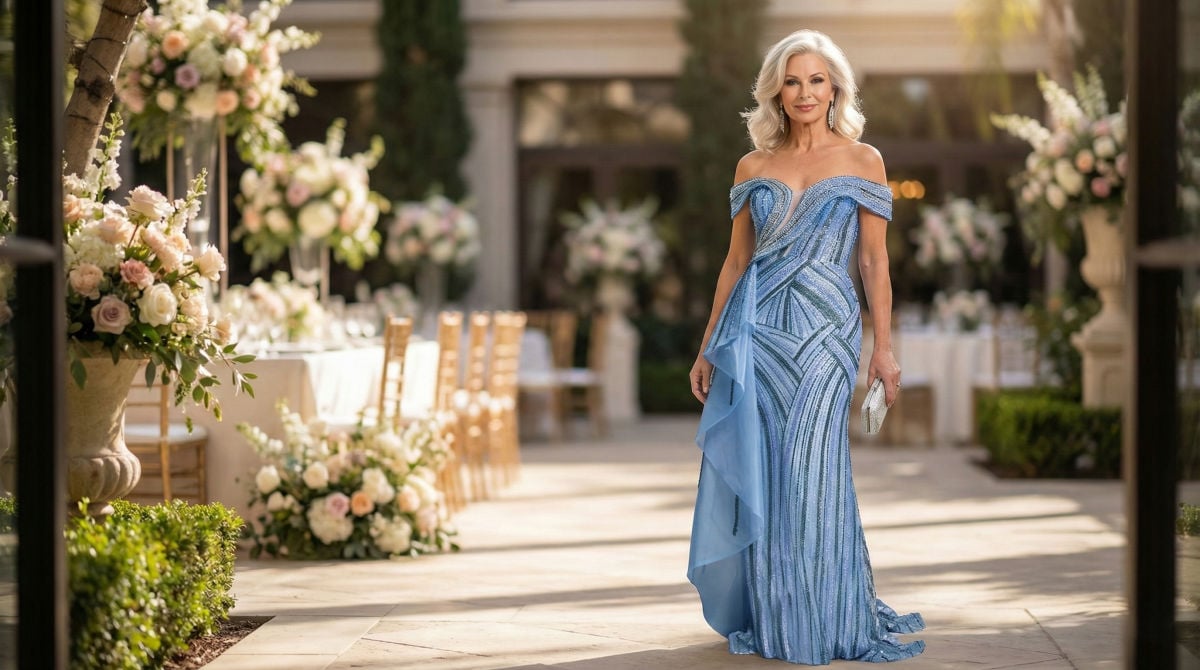
Three more sit slightly outside both groups. An off the shoulder sleeve sits below the shoulder line across the upper arm. A cold shoulder sleeve covers the arm but leaves a cut out at the shoulder itself. An illusion or sheer sleeve is made from tulle or fine mesh, so it gives the outline of coverage while staying almost invisible, which is why it appears so often on formal gowns that need to look modest without adding weight.
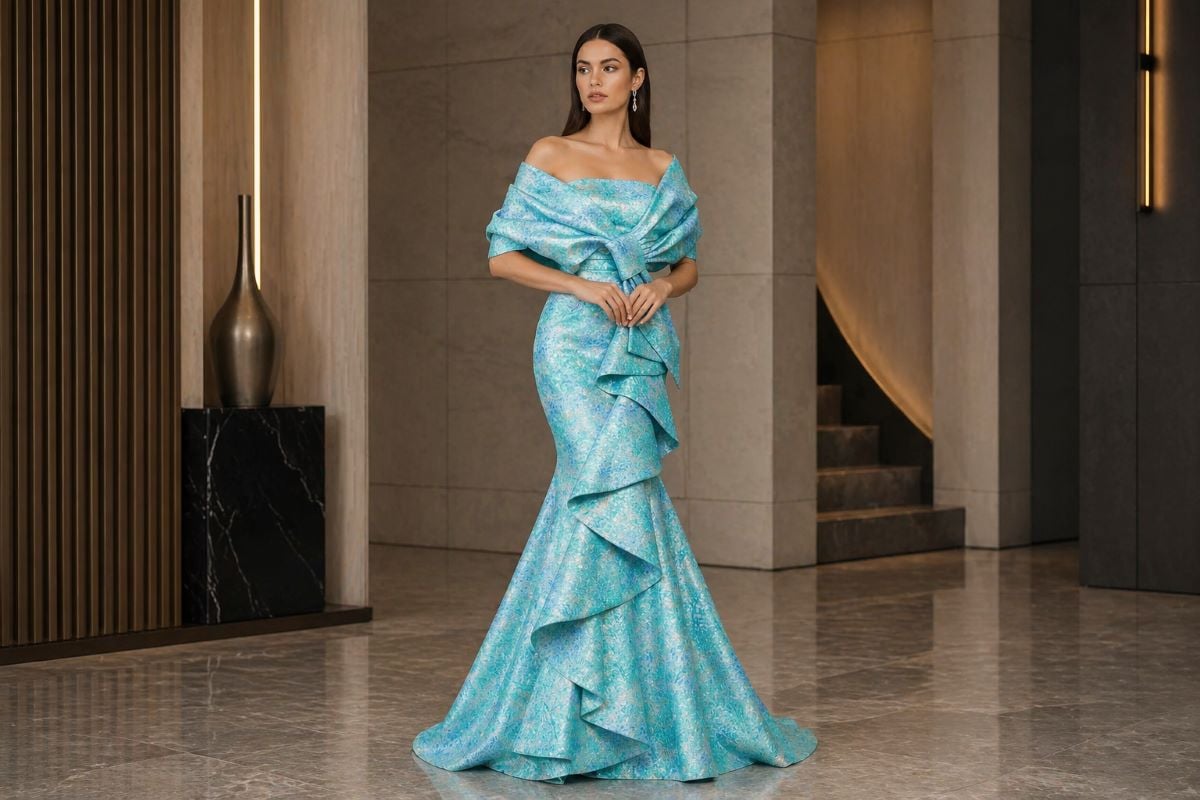
A cape is the outlier. It attaches at the shoulder or neckline and falls freely rather than following the arm, so it is not strictly a sleeve at all, though it solves the same problem. If you want drama from the sleeve itself, our look at statement sleeves and corset bodices covers how far the volume can go before it takes over.
Lace, Sequin, and Sheer Sleeve Finishes
Once you have the shape, the fabric decides the mood. The same three quarter sleeve reads completely differently in lace, in sequin, and in plain crepe.
Lace sleeves are the most timeless of the three. Cut in cap, short, three quarter, or full length, they add texture and softness without weight, and they work particularly well over a nude or matching lining so the arm is covered without being hidden. Pair them with jewelry that echoes the lace rather than competing with it, and keep the shoe simple.
Sequined sleeves are the statement option. They come cropped or full length, with round, flat, or shaped sequins, and they catch every bit of light in a ballroom. Because the sleeve is already doing the work, keep jewelry minimal, and let the sparkle sit in one place rather than across the whole look.
Sheer and illusion sleeves are the quiet solution to a common problem. When you want the coverage of a long sleeve without the heat or the heaviness, tulle or fine mesh gives you the line without the layer. This is the most useful sleeve on the list for warm weather formal events, and our guide to styling long sleeve dresses covers how to keep the rest of the look balanced.
Evening Gowns With Sleeves, by Length
Knowing the names is useful, but at some point you have to see the gowns. Jovani organizes eveningwear by sleeve length, which is the fastest way to filter once you know what you want.
Full coverage sits in the long sleeve evening dresses range, which is where lace, illusion, and bishop shapes appear most often. This is the group to browse for winter weddings, black tie events in cooler months, and any occasion where you want the arm covered from shoulder to wrist.
For something lighter, the short sleeve evening dresses range covers cap, flutter, and puff shapes. These give a finished shoulder line without the warmth of a full sleeve, which makes them the practical middle choice for spring and autumn events.
If the sleeve is not the point but the coverage is, the cape evening dresses range solves the same problem with movement instead. A cape floats away from the arm rather than following it, which flatters almost every upper arm and photographs beautifully outdoors.
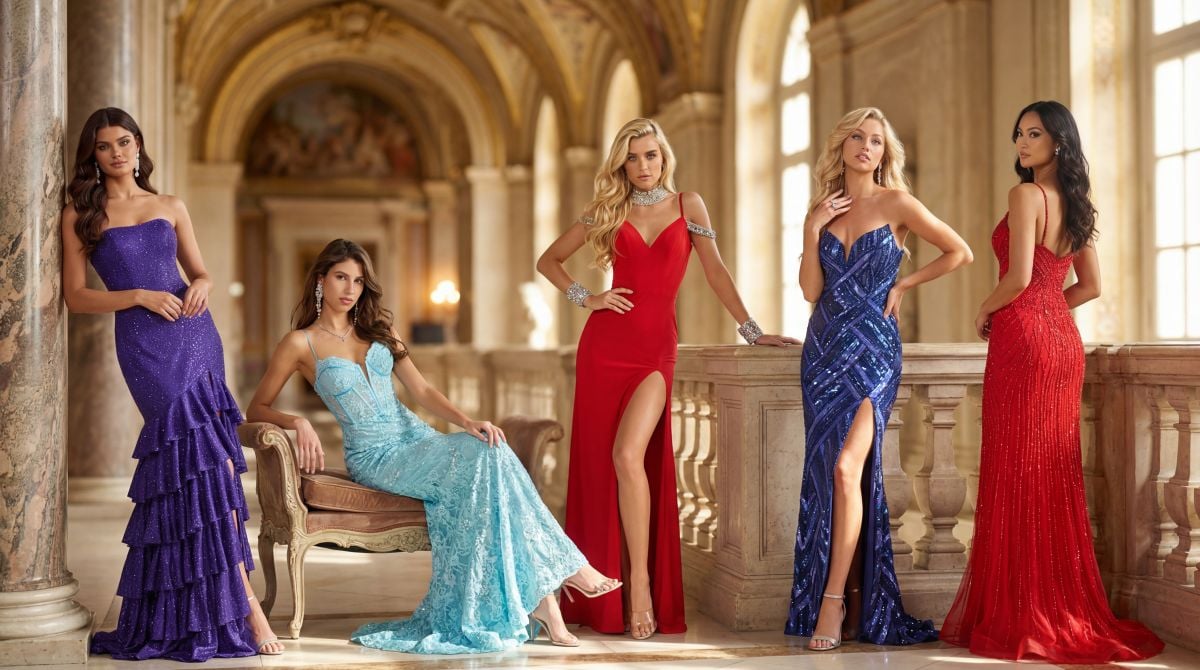
And when the answer is no sleeve at all, the sleeveless evening dresses range runs from strapless to halter to one shoulder. Pair one with a wrap and you have both options in a single outfit.
How to Choose the Perfect Sleeve Style for Your Body Type
Sleeve choice does more for proportion than almost any other detail on a gown, because it decides where the eye stops along the arm. Considering your frame alongside the occasion and the overall design will get you to the right answer faster than browsing at random, and the body type calculator is a useful starting point if you are not sure where you fall.
Petite Frames
Shorter sleeves keep the proportions balanced on a petite frame. Cap, flutter, and short sleeves all sit above the point where a longer sleeve would visually cut the arm in half, and a three quarter sleeve works well too because it stops at a natural narrow point.
What to approach carefully is volume. A very wide bell or a full bishop sleeve carries a lot of fabric, and on a smaller frame that fabric can dominate rather than flatter. If you love the shape, choose a scaled down version rather than the full one.
Curvy Figures
Three quarter and long sleeves are the most reliable choices for a curvier figure, because they follow the arm without gripping it and finish at a slimmer point. Fluid fabrics matter more than the sleeve name here, since a soft lace or chiffon sleeve skims while a stiff one pulls.
The one to avoid is a tight short sleeve that ends at the widest part of the upper arm, since that placement draws the eye exactly where most women would rather it did not linger. A flutter sleeve solves the same problem with movement, and our guide to dress styles that flatter your arms covers this in more detail.
Tall and Slender
A taller, slimmer frame carries dramatic sleeves better than any other, so this is where bell, bishop, puff, and juliet shapes come into their own. There is enough vertical line to absorb the volume, and the sleeve reads as design rather than as bulk.
Long sleeves also suit these proportions particularly well, since the unbroken line from shoulder to wrist echoes the length of the frame. Off the shoulder shapes work for the same reason, adding a horizontal break where one is welcome.
Tips for Accessorizing Your Formal Dress or Evening Gown
Accessorizing matters as much as the sleeve itself, because the sleeve changes what the rest of the look can carry. A heavily embellished sleeve leaves less room for a statement necklace, while a clean sleeveless neckline leaves plenty. Our full guide on how to accessorize an evening dress works through the whole outfit.
Jewelry Pairings
Choose pieces that complement the sleeve rather than compete with it. A statement necklace suits a strapless evening dress or a sweetheart neckline, where there is open space above the bodice. Delicate earrings work better with a high neckline, and a drop earring or pendant suits a v neck or halter.
Bracelets deserve a note of their own here. A long sleeve leaves nowhere for a bracelet to sit, so move that piece to a ring or skip it, and with an asymmetric or one shoulder gown a cuff on the bare arm balances the design. Neckline and sleeve should be considered together, and our guide to the best necklines for different body shapes covers the other half of that pair.
Shoe Selection
Shoes should follow the style and color of the gown rather than the sleeve. Heels in black, nude, or a metallic finish suit almost every formal dress and keep the line clean. Consider the length of the gown when you choose the heel height, since a floor length hem needs enough lift to clear the ground once you are moving. Avoid heavily embellished shoes with an already detailed gown.
Outerwear Options
Outerwear is how a sleeveless gown becomes a cold weather outfit. Boleros and shrugs add a light layer over the shoulders. Capes and capelets create the most dramatic version of the same idea. Wraps and shawls are the most flexible, since they come off in a second and fold away on the back of a chair.
For the walk in from the car, a tailored coat long enough to cover the hem is worth having even if it never appears in a photograph. Match the outerwear to the fabric of the gown rather than to its color, since a heavy wool over a chiffon dress looks mismatched no matter how well the shades agree.
Choosing Your Sleeve With Confidence
Sleeve choice comes down to coverage, comfort, proportion, and the mood you want the gown to carry. Learn the names, decide how much of the arm you want covered, then match the shape to your frame and the fabric to the season. Everything else is preference, and preference is allowed.
Once you have narrowed the choice to two or three gowns, visit an authorized Jovani retailer and try them on. Raise your arms, sit down, and walk a few steps, because a sleeve that feels right standing still can feel very different an hour into an evening.
Dress Sleeve Questions
What are the different types of sleeves on dresses?
By length: cap, flutter, short, three quarter, and long. By shape: bell, bishop, puff, juliet, kimono, off the shoulder, cold shoulder, and illusion. A cape sits alongside these, attaching at the shoulder and falling free rather than following the arm.
Which sleeve is most flattering for the upper arms?
A three quarter sleeve, because it ends at the narrowest point between elbow and wrist rather than cutting across the widest part of the arm. A flutter sleeve and an illusion sleeve both work well too, since neither grips the arm.
Does a formal evening gown need sleeves?
No. Dress codes almost never specify sleeves, and a sleeveless column gown is as black tie appropriate as a long sleeve lace gown. Sleeves are a decision about warmth, coverage, and personal comfort rather than about formality.
What is the difference between a cape and a sleeve?
A sleeve follows the arm and is set into the armhole or cut with the bodice. A cape attaches at the shoulder or neckline and falls freely away from the body, so it gives coverage without touching the arm, which is why it moves so well in photographs.
What sleeve works best for a winter formal event?
A long sleeve in lace, crepe, or a lined fabric gives real warmth, and a bishop or fitted long sleeve suits an evening venue. If you prefer a sleeveless gown, pair it with a cape, bolero, or wrap so you can adjust as the room temperature changes.
Can you add sleeves to a sleeveless dress?
Not usually as a simple alteration, since the armhole and bodice construction would need rebuilding. The practical answer is a detachable layer instead: a bolero, a shrug, an illusion capelet, or a wrap gives you the coverage without touching the gown.