
The question of whether a jumpsuit is acceptable at a wedding has been settled for a while now, and the answer is yes. What has not been settled is the more useful question underneath it: acceptable at which weddings, in what fabric, and where does it still fall short. Almost every guide answers the first question enthusiastically and then hands you a list of products, which leaves you with a jumpsuit that may or may not suit the specific invitation on your fridge. This guide to the wedding guest jumpsuit takes the dress codes one at a time, says plainly where a jumpsuit works and where it does not, and covers the practical realities of wearing one through an eight-hour wedding day.
Why guests choose a jumpsuit
The appeal is not novelty. A wedding is one of the longest events most people dress for: a ceremony, a receiving line, a cocktail hour, a seated dinner, and several hours of dancing, often across more than one location and frequently outdoors for part of it.
A jumpsuit removes an entire category of management from that day. There is no hem to lift on stairs, nothing to gather when you sit, nothing to worry about on grass or gravel, and no draft problem when the sun goes down. Trousers also solve the question of what to do about tights, which is a real consideration at a spring or autumn wedding.
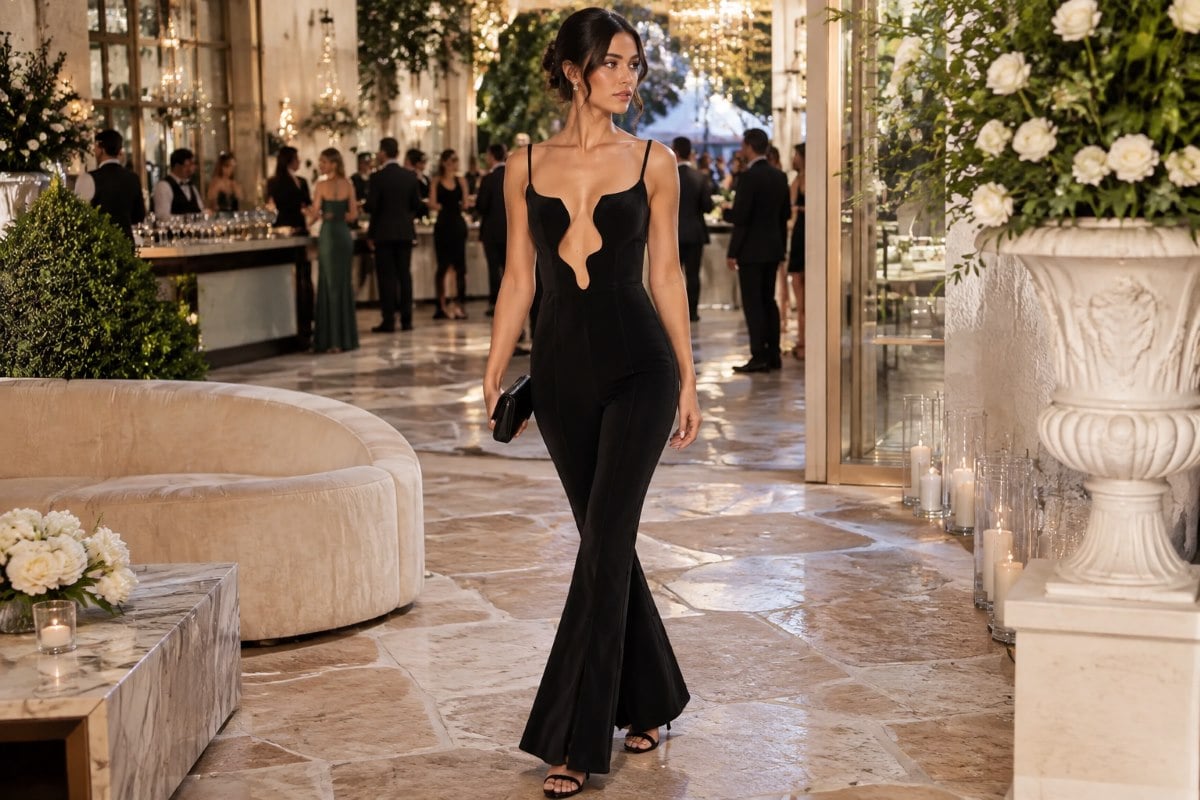
There is a second reason that matters more than it sounds. At a wedding where most guests are in dresses, a well-cut jumpsuit reads as a deliberate choice rather than a default one, which is a quiet advantage in a room full of photographs. The formal jumpsuits currently available show the fabrics and cuts that read as wedding-appropriate rather than everyday.
Which dress codes a jumpsuit suits
This is where most advice stops short. A jumpsuit is not equally at home across every wedding, and the invitation tells you which situation you are in.
Cocktail, semi-formal, and casual weddings
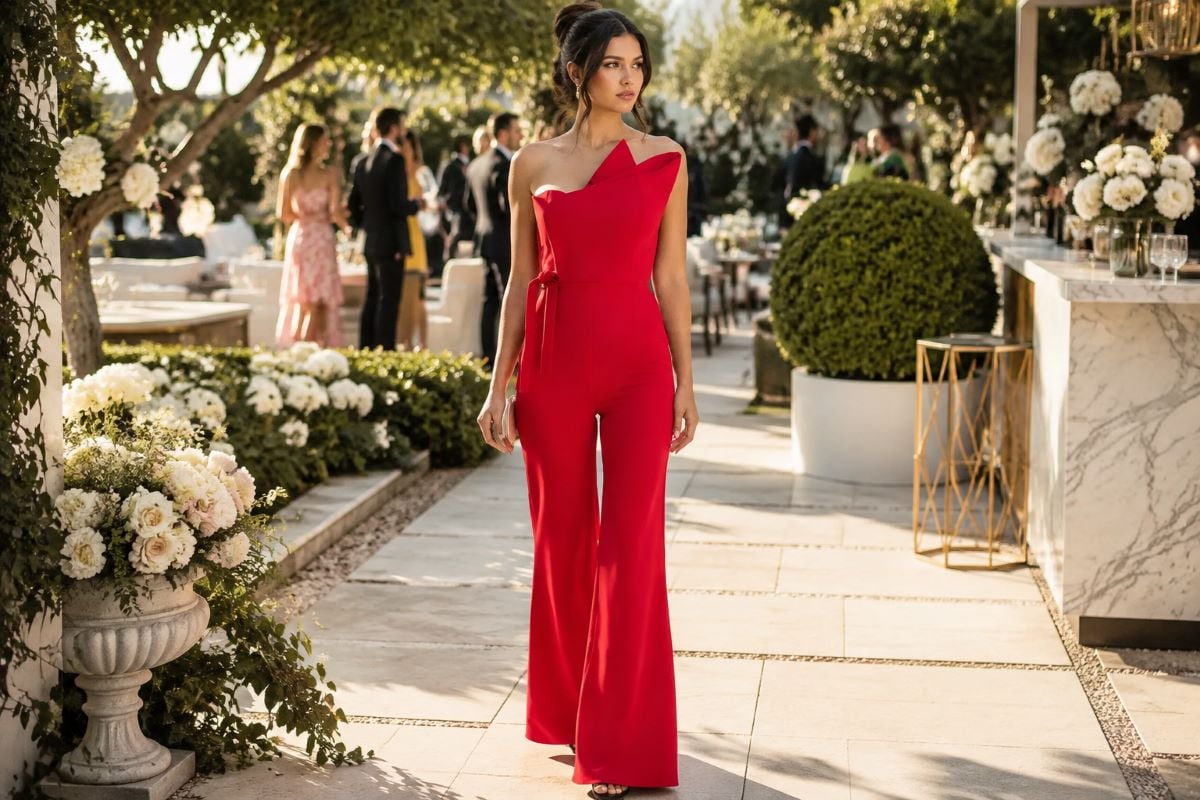
These are the easiest cases and a jumpsuit is entirely at home in all three. For a cocktail wedding, a jumpsuit in crepe, satin, or a similar occasion fabric sits exactly at the right level. For a semi-formal wedding, the range widens further and a slightly softer fabric or a cropped wide leg works well. For a casual or beach wedding, a lighter jumpsuit in chiffon or linen-blend is appropriate, though a jumpsuit with shorts is not, regardless of how warm the venue is. Across these three codes, a jumpsuit is not a compromise or a workaround; it simply reads as one of the correct answers.
Black tie and formal weddings
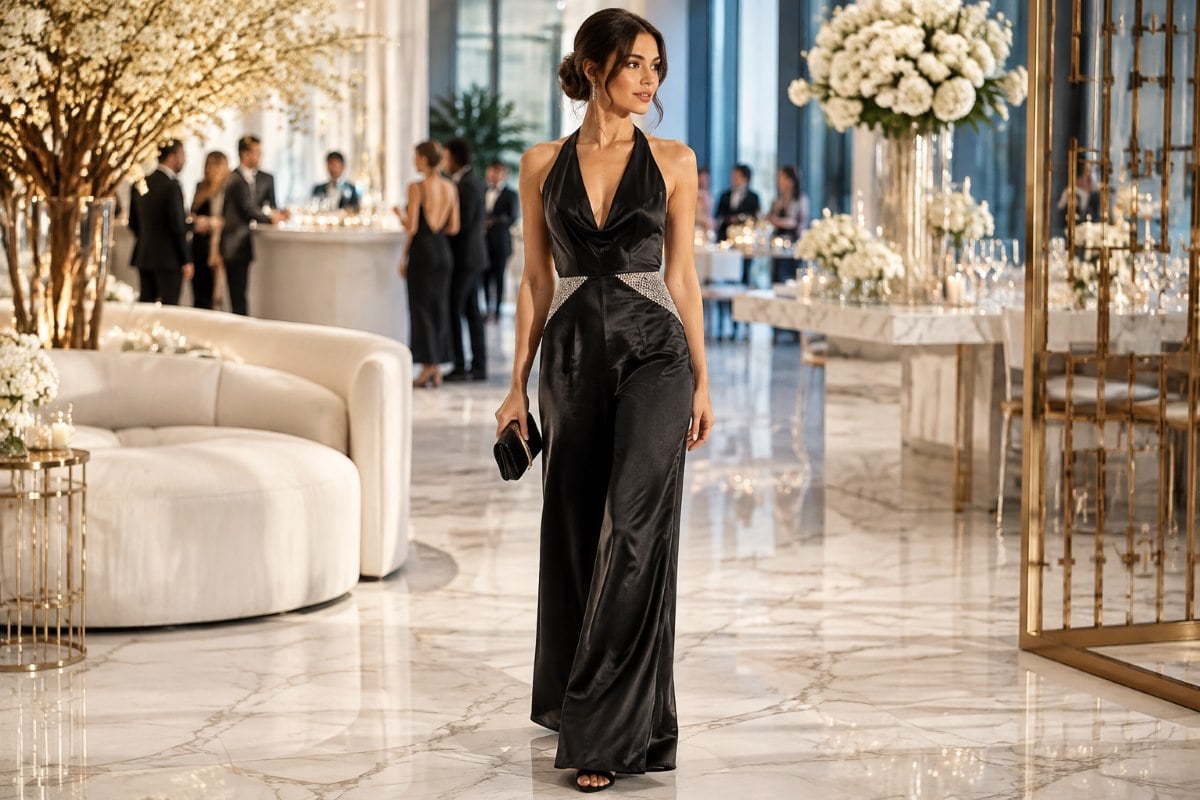
Here the answer is a qualified yes rather than an unqualified one. A jumpsuit can meet a black tie standard, but only in full length, in an evening fabric with weight or luster, and in a deep or metallic color rather than a print. The version that fails is the one that would look right at a nice dinner: correct in shape but too light in fabric and too casual in color. At the most traditional formal weddings, particularly where the invitation specifies a long gown or where the family is conservative about these things, a gown carries less risk. That is a judgment about the room rather than a rule. The breakdown of wedding guest dress codes covers what each level expects.
Where a jumpsuit is genuinely the wrong choice
Being honest about this matters more than another list of styling tips, and there are three situations where a dress is simply the better decision.
The first is a religious ceremony with specific expectations. Some churches, synagogues, mosques, and temples have guidance on covered shoulders, covered knees, or skirts specifically, and a few communities still expect a skirt rather than trousers for women in a place of worship. This has nothing to do with fashion and everything to do with respect for the setting, and it is worth asking rather than assuming.
The second is a wedding in a culture or family tradition where trousers on a female guest would read as pointedly modern. You will usually know if this applies to you, and if you are unsure, the couple or a family member will tell you in thirty seconds.
The third is any wedding where the couple has explicitly requested something. If the invitation asks for a long gown, a jumpsuit is testing a boundary at someone else’s occasion, which is rarely worth doing. The wider conventions are set out in the guide to wedding guest dress etiquette.
Fabric, cut, and color
Most disappointing wedding jumpsuits fail on one of three things, and each is easy to check before you buy.
The fabric does most of the work
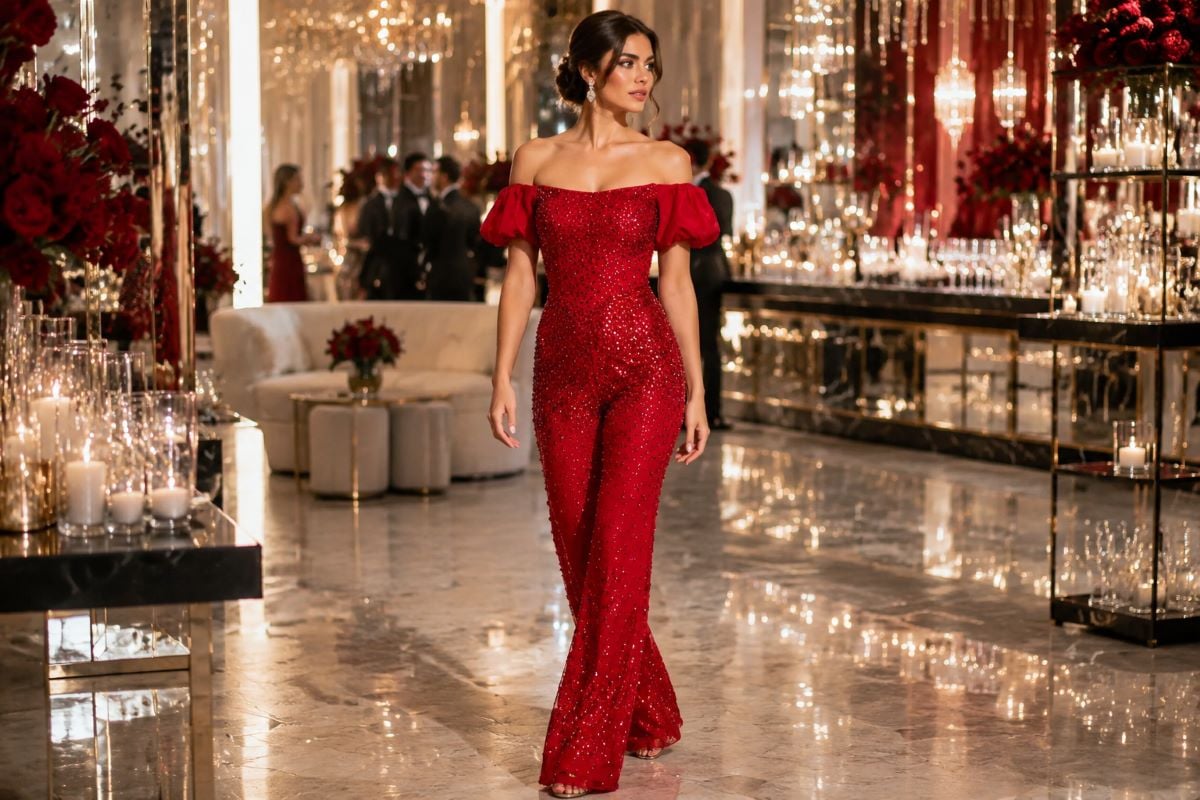
Crepe is the most reliable choice, since it holds a tailored line, does not crease badly through a long seated dinner, and reads as formal without shine. Satin and silk read as dressier still and suit an evening wedding. Chiffon and georgette suit a daytime or outdoor celebration. Velvet works for a winter wedding. What does not work is jersey, cotton poplin, denim in any form, or anything with visible stretch, all of which read as daywear no matter how well the piece is cut. This single factor separates a wedding guest jumpsuit from an ordinary one more than any other.
Cut and length
A defined waist is what stops a jumpsuit reading as a boilersuit, and it is the detail worth prioritizing. Wide-leg styles are the most forgiving and the most formal, since the leg reads almost like a skirt when you stand still. A straight or tapered leg is sharper and more modern. The hem should clear the floor by a small margin with your actual shoes on, which means the trousers must be taken up to your exact heel height. This is the most common failure in the category and the easiest to fix, since a jumpsuit hemmed for a different shoe looks wrong in every photograph.
The color rules that still apply
Choosing a wedding guest jumpsuit does not exempt you from the usual color conventions, and the same two rules hold.
White, ivory, cream, and anything that reads as bridal are out. This catches people more often with a jumpsuit than with a dress, because a white jumpsuit does not feel like a wedding dress and therefore feels safe, when in a photograph beside the bride it reads exactly the same as a white dress would. The advice on how not to look like the bride applies to a jumpsuit precisely as it does to a gown.
Beyond that, avoid an exact match with the bridesmaid color, since being mistaken for the wedding party is the other common misstep. Everything else is open. Deep colors, jewel tones, and metallics all read as formal, and black is entirely acceptable at most modern weddings. A print can work at a daytime or garden wedding but usually reads as less formal, so it suits the more relaxed codes better. The range of wedding guest dresses shows the color range that works for a guest, and the same logic transfers directly.
Styling it so it reads as occasionwear
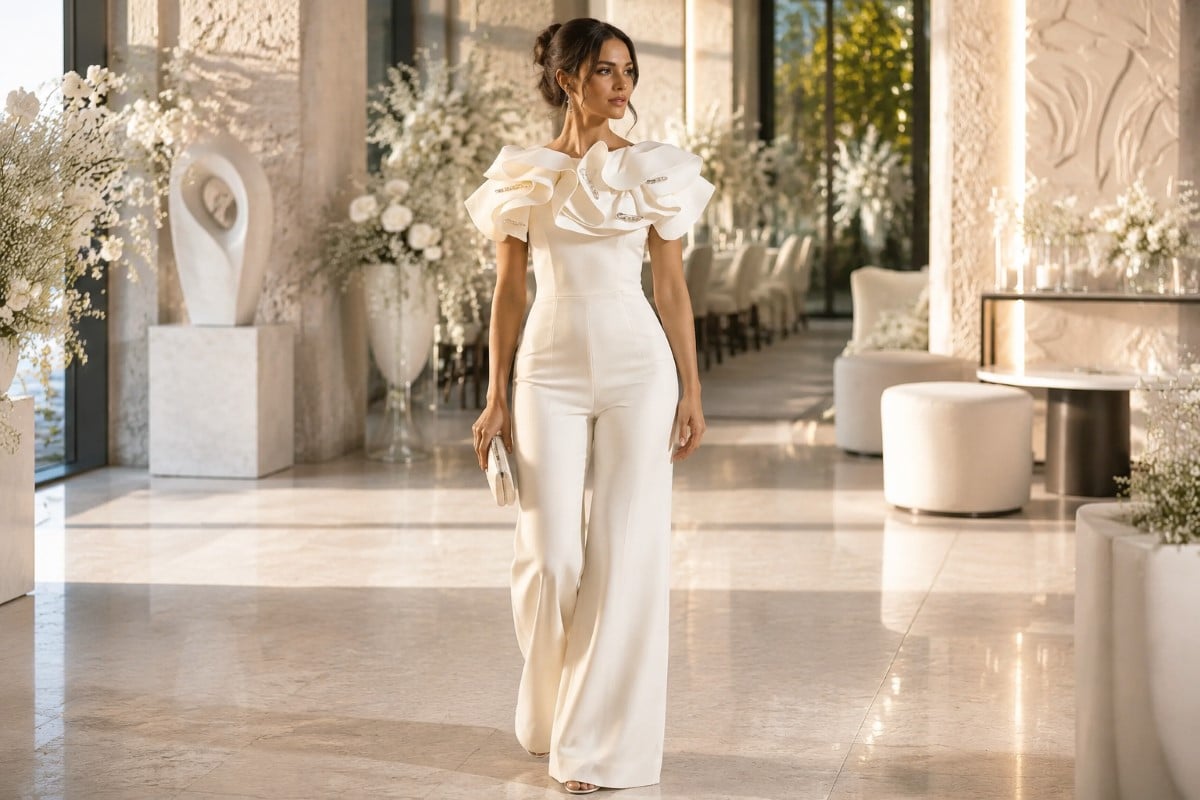
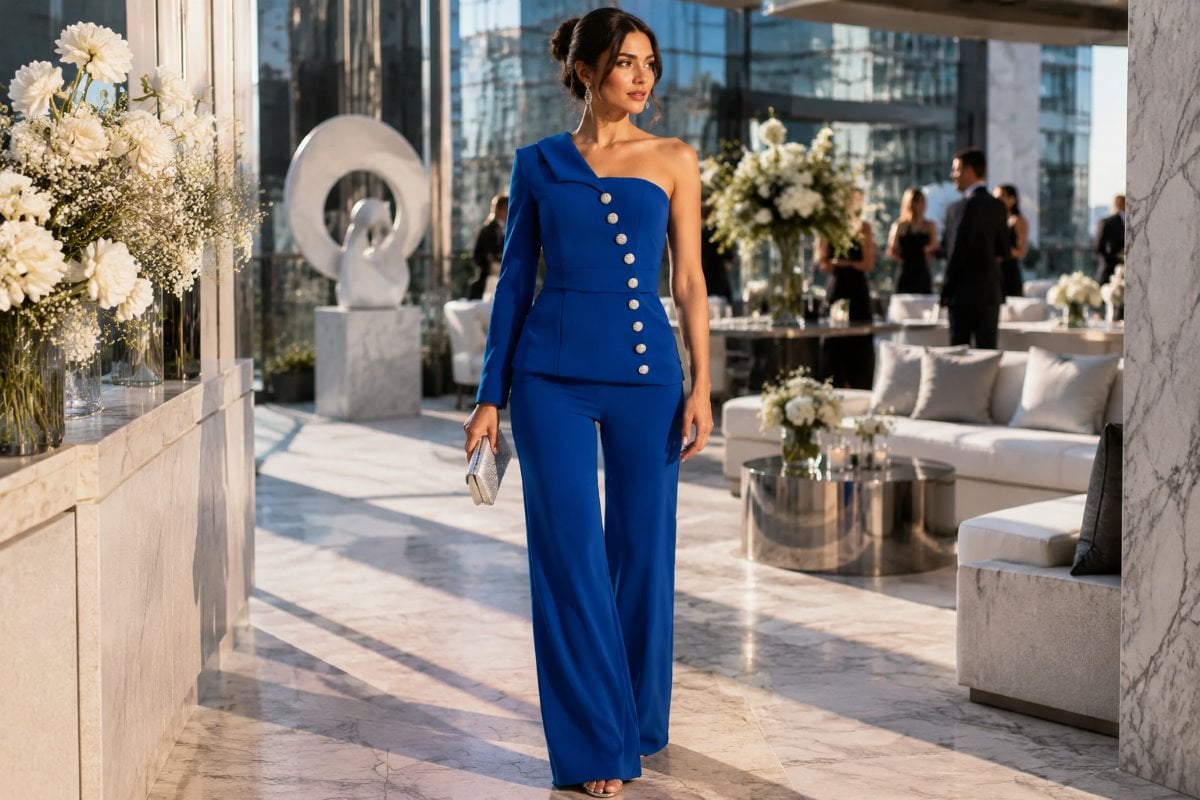
Because a jumpsuit has less fabric and less visual weight than a gown, the accessories carry more of the formality. This is the difference between a jumpsuit that reads as an outfit and one that reads as wedding attire.
Heels do structural work rather than decorative work. A gown’s length creates its own long line, while a jumpsuit relies on the shoe for it, so a heel matters more here than with a dress. If heels are not comfortable for a long day, a block heel or an elegant flat is fine, but the trousers need to be hemmed for whichever you choose.
Statement earrings and a refined clutch do a great deal, and one considered piece of jewelry reads better than several. Something at the shoulders is the finishing detail most people skip: a tailored blazer, a cape, or a wrap adds the visual weight a gown’s skirt would otherwise supply, and it doubles as coverage for a ceremony that expects it. For more on finishing the look, the piece on evening party jumpsuits covers what turns a one-piece into occasionwear.
The practical realities of a long day
Two things about wearing a jumpsuit to a wedding are worth knowing in advance rather than discovering at the reception.
The first is the bathroom. The whole garment comes off rather than lifting, which in a small cubicle, in heels, six hours into a wedding, is more of an operation than it sounds. A style that separates at the waist, or one with a back zip you can reach yourself, removes most of the difficulty. Worth checking in the fitting room rather than finding out at the reception.
The second is fit through the torso. The rise is fixed at the point of manufacture, so if it does not match your torso length the garment either pulls upward when you sit or hangs low when you stand, and no alteration reaches it. This is why jumpsuits fit some people effortlessly and others not at all, and why trying one on seated is more informative than trying it on standing.
On the practical side, a jumpsuit handles a long wedding day well in every other respect. It stays put while dancing, it works on grass and gravel, it keeps you warmer than a dress when the evening cools, and it removes the tights question entirely. The styles among long sleeve wedding guest dresses show the other route to the same warmth if you decide a dress suits you better.
Making the call for your invitation
Read the dress code first, then the venue, then the culture around the wedding. Cocktail, semi-formal, and casual weddings take a jumpsuit without a second thought. Black tie takes one in full length, evening fabric, and a deep or metallic color. A religious ceremony with specific expectations, a traditional family, or an invitation that asks for a gown are the cases where a dress is the better decision.
Where it works, a jumpsuit gives you a look that is comfortable for a long day, secure on a dance floor, and unlikely to be duplicated by anyone else in the room. The range of cocktail dresses is worth looking at alongside it, since seeing both at the same formality is the quickest way to know which one you actually want to wear. To see how evening jumpsuits compare with occasion dresses in the fabrics a wedding calls for, explore the current styles through an authorized Jovani retailer.
Jumpsuits at Weddings, Answered
Can you wear a jumpsuit to a wedding as a guest?
Yes, at most weddings. A well-cut jumpsuit in an occasion fabric is entirely appropriate for cocktail, semi-formal, and casual weddings, and it can meet a black tie standard in full length and an evening fabric. The exceptions are religious ceremonies with specific expectations about skirts or coverage, traditions where trousers would read as pointedly modern, and any invitation that explicitly asks for a long gown.
What fabric should a wedding guest jumpsuit be?
Crepe is the most reliable, since it holds a tailored line, resists creasing through a long seated dinner, and reads as formal without shine. Satin and silk are dressier and suit an evening wedding, chiffon and georgette suit daytime or outdoor celebrations, and velvet works for winter. Avoid jersey, cotton poplin, denim, and anything with visible stretch, all of which read as daywear regardless of how well the piece is cut.
What color jumpsuit should you avoid at a wedding?
White, ivory, cream, and anything that reads as bridal, exactly as with a dress. This catches people out more often with a jumpsuit, because a white jumpsuit does not feel like a wedding dress and therefore feels safe, when in a photograph beside the bride it reads the same way. Also avoid an exact match with the bridesmaid color. Beyond those two, deep shades, jewel tones, metallics, and black are all fine.
How do you make a jumpsuit look formal enough for a wedding?
The accessories carry more weight than they would with a gown, because a jumpsuit has less fabric doing the work. Heels lengthen the line that a gown’s hem would create, statement earrings and a refined clutch add occasion, and something at the shoulders such as a blazer, cape, or wrap supplies the visual weight a skirt otherwise would. The hem must also be set to the exact shoes you plan to wear.
Are jumpsuits practical for a full wedding day?
In most respects yes: no hem to manage on stairs or grass, secure while dancing, warmer than a dress when the evening cools, and no question about tights. The two drawbacks are the bathroom, since a one-piece has to be almost entirely removed, and torso fit, since the shoulder-to-crotch measurement is fixed and will pull or sag if it is wrong for your body. Trying one on seated tells you more than standing does.