


The gown can be flawless and the styling perfect, but if a contestant cannot walk in it with confidence, the whole effect falls apart the moment she steps on stage. Learning how to walk in a pageant gown with a train is a learned skill, not something that happens automatically because the dress is beautiful. The walk lasts only sixty to ninety seconds, but those seconds carry an enormous amount of weight in a competition, and judges read confidence, poise, and command in the way a contestant moves. Proper pageant gown walking practice is what turns a beautiful dress into a winning presentation, teaching the body to handle the length, the train, the turns, and the lights with grace. This guide walks through how to practice effectively, from getting used to the gown and managing the train, to mastering the turns, building stage confidence, and rehearsing the full sequence so that on competition day the walk feels like second nature.
Why walking in a pageant gown has to be practiced
A pageant gown moves differently from any everyday clothing, and the body needs time to adjust to it. The length changes your stride, the weight of embellishment shifts how you balance, and a train adds an entirely separate element that follows behind you and has to be managed without looking like you are managing it.
The reason practice matters so much is that the pageant walk is a performance under pressure. A contestant has a short window on stage, often with bright lights, a live audience, and judges watching every detail, and there is no opportunity to recover gracefully from a stumble or a tangled train. The walk has to look effortless, which is precisely what hours of practice produce. The goal of practice is to make the gown feel like an extension of your body rather than something separate you are wearing, so that your attention can be on your expression, your poise, and your connection with the judges rather than on your feet or your skirt. The styles in the pageant gowns collection are engineered with weight distribution and movement in mind, so that trains follow rather than drag, but even the best-designed gown still requires the contestant to learn how to move in it. Practice is what bridges the gap between a gown that is built to move and a contestant who moves beautifully in it.
Start by getting used to the gown
The first phase of pageant gown walking practice is simply wearing the gown and getting comfortable in it before worrying about the walk itself. This foundational step is often rushed, but it makes everything afterward easier.
Put the gown on and spend time standing, sitting, and moving in it at home, letting your body learn its weight and how it falls. Practice walking slowly in a straight line, paying attention to how the length affects your stride and where the hem falls with each step. The goal at this stage is awareness, noticing how the gown moves with you so that nothing surprises you later. Wear the shoes you will compete in during practice, since the heel height dramatically affects your balance and stride, and practicing in different shoes than you will wear on stage defeats the purpose. If the gown has significant weight from beading or embellishment, your core and posture have to work harder to carry it gracefully, so getting used to that weight early is important. Practice in front of a full-length mirror so you can see what the judges will see, and over time in front of family or a coach who can give honest feedback. The mermaid silhouette in particular, one of the most popular pageant shapes, requires getting used to since the fitted construction through the hips limits stride until the flare, and the styles among mermaid evening dresses show how the shape demands a controlled, deliberate walk. This early familiarity phase is the foundation that the rest of your practice builds on.

Managing the train
A train is what separates a dramatic pageant gown from a standard one, and it is also the element that requires the most specific practice. A train that follows gracefully reads as elegant, while one that drags awkwardly or gets stepped on can undermine an entire presentation.
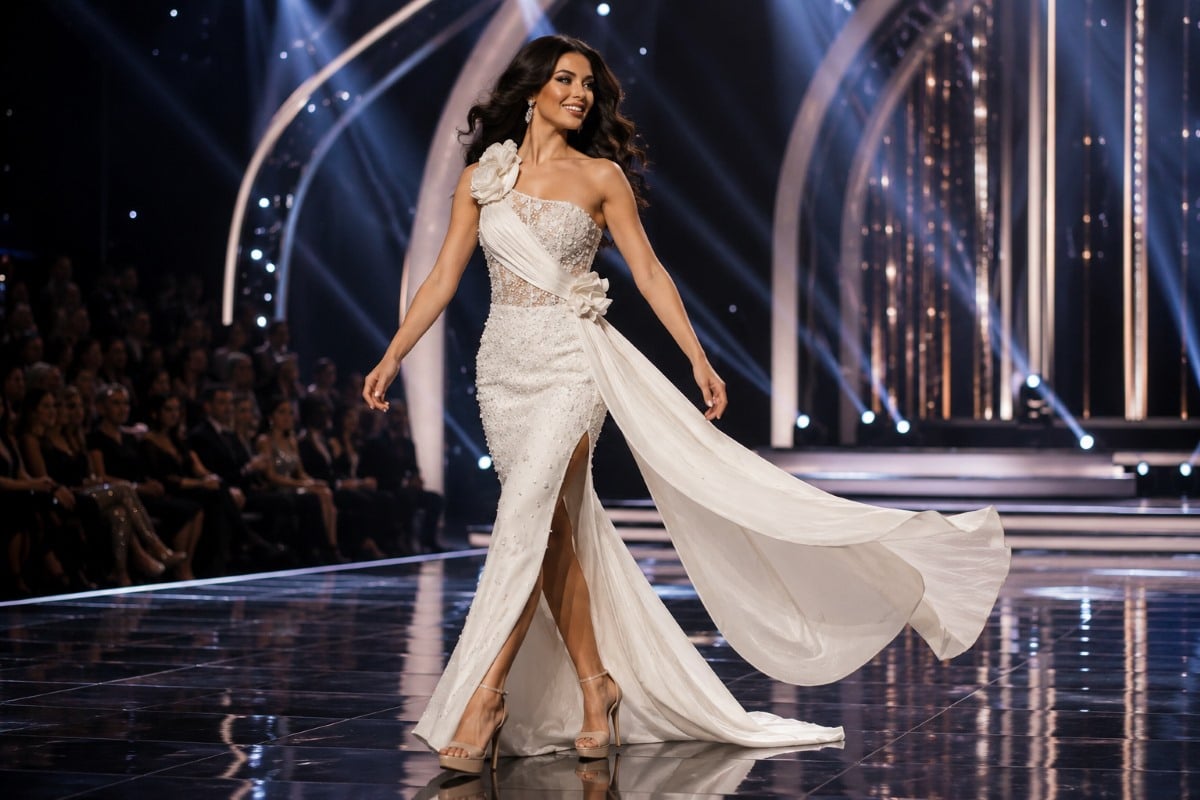
The first thing to learn is how the train follows you during a normal walk, since a well-designed train should trail behind you naturally without much intervention. Practice walking forward and feeling how the train moves, so you develop a sense of where it is without having to look at it. The critical skill in any train pageant walk is the turn, since this is where trains most often cause problems. When you turn, the train needs to sweep around with you rather than wrap around your legs or get caught underfoot. Practicing turns slowly and deliberately teaches you to kick or sweep the train subtly with your foot or to pause and let it settle before completing the turn. Many contestants learn a small, almost invisible kick that moves the train out of the way during a turn, and this technique only becomes natural through repetition. For longer or heavier trains, you may learn to give a gentle sweep with your foot at specific moments, and knowing the exact length and weight of your train is essential to mastering this. The styles among long formal dresses with trailing hemlines help you understand how length behaves on the move.
The principles in our guide on how to walk in long gowns apply directly to managing a pageant train, since the challenge of a trailing hem is much the same. The goal is for the train to look like it follows you effortlessly, which only hours of practice can achieve.

Mastering the turns and the stage pattern
The pageant walk is not just walking forward, it is a choreographed pattern of entrance, walk, turns, poses, and exit, and each element needs practice. The turns in particular are where poise is most visible.
Most pageant walks include specific turns, often at marked points on the stage, and these turns are where a contestant either looks polished or looks uncertain. Practice your turns until they are smooth and controlled, with your weight balanced and your train sweeping cleanly. A turn should be unhurried and deliberate, giving the judges a moment to see the gown from every angle. Learn the typical stage pattern for your competition, which usually involves entering, walking to a front mark, pausing and posing, turning, and exiting along a set path. Practicing the full pattern repeatedly builds the muscle memory that lets you execute it confidently on stage. Pay attention to your pacing, since rushing reads as nervousness while moving too slowly loses energy. A measured, confident pace that fills the time gracefully is the goal. Practice pausing at the marks and holding a confident pose, since these stationary moments are when judges study you most closely. Fuller ball gown skirts require particular attention to turns, since the volume needs room to move, and our overview of winning pageant dress trends shows how stage-ready silhouettes are built for exactly this kind of movement. Rehearsing the pattern until it is automatic frees your mind to focus on your expression and presence rather than remembering where to go next.
Building posture, poise, and stage presence
Walking beautifully is about far more than the feet. Posture, carriage, and presence are what make a walk command attention, and these are built through deliberate practice alongside the mechanics of the walk.
Posture is the foundation of pageant presence. Practice walking with your shoulders back, your spine long, your head held high, and your core engaged, since this carriage reads as confidence from across a stage. A gown, especially a heavy embellished one, can pull you out of good posture if your core is not working, so building the strength and habit to hold yourself tall throughout the walk is essential. Practice your facial expression alongside the walk, since a confident, genuine expression is as important as the movement itself. Many contestants practice walking while holding a warm, composed expression, since on stage the face has to perform as much as the body. Work on your arms and hands too, since awkward arm movement undermines an otherwise graceful walk. Practice a natural, relaxed arm carriage and any specific gestures your walk includes. The connection with the judges and audience is the final layer, learning to project warmth and confidence outward rather than turning inward with nerves. For more on holding a confident, photo-ready posture, our guide on how to pose in an evening gown covers techniques that apply directly to the stationary moments in a pageant walk. Presence is what transforms correct mechanics into a captivating presentation, and it grows with practice and confidence.

Rehearsing under realistic conditions
The final phase of stage walking practice in your gown is rehearsing under conditions as close to the real competition as possible, since the stage environment introduces elements that home practice cannot fully replicate. Bridging that gap is what prevents surprises on competition day.
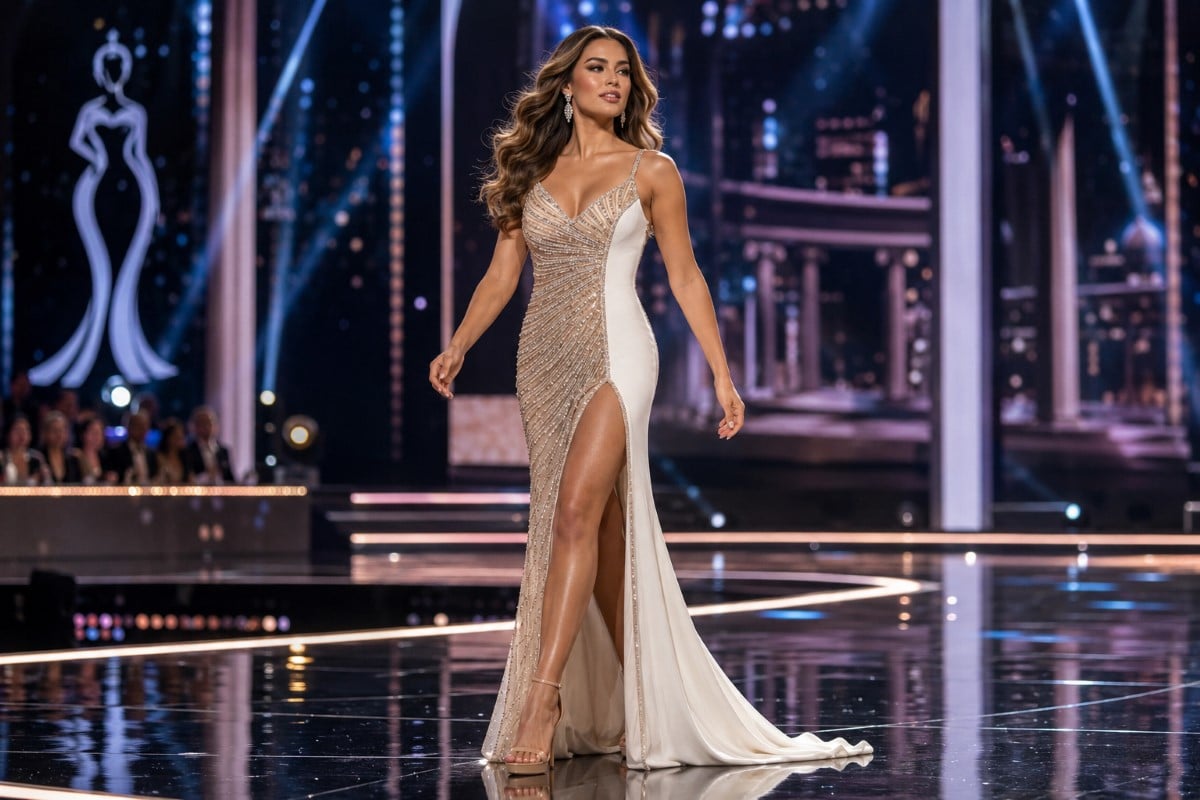
Practice under bright lights if you can, since stage lighting is disorienting and affects your ability to see marks and judges. Getting used to walking confidently while slightly blinded by lights is genuinely valuable. Rehearse on a stage or a space the size of your competition stage if possible, since the dimensions affect your pacing and pattern, and a walk practiced in a small room can feel rushed on a large stage. Practice with an audience, even just family, since being watched changes how the walk feels and builds tolerance for the pressure of eyes on you. If your competition includes music, practice walking to it, since the pacing should feel connected to the music rather than disconnected from it. Record yourself walking and watch it back critically, since seeing yourself reveals issues you cannot feel, from posture breaks to train problems to pacing that is too fast or slow. Many contestants find that recording and reviewing is the single most useful practice tool, since it shows them exactly what the judges will see. The styles among the pageant interview dresses remind us that different competition segments have different movement demands, and rehearsing each in its specific outfit matters. The closer your practice conditions are to the real thing, the more confident and prepared you will feel when it counts.
A practice timeline leading up to competition
Effective pageant gown walking practice is spread over time rather than crammed at the last minute, since the body needs repetition to build genuine muscle memory. A sensible timeline makes the preparation manageable and effective.
In the weeks well before the competition, focus on the foundational work, getting used to the gown, building posture and core strength, and learning the basic walk and turns. This early phase builds the base everything else rests on. In the middle phase, refine the full stage pattern, master the train management and turns, and begin practicing your expression and presence alongside the mechanics. This is where the individual elements come together into a complete walk. In the final week or two, rehearse under realistic conditions, run the full sequence repeatedly until it is automatic, and record and review to catch any remaining issues. By competition day, the walk should feel like second nature, so that your conscious attention can be on connecting with the judges and enjoying your moment rather than on the mechanics. Avoid cramming intense new practice in the final days before competition, since fatigue undermines both your body and your confidence. Instead, the final days should be about light rehearsal and rest, arriving at the competition feeling prepared and fresh. The black-tie level of polish that competition demands, similar to what the styles among black tie gowns represent, comes from this kind of structured, patient preparation rather than last-minute effort.
Common walking mistakes and how to fix them
Certain errors show up again and again in pageant walks, and knowing them helps you watch for them in your own practice. Most are fixable with focused repetition once you are aware of them.
- Looking down at the feet or train. Glancing down to check the train reads as nervous and breaks the connection with the judges. The fix is enough practice that you sense the train without looking, keeping your head up throughout.
- Rushing the walk. Nerves make many contestants walk too fast, which reads as anxiety and wastes the stage time. The fix is practicing a measured, deliberate pace until the slower rhythm feels natural rather than forced.
- Breaking posture under the gown’s weight. A heavy embellished gown can pull the shoulders forward over a long walk. The fix is core strength and the habit of resetting your posture, practiced until holding yourself tall is automatic.
- Stiff or awkward arms. Uncertain arm carriage undermines an otherwise graceful walk. The fix is practicing a natural, relaxed arm position until it stops feeling like something you have to think about.
- Tense or absent facial expression. Concentrating on the mechanics often makes contestants forget their expression, leaving them looking blank or strained. The fix is practicing the walk and the expression together until the face performs automatically.
- Mishandling the turn. Turning too quickly or letting the train wrap around the legs is the most visible error. The fix is slow, repeated practice of each turn with deliberate train management until it is smooth.
The thread running through all of these fixes is the same: awareness plus repetition. Once you know what to watch for, recording your practice and reviewing it honestly shows you which of these issues appear in your own walk, and focused repetition irons them out. By competition day, the walk should look effortless precisely because every one of these potential problems has been practiced away, leaving you free to simply shine on stage.
Frequently asked questions about pageant gown walking practice
How long does it take to learn to walk in a pageant gown?
It varies by experience, but most contestants benefit from several weeks of practice leading up to a competition. The foundational work of getting used to the gown and building posture comes first, followed by mastering the pattern and train, then rehearsing under realistic conditions. Spreading practice over time builds genuine muscle memory better than last-minute cramming.
How do I keep from stepping on my train?
Practice is the answer. Learn how your train follows during a normal walk so you sense where it is without looking, and master the turns where trains most often cause trouble. Many contestants learn a subtle, almost invisible kick or sweep with the foot to move the train during turns. Knowing your train’s exact length and weight is essential to managing it gracefully.
Should I practice in my competition shoes?
Yes, always. The heel height dramatically affects your balance, stride, and posture, so practicing in different shoes than you will compete in defeats the purpose. Wear your actual competition shoes throughout practice so your body learns to walk gracefully in exactly what you will have on stage.
How do I practice the turns in a pageant walk?
Practice turns slowly and deliberately until they are smooth and controlled, with your weight balanced and your train sweeping cleanly around you. A turn should be unhurried, giving judges a moment to see the gown from every angle. Repetition builds the muscle memory that makes turns look effortless, so practice them far more than you think you need to.
What is the best way to build stage confidence?
Rehearse under realistic conditions as much as possible, including bright lights, a stage-sized space, an audience, and music if your competition uses it. Recording yourself and watching it back reveals issues you cannot feel and shows exactly what judges will see. The more your practice resembles the real competition, the more confident you will feel on the day.
How much should I practice the week before competition?
The final week should focus on light rehearsal and rest rather than intense new practice, since fatigue undermines both your body and your confidence. Run the full sequence until it feels automatic, do light refinement, and arrive at the competition feeling prepared and fresh rather than exhausted from last-minute cramming.