


Crepe is the fabric that formal design keeps returning to when the goal is a clean line rather than a spectacle. It has no shine to speak of, no woven pattern, and no sparkle, and yet it has quietly become one of the most requested materials in modern occasion wear. The reason is that crepe does something useful rather than something decorative. It skims the body instead of clinging to it, holds a tailored shape without stiffness, and photographs without a single hot spot of glare. If you have ever put on a dress and thought it looked more expensive than it had any right to, there is a fair chance it was cut in crepe. This guide covers what crepe actually is, why it flatters, the different types you will encounter, the silhouettes it belongs in, and the drawbacks worth knowing.
What crepe actually is
Crepe is defined by its surface: a fine, slightly crinkled, pebbled texture with a matte finish and a fluid drape that still carries some body. It is one of the oldest fabric treatments in formal dressmaking and one of the most versatile, appearing in everything from lightweight blouses to structured evening gowns.
Crepe is a finish, not a fiber
This trips people up constantly. Crepe is not a material in the way that silk, wool, or polyester are materials. It is a way of making cloth, which means crepe can be silk, wool, rayon, polyester, or a blend, and the fiber changes the price, the breathability, and the weight while the crepe character stays recognizable throughout. When a label says crepe, it is telling you about the surface and the hand of the fabric rather than what it is made from, which is why it pays to check the fiber content separately.
The twist in the yarn creates the surface
The pebbled texture comes from the yarn rather than from any applied treatment. Crepe yarns are twisted far more tightly than ordinary ones, sometimes in alternating directions across the weave, and when the finished cloth is relaxed those over-twisted yarns pull back slightly and buckle the surface into countless tiny irregularities. Some crepes achieve a similar effect through a specific crepe weave structure instead. Either way the result is the same: a surface that is subtly broken rather than perfectly smooth, which is exactly why crepe does not reflect light in a single sheet the way satin does.
Why crepe flatters
The flattering quality of crepe is not a marketing claim, and it comes from two properties working together. The first is that broken surface. Because the texture scatters light in many small directions rather than reflecting it in a continuous plane, crepe does not map the contours underneath it. A smooth, shiny fabric shows every ripple as a highlight and every hollow as a shadow. A matte, slightly textured fabric simply does not produce that contrast.
The second is weight combined with drape. Good formal crepe has enough substance to hang away from the body rather than settling into it, but enough fluidity to follow the overall line rather than standing off stiffly. The practical effect is that the fabric glides over the midsection and hips, smoothing the silhouette rather than tracing it. Designers use crepe for exactly this reason, since it does some of the work that shapewear would otherwise be asked to do.
The third factor is less about the fabric and more about what it allows. Because crepe holds a tailored line, a well-cut crepe dress can rely on seaming and shaping rather than on embellishment, which produces the clean, unfussy look that reads as modern. The advice in the guide to looking slimmer in an evening dress covers the wider set of choices that produce a smooth line, and crepe is one of the simplest of them.

The types of crepe you will meet
Not all crepe behaves the same way, and knowing the common varieties helps you predict how a dress will wear before you try it on. Crepe de chine is the lightest of the group, fine and fluid with a soft sheen and a very subtle texture, and it drapes closely and moves beautifully. It suits softer, flowing designs rather than structured ones.
Double crepe, sometimes called heavy crepe or double-faced crepe, is the workhorse of formal design. It is thicker, more opaque, and considerably more structured, holding a tailored shape while still draping. This is the crepe behind most modern column and sheath gowns. Crepe-back satin is a hybrid worth knowing, with a matte crepe face on one side and a satin sheen on the other, so a designer can use both surfaces in a single dress for contrast.
Stretch crepe adds a small percentage of elastane, which gives comfort and recovery without losing the matte surface, and it has become common in fitted occasion wear for obvious reasons. Scuba crepe is a bonded knit rather than a woven fabric, very structured and almost spongy in the hand, and it holds a sculptural shape extremely well while being warmer and less breathable than woven alternatives. The overview of mother of the bride dress fabrics covers how crepe compares with the other options for a specific role.
Silhouettes that suit crepe
Crepe sits in an unusual middle ground between structure and flow, so it works across more silhouettes than most formal fabrics. Two families in particular show it at its best.

Clean, tailored shapes read best
A sheath, a column, or a narrow A-line in crepe is close to the ideal use of the fabric. These shapes rely entirely on cut and seaming, and crepe rewards good cutting because it holds a line without needing internal structure to prop it up. There is no shine to distract from the shape and no pattern to break it, so the eye reads one continuous vertical line. This is also why crepe suits a jumpsuit or a pair of wide-leg formal trousers so well, since tailored pieces live or die by how the fabric hangs. The styles among sheath mother of the bride dresses show how a clean silhouette reads when the fabric does the work.
Crepe holds a gather and a drape
The second thing crepe does exceptionally well is hold a deliberate fold. Because the fabric has weight and a matte surface, gathering, ruching, cowl draping, and asymmetric wrapping all read as sculptural in crepe rather than as bunching. A gathered waist detail in satin shows every crease as a highlight; the same detail in crepe reads as a soft, controlled fold. This is why so many draped and ruched formal dresses are cut in crepe, and it pairs particularly well with the fabric’s smoothing quality across the midsection.
Crepe on camera and under lighting
The matte surface is a genuine practical advantage at a photographed event, and it is worth understanding why. A high-shine fabric under a direct flash produces bright reflections that can blow out to pure white in a photograph, losing all detail in those areas. Crepe scatters that light instead, so the fabric holds its color and the seaming stays visible.
Under warm reception lighting, crepe reads as rich and deep rather than glossy, which suits a formal setting. It also photographs consistently across very different lighting conditions, which matters at an event that moves from a bright afternoon ceremony to a dim evening reception. The one thing crepe will not do is sparkle, so if you want the dress itself to catch light, crepe is the wrong choice and a beaded or satin fabric is the right one. For a fuller comparison of how surface finish behaves, the breakdown of matte and shiny fabrics covers the tradeoff directly.
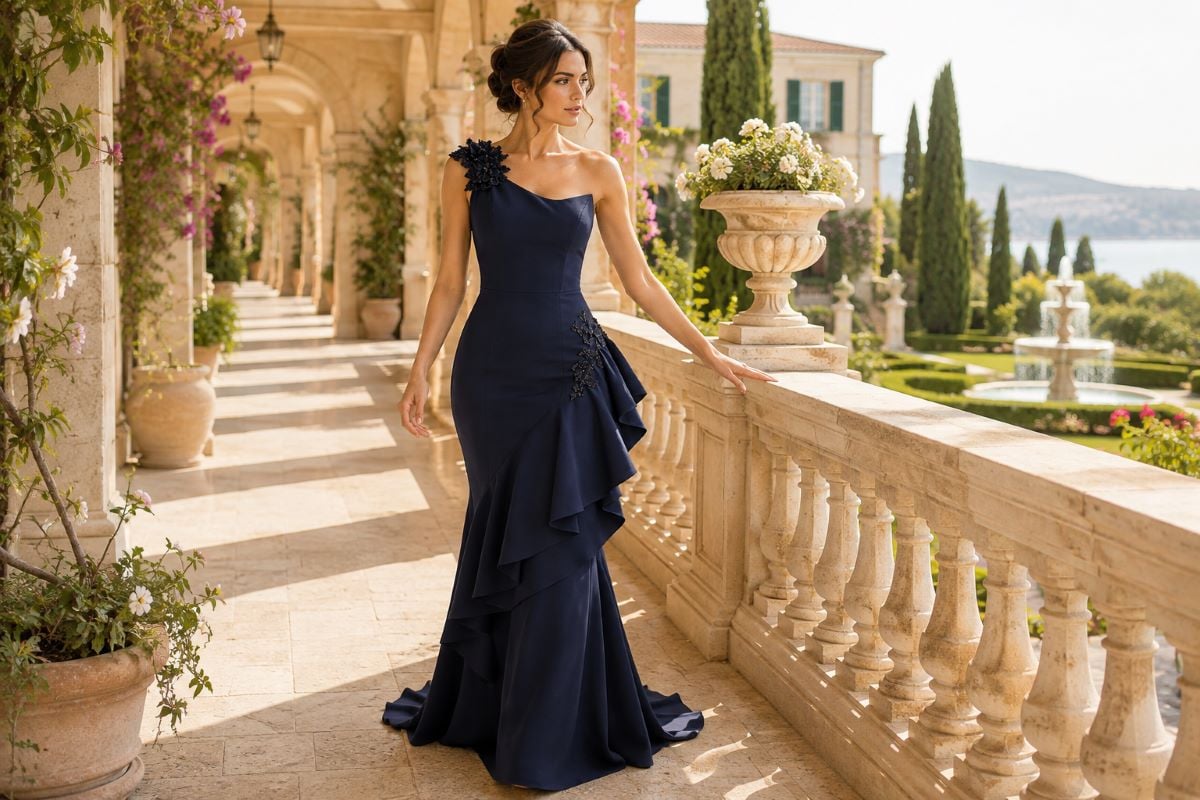
Where crepe fits among the other formal fabrics
Placing crepe against its neighbors makes the choice easier. Against satin, crepe is the matte option: satin gives liquid shine and shows every contour, crepe gives a soft matte surface and smooths. Against chiffon, crepe is the substantial option: chiffon floats and is often sheer, crepe has body and opacity. Against taffeta or brocade, crepe is the fluid option, since those fabrics stand away from the body while crepe follows the line.
What this makes crepe is the default choice for anyone who wants a formal dress that looks considered rather than decorated. It is the fabric for a clean column at a black-tie event, for a tailored cocktail dress, for a mother of the bride who wants comfort across a twelve-hour day, and for anyone whose taste runs to minimal rather than ornate. The range of formal dresses shows how differently the formal fabrics behave on the same kind of silhouette.
The same logic holds at a shorter length, where a matte fabric reads as tailored rather than party-like. The styles among short and cocktail dresses show how crepe changes the character of a semi-formal dress.
The honest drawbacks of crepe
Crepe is forgiving in most respects but it has three real weaknesses worth naming. The first is that it holds pressing marks. Because the surface is created by tension in the yarns, a hard press with a hot iron can flatten the texture permanently in that spot, leaving a shiny patch that will not steam out. This is the most common way a crepe dress gets damaged, and it is entirely avoidable.
The second is sitting creases on lighter weights. A fine crepe de chine will crease across the lap during a long dinner much as any light fabric does, though the marks tend to relax out as you move. Heavier double crepe barely creases at all, so if this concerns you, weight is the thing to check rather than fiber.
The third is warmth in some varieties. Woven silk and wool crepe breathe well, but polyester crepe and especially bonded scuba crepe trap heat, and scuba in particular is noticeably warm for a long event or a warm room. If breathability matters, ask about the fiber content rather than assuming that all crepe behaves alike. This is also where crepe’s lack of shine can become a drawback rather than a feature, since a matte dress at a very formal evening event needs excellent cut or a well-chosen accessory to carry the occasion on its own. The styles among contemporary gowns show how a clean modern cut compensates without embellishment.

Caring for a crepe dress
The care rules for crepe follow directly from how the fabric is made. Steam rather than press, since steam relaxes the twisted yarns back into place while direct heat and pressure flatten them. If you must use an iron, work on the reverse at a low setting with a pressing cloth and keep the iron moving. Never press a crease sharply into crepe unless the design calls for it, because that mark can be permanent.
Hang the dress on a padded hanger in a breathable garment bag rather than folding it for storage, and give it room so the fabric is not compressed. Crepe recovers well from hanging wrinkles with a light steam, so there is rarely any need for aggressive treatment.
Cleaning depends on the fiber. Silk and wool crepe should always be professionally cleaned, and even polyester crepe formal wear is safer at a cleaner than in a home machine, since agitation can distort the twisted yarn structure. Telling the cleaner the fabric is crepe helps them choose a gentler process and avoid a hard final press. The styles among crepe mother of the bride dresses show the kind of gown that repays this level of care across a long day.
Reading the weight before you buy
Weight is the single best predictor of how a crepe dress will behave, and two other things confirm it. Feel the weight first, because weight is the single best predictor of how the dress will behave. A heavier double crepe holds a tailored shape, resists creasing, and reads as substantial. A lighter crepe de chine drapes closely and moves, but it will crease more and show more of what is underneath.
Look at the surface in good light next. Quality crepe has a fine, even pebbling across the whole cloth, while a poor one can look flat in places or have an irregular, plasticky sheen where the texture has failed. Then check the seaming, since a crepe dress with no embellishment to hide behind lives entirely on the quality of its cut, and puckered or wavering seams have nowhere to hide in a matte fabric.
Finally, be clear about what you want from the dress. Crepe is the right answer when you want a clean, modern, smoothing line that photographs consistently and stays comfortable for hours. It is the wrong answer when you want the dress itself to sparkle or to hold a dramatic architectural shape. Chosen deliberately, a crepe dress is one of the most reliably flattering things in formalwear, and it is quietly the reason a great many gowns look better on than they did on the hanger. To see how matte crepe translates across columns, sheaths, and draped silhouettes, explore the current styles through an authorized Jovani retailer.

Crepe, From Weave to Wear
What is crepe fabric?
Crepe is defined by its surface: a fine, slightly crinkled, pebbled texture with a matte finish and a fluid drape that still carries some body. Importantly, crepe is a finish rather than a fiber, so it can be made from silk, wool, rayon, polyester, or a blend. The texture comes from yarns twisted far more tightly than usual, which pull back and buckle the surface when the finished cloth relaxes, producing the characteristic broken, non-reflective face.
Why is crepe considered flattering?
Two properties work together. The broken, matte surface scatters light in many small directions rather than reflecting it in a continuous plane, so it does not map the contours underneath the way a shiny fabric does. Meanwhile the combination of weight and drape means the fabric hangs away from the body and glides over the midsection and hips rather than tracing them. Together these let crepe smooth the silhouette, which is why designers reach for it so often.
What are the different types of crepe?
Crepe de chine is the lightest, fine and fluid with a soft sheen, suited to flowing designs. Double crepe is thicker, more opaque, and more structured, and it is the fabric behind most modern column and sheath gowns. Crepe-back satin has a matte crepe face and a satin reverse, so both surfaces can be used in one dress. Stretch crepe adds elastane for comfort. Scuba crepe is a bonded knit that holds sculptural shapes very well but is warmer and less breathable.
Does a crepe dress wrinkle?
It depends heavily on the weight. Heavier double crepe barely creases and recovers quickly, which is part of why it is favored for long events. Lighter crepe de chine will crease across the lap during a long dinner, though the marks usually relax out as you move and stand. The bigger risk is not wrinkling but pressing: a hard press with a hot iron can permanently flatten the texture and leave a shiny patch, so steaming is always the safer approach.
Is crepe suitable for a formal or black-tie event?
Yes, and it is one of the most common fabrics in modern formal design. A floor-length column or sheath in heavy crepe reads as thoroughly formal, and the matte surface photographs beautifully without the glare a shiny fabric produces under a flash. The one thing to be aware of is that crepe does not sparkle, so a very formal evening dress in crepe depends on excellent cut, a strong neckline, or considered accessories rather than on the fabric catching light.
How does crepe compare to satin and chiffon?
Against satin, crepe is the matte option: satin gives liquid shine and shows every contour, while crepe scatters light and smooths. Against chiffon, crepe is the substantial option: chiffon floats and is often sheer, while crepe has body and opacity and holds a tailored line. Against structured fabrics such as taffeta or brocade, crepe is the fluid option, since those stand away from the body while crepe follows the line of the figure.