
Quick answer: Yes, blue is appropriate for many weddings. The exceptions come from the specific event, not from a general ban on the color. Follow the invitation, any requested palette, the ceremony’s religious or cultural expectations, and the couple’s guidance. If the wedding party is wearing blue and you prefer not to look coordinated with it, choose a clearly different hue, depth, print, or texture. Then judge the dress by its formality, fit, movement, and construction rather than assuming that a particular shade is automatically casual, seasonal, or camera-friendly.
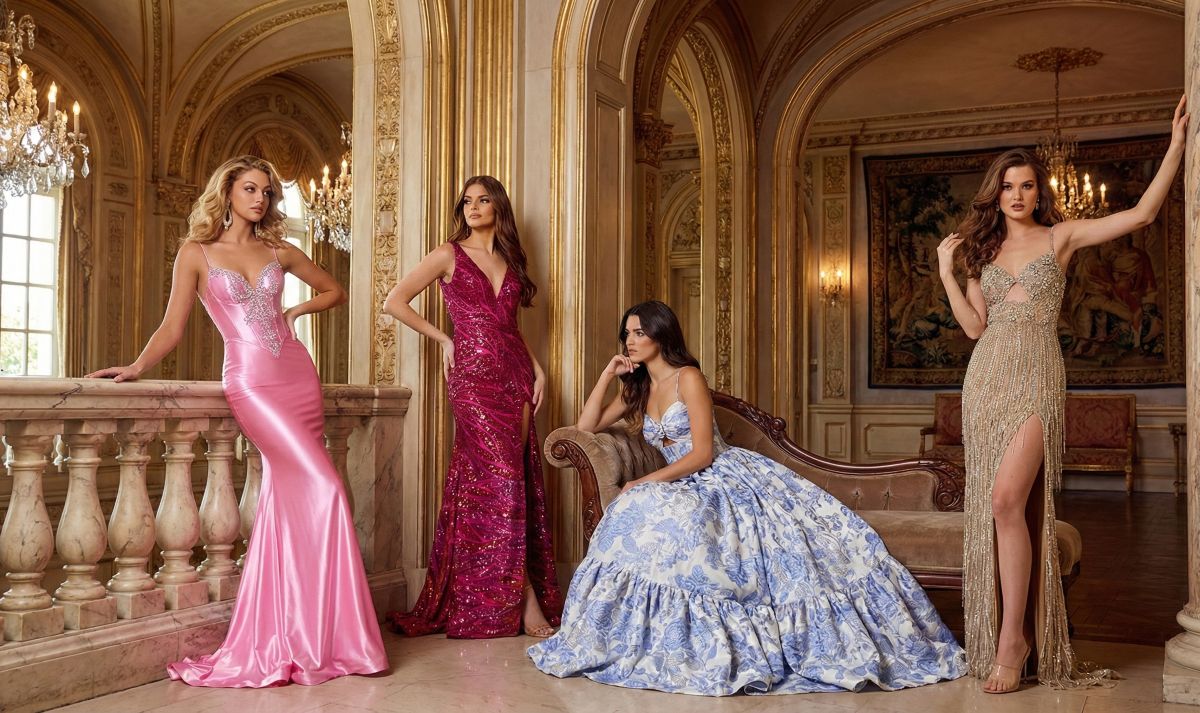
Blue wedding guest dresses range from pale chiffon midis to royal satin cocktail dresses and midnight evening gowns. That breadth makes blue versatile, but it also makes rules such as “navy is always formal” or “dusty blue is only for spring” unreliable. Use this guide to define the wedding’s requirements first, then compare the current blue wedding guest dresses by the details that matter for the actual event.
Check the Wedding Before You Check the Color Chart
The invitation and wedding website are the best starting points. Emily Post’s wedding guest attire guidance recommends using the invitation and event time to judge formality, then considering the type of service, religious or cultural expectations, and local custom. Those factors can change what is appropriate even when two invitations use the same dress-code words.
Before buying, confirm:
- the stated dress code and event time;
- whether the couple has requested, encouraged, or prohibited specific colors;
- whether the ceremony takes place in a house of worship or another setting with coverage expectations;
- the venue surface, climate, and distance between ceremony and reception;
- whether the event includes multiple functions with different attire;
- any regional or family custom that the couple wants guests to follow.
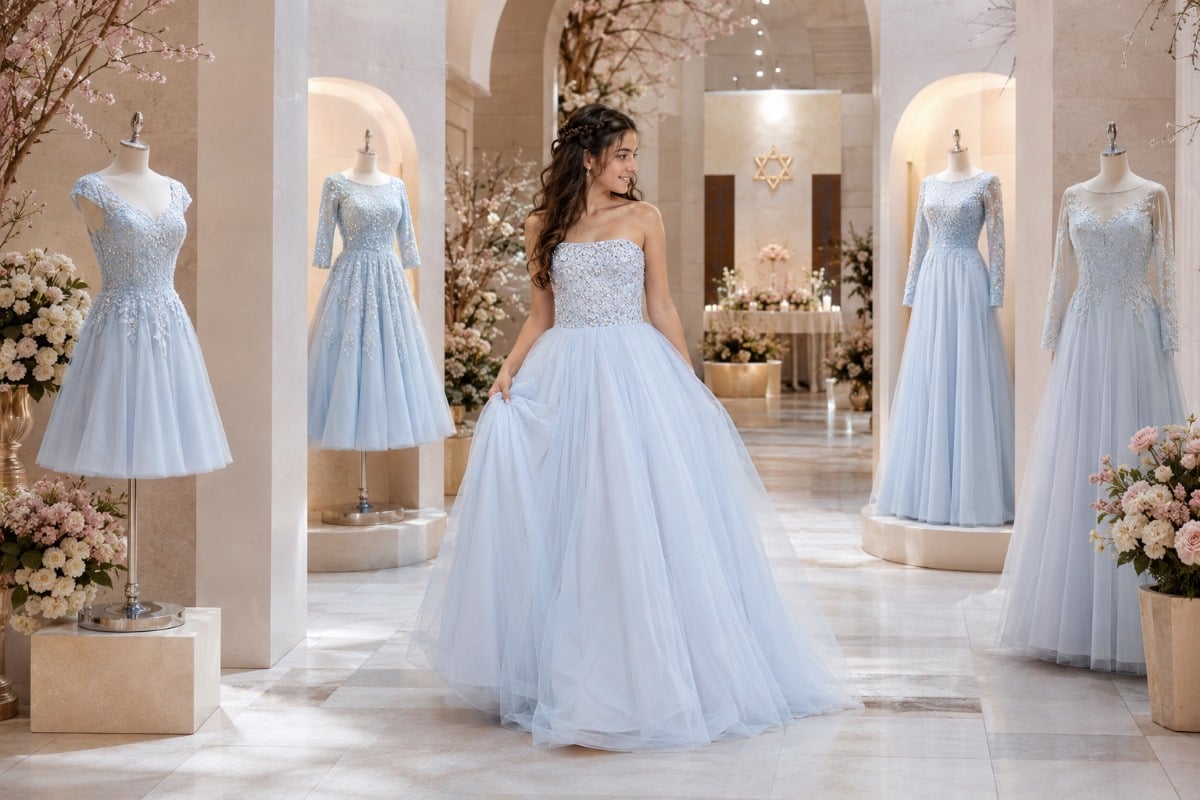
Do not infer a mandatory palette from the invitation design alone. A blue border or floral motif may be decorative rather than a request that guests wear blue. Follow explicit instructions, and ask only when the answer will materially affect the purchase. If the ceremony carries coverage expectations, the long sleeves wedding guest dresses range meets them without a separate wrap.
What If the Bridesmaids or Wedding Party Are Wearing Blue?
There is no universal rule requiring every guest to discover and avoid the wedding-party color. Guests may not know it, and some couples intentionally invite everyone into a coordinated palette. The couple’s instructions take priority.
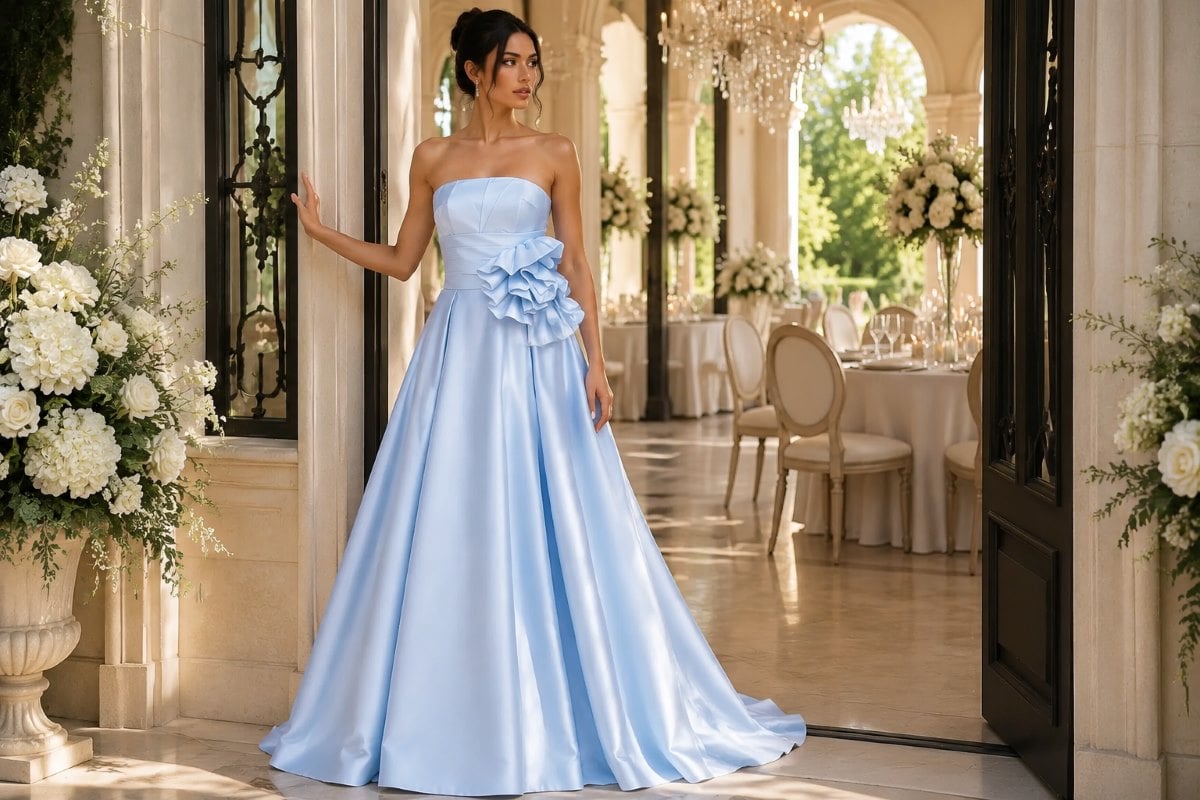
If you know the wedding party is wearing blue and you want to look clearly separate, compare the actual shade rather than the name. Dusty blue, slate, steel, cornflower, periwinkle, navy, and teal can overlap across brands. A visibly different value, hue, print, texture, or length may provide enough distinction. For example, a navy print can look unrelated to a solid powder-blue bridesmaid dress, while two garments both labeled “dusty blue” may look almost identical.
When the couple has requested that guests wear blue, matching the palette is not a mistake. When the couple has reserved a specific blue for the wedding party, respect that instruction. The useful question is not “Is blue allowed?” but “What has this couple asked its guests to do?”
Blue Shade Names Are Not Exact Standards
Retail color names are descriptive, not reliable specifications. One brand’s royal blue may be another brand’s cobalt; teal may lean blue or green; navy may be nearly black or visibly saturated. Fabric sheen, pile, transparency, lining, print, and dye lot can also change the appearance.
Use shade labels to create a shortlist, then judge the garment itself. Compare product photographs from multiple views, read the color name and fabric details, and inspect the dress in person whenever possible. Screens differ, and a product image cannot reproduce every lighting condition.
| Approximate family | Possible descriptions | What to check |
|---|---|---|
| Very pale blue | Ice, mist, powder, silver-blue | Whether it remains visibly blue in daylight and flash, plus lining and transparency |
| Soft or muted blue | Dusty, slate, cornflower, periwinkle | Gray or violet undertone, contrast with the wedding palette, and visibility in dim light |
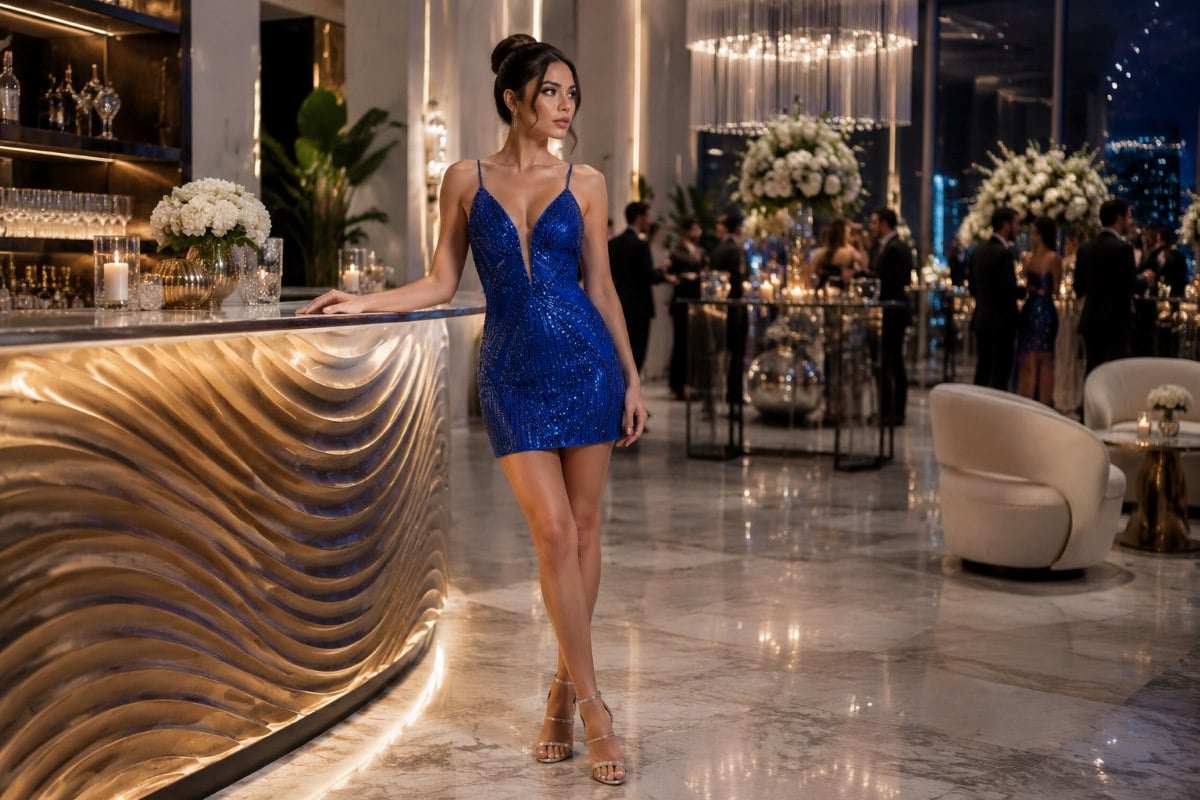
| Bright saturated blue | Royal, cobalt, electric, sapphire | Overall formality, fabric reflection, embellishment, and appearance under colored LEDs |
| Dark blue | Navy, midnight, ink | Whether it appears black in low light, surface detail, and whether the design meets the dress code |
| Blue-green | Teal, peacock, turquoise, aqua | Whether the shade reads more blue or green beside the wedding colors and in venue light |
Match the Complete Dress to the Dress Code
Color does not determine formality by itself. A navy cotton day dress can be less formal than a pale-blue beaded gown, while a royal-blue mini and a royal-blue floor-length evening dress serve different events. Length, fabric, construction, embellishment, neckline, sleeves, and styling all contribute. How each code works in practice for guests is mapped in our guide to wedding guest dress codes, explained.
| Dress code | Reliable starting point | Questions to resolve |
|---|---|---|
| Black tie | Formal floor-length evening gown; some hosts also accept a highly dressy cocktail dress | How traditional the hosts’ interpretation is, plus fabric, finish, length, and ceremony requirements |
| Black tie optional or formal | Floor-length gown, polished midi, or dressy cocktail design | Event time, venue, degree of embellishment, and whether family members have stricter guidance |
| Cocktail | Polished knee-length, tea-length, or midi cocktail dress | Hem, cutouts, neckline, fabric, and whether the event leans daytime or evening |
| Semi-formal | Dressy midi, knee-length style, jumpsuit, or polished separates | Ceremony setting, climate, and how casual the venue really is |
| Daytime, garden, beach, or destination | A design that meets the stated formality and works on the actual surface | Wind, sun, sand, grass, steps, transportation, and temperature changes |
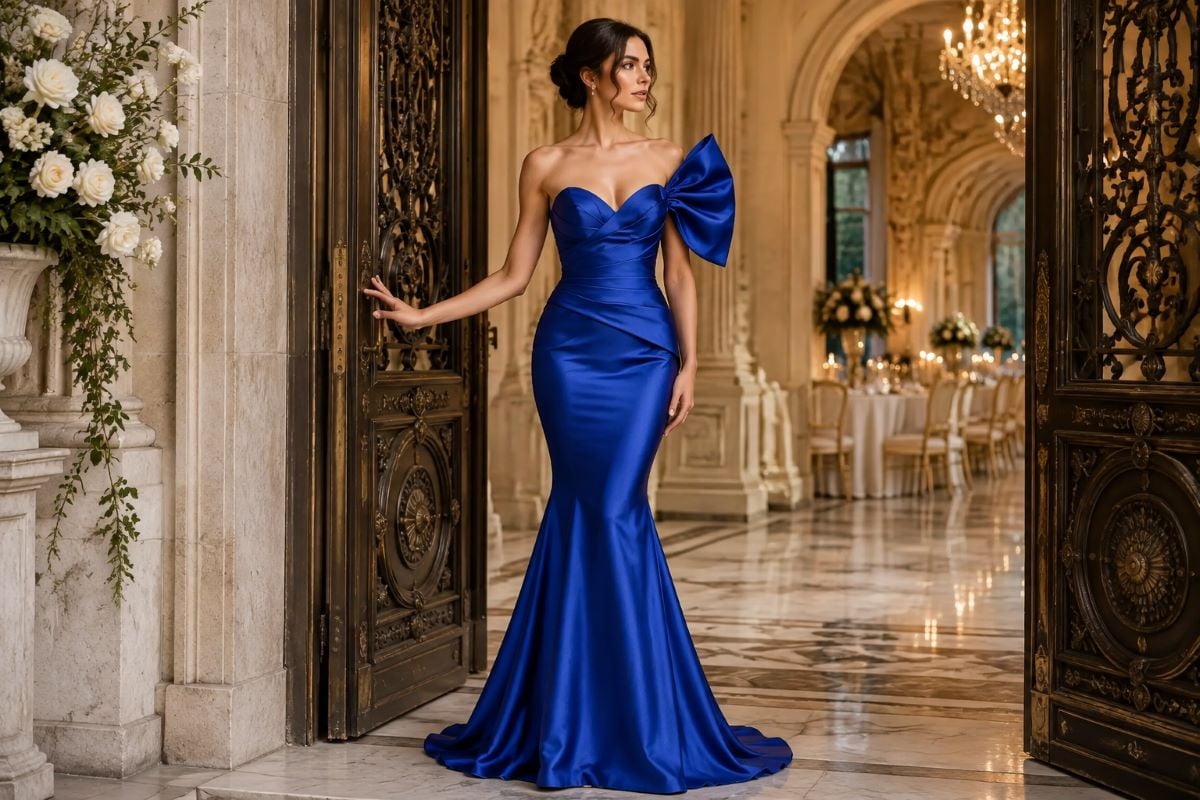
For black tie, Emily Post’s current black-tie guide lists a formal floor-length gown, a dressy cocktail dress, and the dressiest version of a little black dress among women’s options. That means a navy or cobalt cocktail dress is not automatically disqualified by color or length, but a floor-length gown remains the most traditional choice when the host expects a conventional black-tie look.
The full wedding guest dresses collection can help compare blue against other colors once the required length and formality are clear.
How to Evaluate Different Blue Families
Pale blue and white-adjacent shades
Light blue is not automatically too close to white. The decision depends on the actual saturation, fabric, lining, and event guidance. A clearly blue dress may be easy to distinguish from bridal white, while an extremely pale ice-blue tulle or high-shine fabric may look much lighter in sun or direct flash.
Test a borderline color in open shade, direct daylight, indoor light, and flash. Compare it with a white object in the same frame. If it still looks ambiguous and the purchase matters, ask the couple rather than relying on a product name.
Royal blue and cobalt
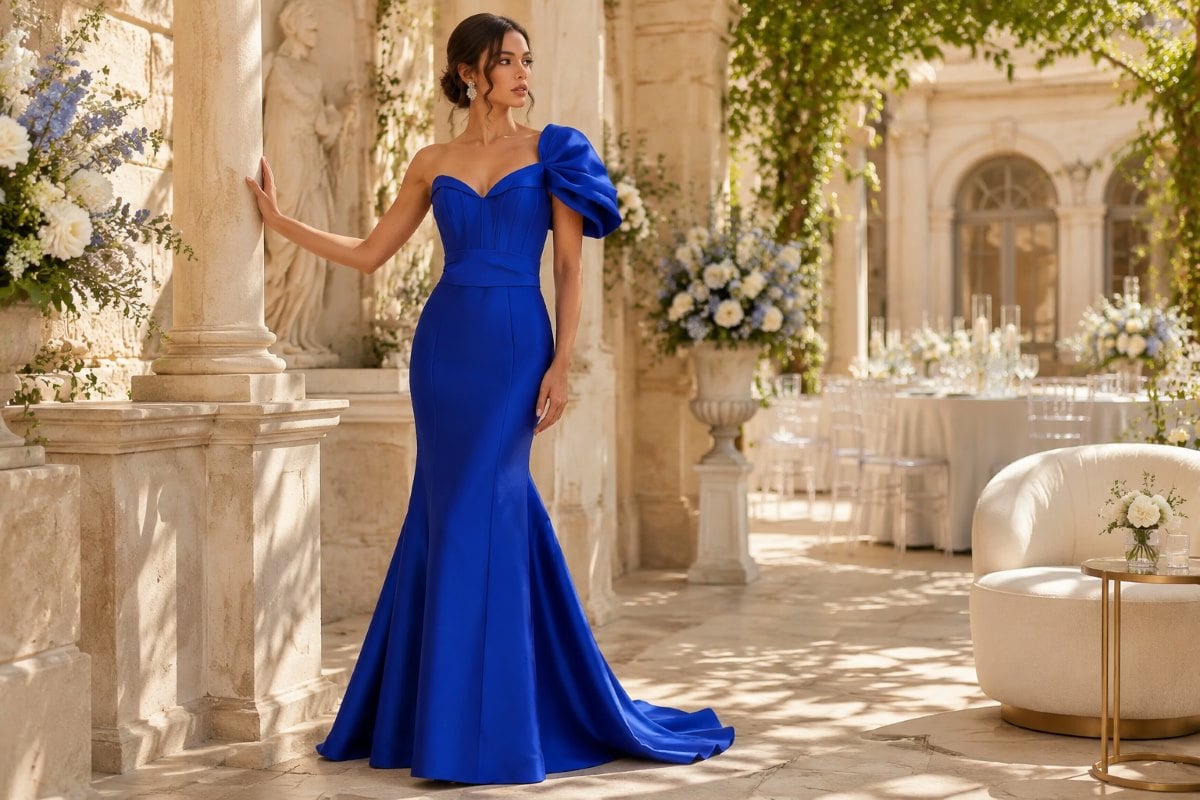
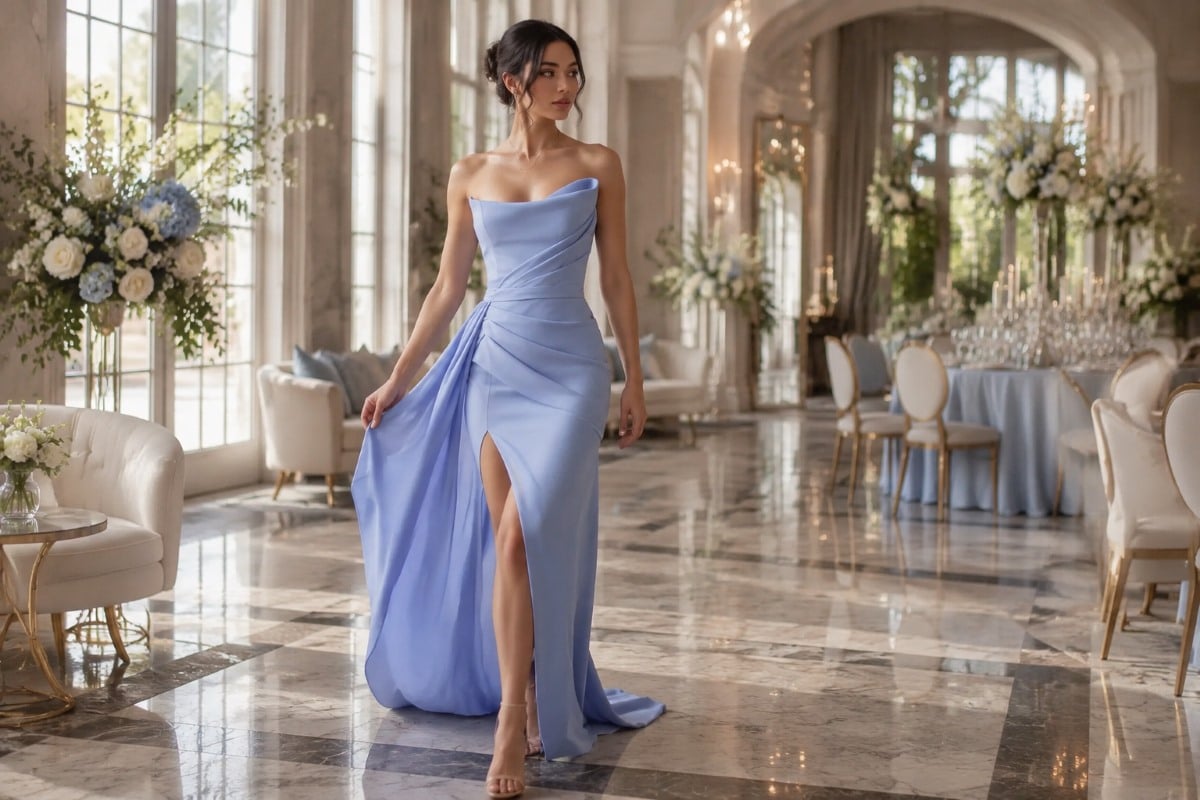
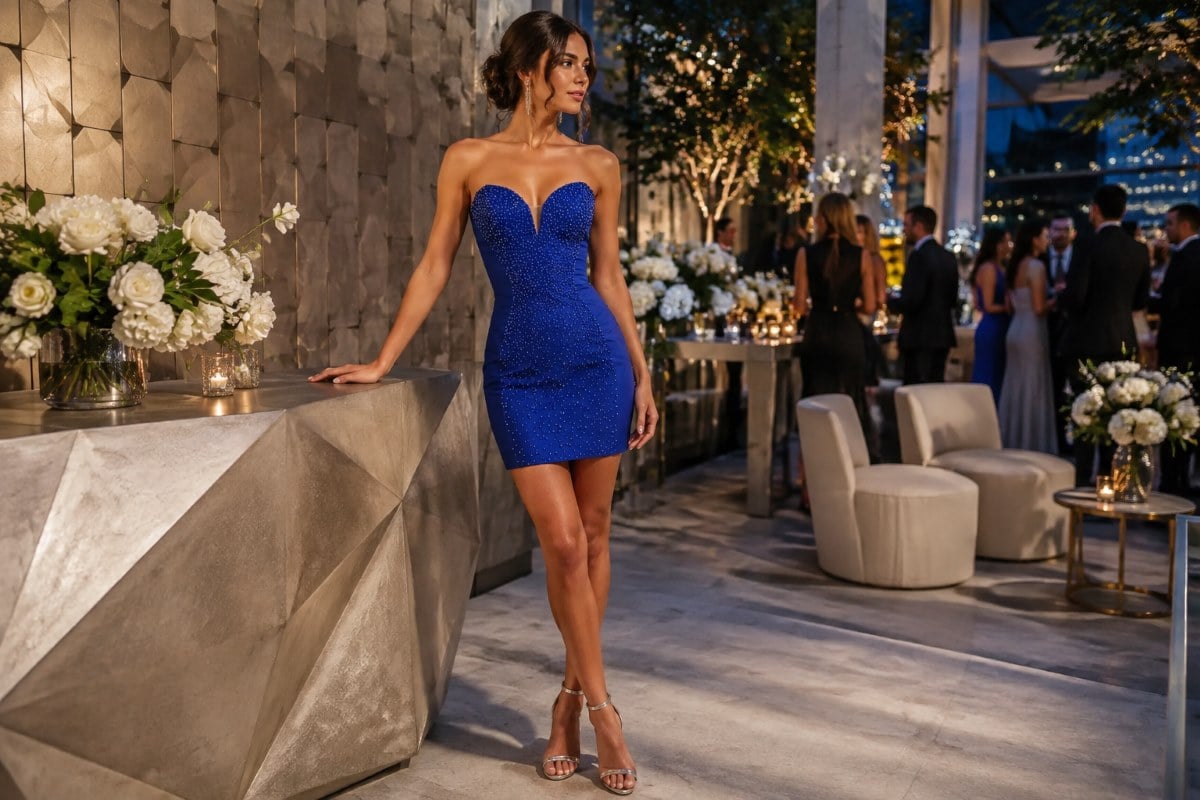
Royal and cobalt can create a strong visual presence, but that does not make them inappropriate by default. Evaluate the dress’s silhouette, amount of embellishment, neckline, and overall balance. A saturated color does not require neutral accessories, and it does not guarantee that the dress will remain equally vivid under every light source.
For cocktail events, the blue cocktail dresses collection can be filtered by design details after the invitation has established the formality.
Navy and midnight blue
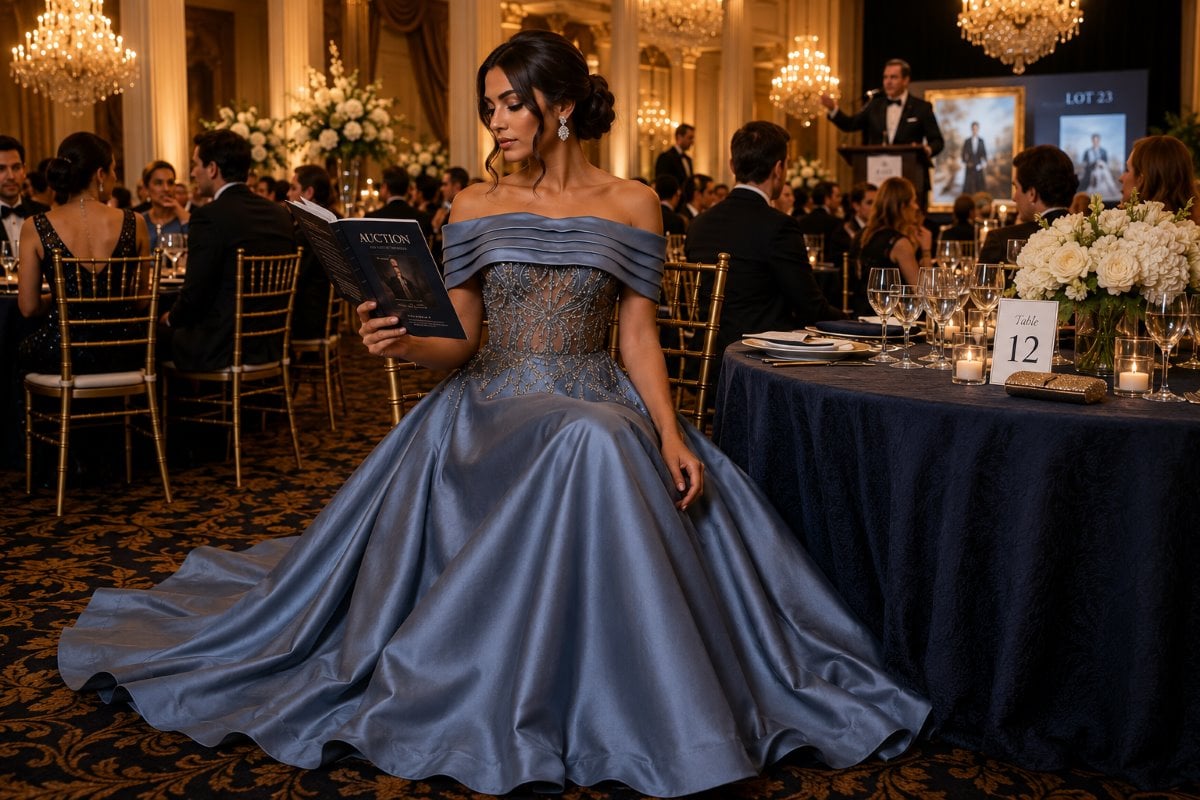
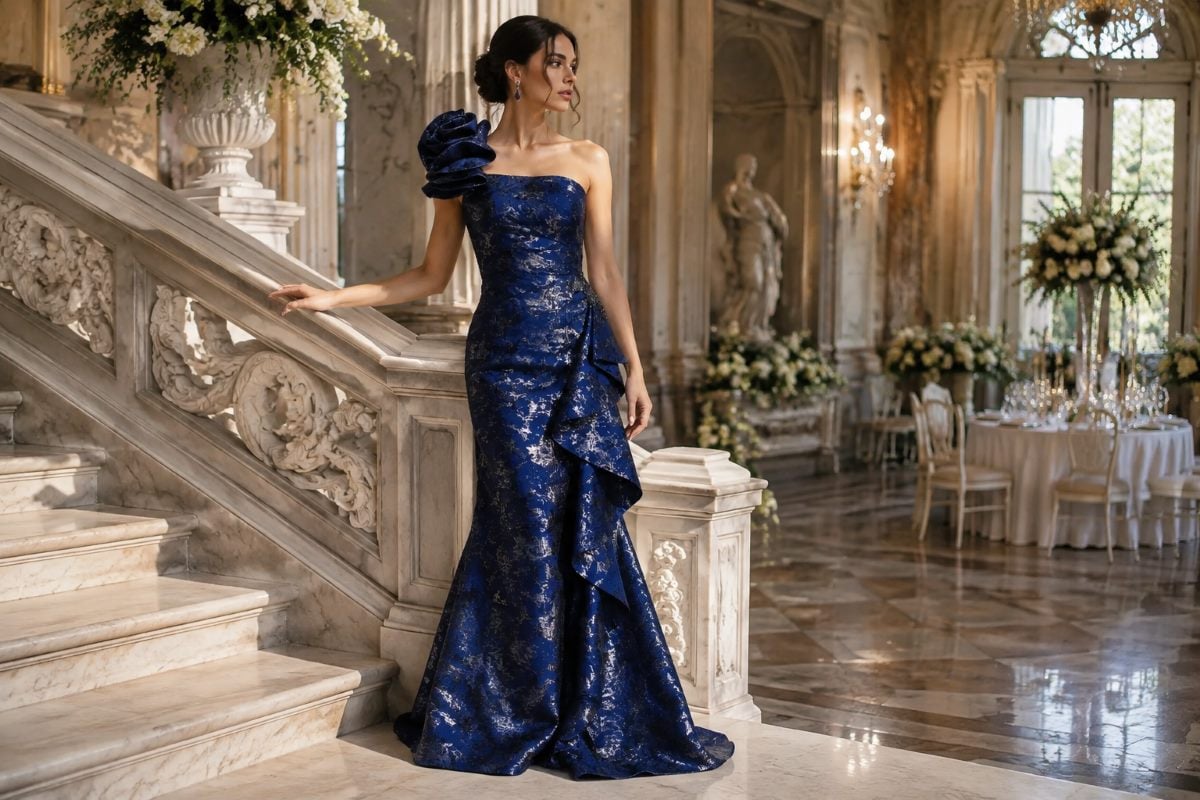
Navy can work at daytime, cocktail, formal, and black-tie weddings; the construction determines the result. A matte navy day dress may feel restrained, while a structured satin or embellished midnight gown can read as formal eveningwear. Navy may appear close to black in dim rooms or low-exposure photographs. That is not inherently a problem, but it is worth testing when the blue appearance matters to the wearer.
For formal comparisons, the blue evening dresses collection shows how length, fabric, and finish can change the formality of related dark shades.
Teal, peacock, aqua, and blue-green shades
Blue-green names overlap heavily. Compare the actual garment with any requested wedding palette, especially when bridesmaids are wearing green, turquoise, or teal. These shades are not restricted to a season. A lightweight aqua dress may suit warm weather, while a velvet or brocade teal gown may suit a colder formal event, but the fabric and construction create that difference. If the palette collision feels unavoidable, stepping fully into the green wedding guest dresses range is often cleaner than a near-miss teal.
Choose Fit Before Styling
A color cannot rescue a dress that pulls, shifts, restricts movement, or requires constant adjustment. New Mexico State University’s garment-fitting guidance describes good fit as neither too large nor too small and free from binding, pulling, sagging, straining, and unintended wrinkling. Use those signs to evaluate the garment instead of buying for a generalized body-shape rule.
Complete a wedding-day movement test
Wear the planned undergarments and shoes, then:
- stand and walk without holding the neckline, straps, skirt, or sleeves in place;
- sit in a dining chair and check the waist, abdomen, back, neckline, and hem;
- raise both arms and reach forward as if greeting or hugging someone;
- turn, use a safe step or stairs, and check whether the heel catches the hem;
- bend slightly to pick up a bag and confirm neckline security;
- try several dance movements and review a short video from the front, side, and back.
If the dress twists, rides up, gaps, restricts breathing, becomes transparent under tension, or relies on repeated pulling and pinning, try a different size or construction and consult an alterations professional. Fashion tape can help control a compatible edge, but it cannot correct a bodice that does not fit.
Fabric and Construction Change How Blue Looks and Feels
The word “blue” describes color, not comfort. Likewise, a fabric name alone does not predict total weight, warmth, stretch, wrinkle behavior, opacity, or breathability. Fiber content, weave or knit, weight, lining, underlayers, embellishment, and fit all contribute.
| Construction | Possible visual effect | What to inspect |
|---|---|---|
| Satin | May appear brighter or deeper as the surface reflects light | Seam pulling, snagging, wrinkles, flash hotspots, lining, and visible undergarment lines |
| Chiffon or georgette | Can soften or layer the color | Opacity, lining color, static, wind behavior, snagging, and number of layers |
| Crepe | May produce a more matte or controlled surface | Fiber content, stretch and recovery, seam impressions, drape, and lining |
| Velvet | Can shift from bright to dark as the pile direction and light change | Nap direction, pressure marks, warmth of the complete garment, and specialized care |
| Sequins, beads, metallic thread, or brocade | Can create points of reflection and increase visual formality | Total weight, sharp edges, snagging, flash reflection, repair risk, and alteration complexity |
| Lace, mesh, or tulle | Can make the color look lighter where skin or lining shows through | Actual opacity, lining match, scratchiness, seam placement, and transparency under flash |
Test the Dress in Realistic Light and Photos
There is no single blue that always photographs best. The International Commission on Illumination defines color rendering as the effect of an illuminant on the perceived color of objects compared with a reference illuminant. Its vocabulary also notes that perceived color depends on the stimulus, surroundings, adaptation, and viewing conditions. In practical terms, daylight, warm lamps, colored LEDs, and mixed venue lighting can change how a blue dress appears before a camera is involved.
Camera exposure, white balance, flash, phone processing, background, and compression can change the recorded result further. A product photo or mirror view is therefore not a guarantee of how the dress will look in wedding images.
Use a repeatable photo test
When color matters, photograph the actual dress:
- in open daylight and direct daylight;
- under warm indoor lighting;
- with and without phone flash;
- against both a light and a dark background;
- in a short low-light video while walking and turning.
Keep the camera settings as consistent as practical and review the images on more than one screen. Check whether pale blue remains visibly blue, whether navy becomes nearly black, whether reflective fabric creates hotspots, and whether lining or mesh changes the color in motion. The goal is not to make the dress look identical in every image. It is to understand the range before the wedding and decide whether you like it.
Accessories Do Not Need a Fixed Formula
Blue does not require one metal, one shoe color, or one neutral. Gold, silver, pearls, clear stones, black, white, tonal blue, mixed metals, prints, and contrasting colors can all work. Use the dress’s visible hardware, beading, embroidery, and finish as references, then choose the amount of contrast you prefer. A fuller walkthrough sits in our guide to accessorizing a wedding guest outfit.
Shoes should suit the venue surface, walking distance, stability needs, and hem. Metallic, neutral, black, white, blue, transparent, patterned, or contrasting shoes can all work. Put on the final pair before approving a floor-length or high-low hem. If a second pair is planned for dancing, test both heights against the dress.
Check necklaces, bracelets, rings, handbags, wraps, and jacket closures for snagging on chiffon, lace, mesh, sequins, or satin. A visually coordinated accessory is not useful if it damages the dress or restricts movement.
Plan Alterations Around the Exact Garment
Do not assume a blue dress can be made longer, substantially let out, converted from strapless to sleeved, or reworked at a beaded neckline without consequences. Alteration feasibility depends on seam allowance, pattern pieces, lining, boning, cups, zippers, lace borders, bead layouts, prints, pleats, and directional surfaces.
Before relying on a major change, ask an alterations professional about:
- hemming layered, scalloped, pleated, beaded, or high-low skirts;
- adjusting the neckline without changing support or symmetry;
- taking in or letting out the bodice and whether usable seam allowance exists;
- moving cups, boning, appliques, or waist seams;
- how a print, velvet nap, satin sheen, or bead pattern will align after alteration;
- whether the chosen shoes and undergarments change the final fit.
Bring the planned undergarments and final shoes to fittings. Confirm retailer lead times and tailor availability instead of assuming that every wedding guest dress follows the same schedule.
Follow the Care Label, Not a Generic Fabric Rule
Do not apply a universal steaming, ironing, washing, dry-cleaning, rolling, or hanging method based on the shade or outer fabric. The U.S. Federal Trade Commission’s Care Labeling Rule guidance explains that instructions must account for the entire garment, including non-detachable linings, trim, buttons, zippers, and other components. Follow the label on the finished dress and ask the retailer or manufacturer when it is unclear.
Before travel, confirm whether the garment should be folded, supported on a hanger, professionally packed, or protected from pressure on beads and embellishment. Test any approved wrinkle-removal method before the wedding day and away from visible areas when the manufacturer permits it.
Blue Wedding Guest Dress Checklist
- Read the invitation, website, and explicit color instructions.
- Confirm ceremony, reception, climate, venue surface, and transportation conditions.
- Decide whether you want visual separation from a blue wedding party.
- Judge the actual garment rather than relying on the shade name.
- Match the complete design, not the color alone, to the dress code.
- Test pale, dark, shiny, and transparent areas in daylight, indoor light, flash, and video.
- Wear the planned undergarments and shoes during the movement test.
- Inspect lining, seams, closures, stretch recovery, opacity, and snag risk.
- Get a garment-specific alterations estimate for major changes.
- Read the care label before planning cleaning, wrinkle removal, travel, or storage.
Blue Wedding Guest Dress FAQ
Can you wear blue to a wedding?
Yes, blue is appropriate for many weddings. Follow any explicit palette, dress code, religious or cultural expectation, and the couple’s guidance. The complete outfit matters more than the color name.
What if the bridesmaids are wearing blue?
If the couple has invited matching colors, follow that request. If you prefer to look distinct, choose a visibly different hue, depth, print, texture, or silhouette. You are not expected to know a private wedding-party color that the couple has not shared.
Is light blue too close to white for a wedding guest?
Not automatically. A clearly saturated light blue can be easy to distinguish from white, while a very pale ice-blue fabric may look lighter in sun or flash. Test the actual dress and ask the couple when it remains genuinely ambiguous.
Is navy formal enough for a black-tie wedding?
Navy can be an excellent black-tie color, but the shade alone does not establish formality. Choose a design whose length, fabric, construction, and finish meet the host’s expectations. A floor-length evening gown is the traditional low-ambiguity option.
Can you wear royal blue or cobalt to a wedding?
Yes, unless the couple has restricted the color. Evaluate the complete design and event rather than treating saturation as inappropriate. Test reflective fabrics and embellishment under flash and venue-like light.
What accessories go with a blue wedding guest dress?
Gold, silver, pearls, clear stones, black, tonal blue, mixed metals, and contrasting colors can all work. Use visible dress hardware and embellishment as references, choose the level of contrast you prefer, and check for snag risk.
Does a blue wedding guest dress have to match the season?
No. Fabric, construction, venue, and formality matter more than a seasonal color chart. Light blue can work in winter, and navy can work in summer when the complete outfit suits the event.
Will navy look black in wedding photos?
It may appear very dark in low exposure or against a dark background. Test the actual dress with and without flash. Decide whether you like that range; reflective embellishment is optional, not a requirement.
A successful blue wedding guest dress does not come from assigning each shade a fixed season, skin tone, metal, or dress code. It comes from reading the wedding correctly, choosing a secure and event-appropriate design, and understanding how the actual garment behaves in movement and light. Once those requirements are clear, compare blue styles online and use an authorized Jovani retailer to inspect the fit, construction, and color in person.