
Quick answer: The grandmother of the bride should wear an outfit that matches the wedding’s dress code, respects any guidance from the couple, and remains comfortable through the ceremony, photographs, meal, and reception. There is no separate rule that requires a grandmother to dress “matronly,” wear a particular color, or choose a dress rather than a pantsuit or dressy separates. Start with the invitation and the couple’s preferences, then choose the fit, coverage, length, fabric, and footwear that work for the person wearing them.
Many grandmothers shop in the same formalwear categories as the mothers of the couple. The current mother of the groom dress collection is therefore a practical place to compare gowns, cocktail lengths, sleeves, jackets, and formal separates. This guide explains how to narrow those options without treating age, body shape, or family role as a uniform.
There Is No Separate Grandmother-of-the-Bride Uniform
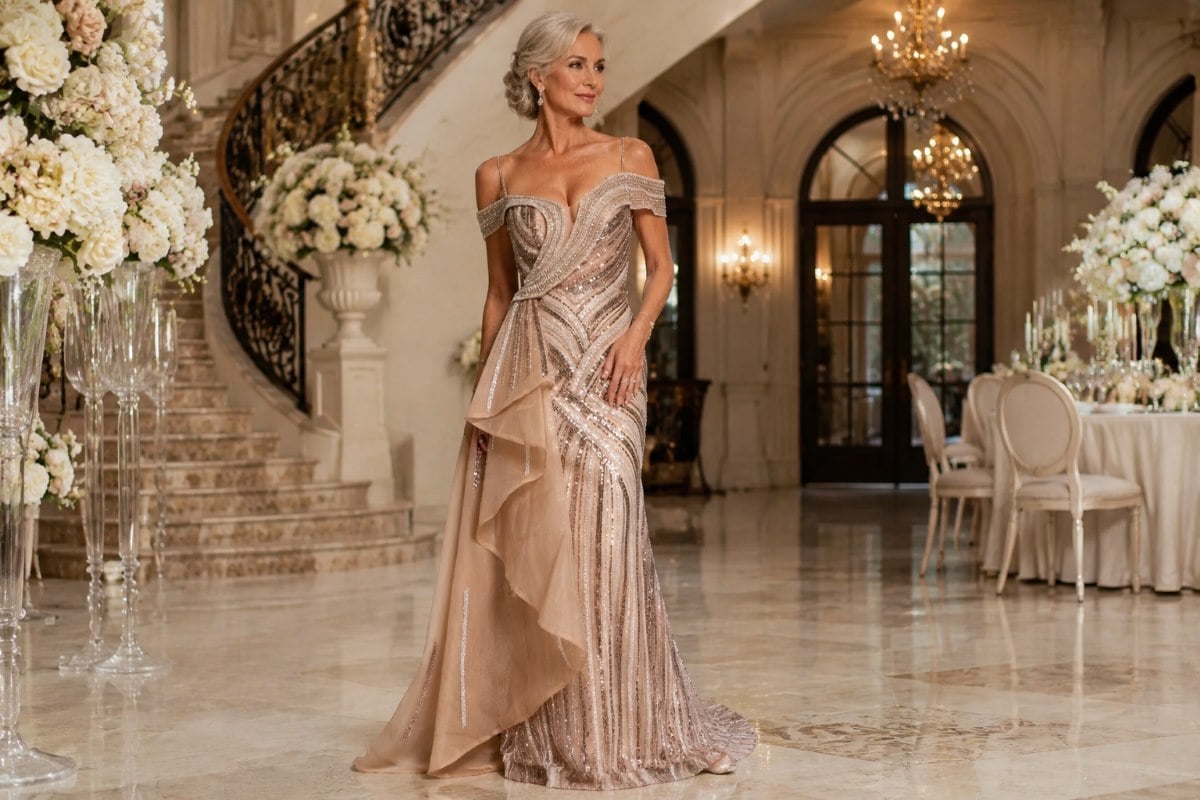
A grandmother may wear a floor-length gown, cocktail dress, tea-length style, tailored pantsuit, dressy jumpsuit, skirt-and-jacket set, or another polished outfit that suits the event. The correct category is determined by the wedding, not by the wearer’s age.
Emily Post’s guidance for the mothers of the couple reflects the same modern principle: formal gowns, short or long dresses, and skirt-and-jacket ensembles can all be appropriate when they match the wedding’s style. A grandmother does not automatically need more coverage, a softer color, a lower heel, or a less noticeable design. Those are personal choices and practical considerations, not universal etiquette requirements.
The same framework applies to the grandmother of the groom and to step-grandmothers. The useful questions are the same: What has the couple requested? What level of formality does the invitation indicate? Will the outfit work for the venue and schedule? Does it fit securely and feel like the wearer’s own style?
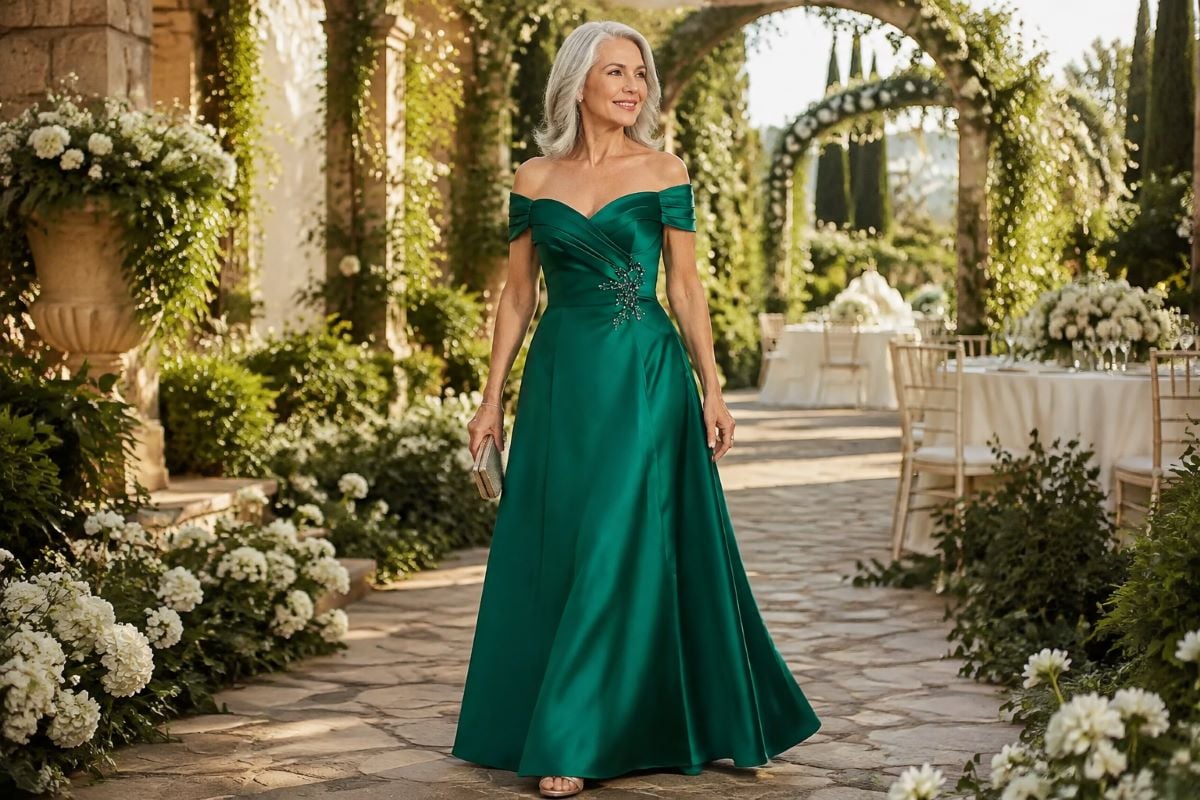
Start With the Invitation, Venue, and Couple’s Guidance
The invitation and wedding website should be the first sources of truth. Note the stated dress code, event time, ceremony setting, reception venue, and any requested color palette. If the wording is unclear, ask the couple or the person coordinating family attire rather than relying on a generic rule.
Religious and cultural settings may have expectations that are not visible in the words “formal” or “cocktail.” The Emily Post wedding guest guide recommends considering the nature of the service, local custom, and whether features such as bare shoulders, open-toed shoes, or uncovered hair are appropriate. The couple or venue can give the most accurate answer for a specific ceremony.
| Dress code | Reliable starting point | Details to confirm |
|---|---|---|
| Black tie | A formal evening gown is the traditional low-ambiguity choice; a highly dressy cocktail dress may also fit some interpretations | Whether the hosts expect floor length, how formal the family portraits will be, and whether the ceremony has coverage requirements |
| Black tie optional or formal | Floor-length gown, refined midi or cocktail dress, or dressy separates | Event time, venue, fabric finish, and how elevated the design should feel |
| Cocktail | Knee-length, tea-length, or midi cocktail dress; tailored jumpsuit or dressy separates can also work | Hem, neckline, embellishment, and whether the event leans daytime or evening |
| Semi-formal | Dressy afternoon dress, polished midi, suit, pantsuit, or comparable separates | Ceremony setting, climate, and whether the reception is indoors or outdoors |
| Daytime, garden, beach, or destination | An outfit that meets the stated formality while allowing safe movement on the actual surface | Grass, sand, steps, wind, temperature changes, and transportation between locations |
Black tie does not create one universal hem rule
A floor-length gown is the most traditional and least ambiguous black-tie option. However, Emily Post’s current black-tie guide also lists a dressy cocktail dress among women’s choices. The host may still expect a conventional floor-length look, especially for close family members, so use the invitation, wedding website, venue, and direct family guidance together rather than treating one internet rule as final.
Venue labels do not replace the dress code
A garden wedding is not automatically casual, and a hotel ballroom is not automatically black tie. A beach event may still request formal attire. Choose the level of formality first, then adapt the design for wind, heat, stairs, grass, sand, or long walking distances.
Coordinate With the Family Without Inventing a Hierarchy
There is no universal rule that every grandmother must shop after both mothers or match a fixed family sequence. One family may choose a coordinated palette; another may simply ask everyone to follow the dress code. The most efficient approach is to ask for the information that matters and avoid creating obligations the couple did not request.
Before buying, ask whether the couple wants:
- close family members in a shared or complementary palette;
- the mothers and grandmothers to look visually distinct;
- specific coverage for the ceremony;
- a formal level beyond what is written for general guests;
- family photographs that include a particular jacket, wrap, or second look.
When coordination is requested, compare photographs or swatches of the actual garments. Color names vary across brands and screens. “Navy,” “slate,” “dusty blue,” “champagne,” and “sage” can represent very different colors, and two dresses with different labels may still look nearly identical.
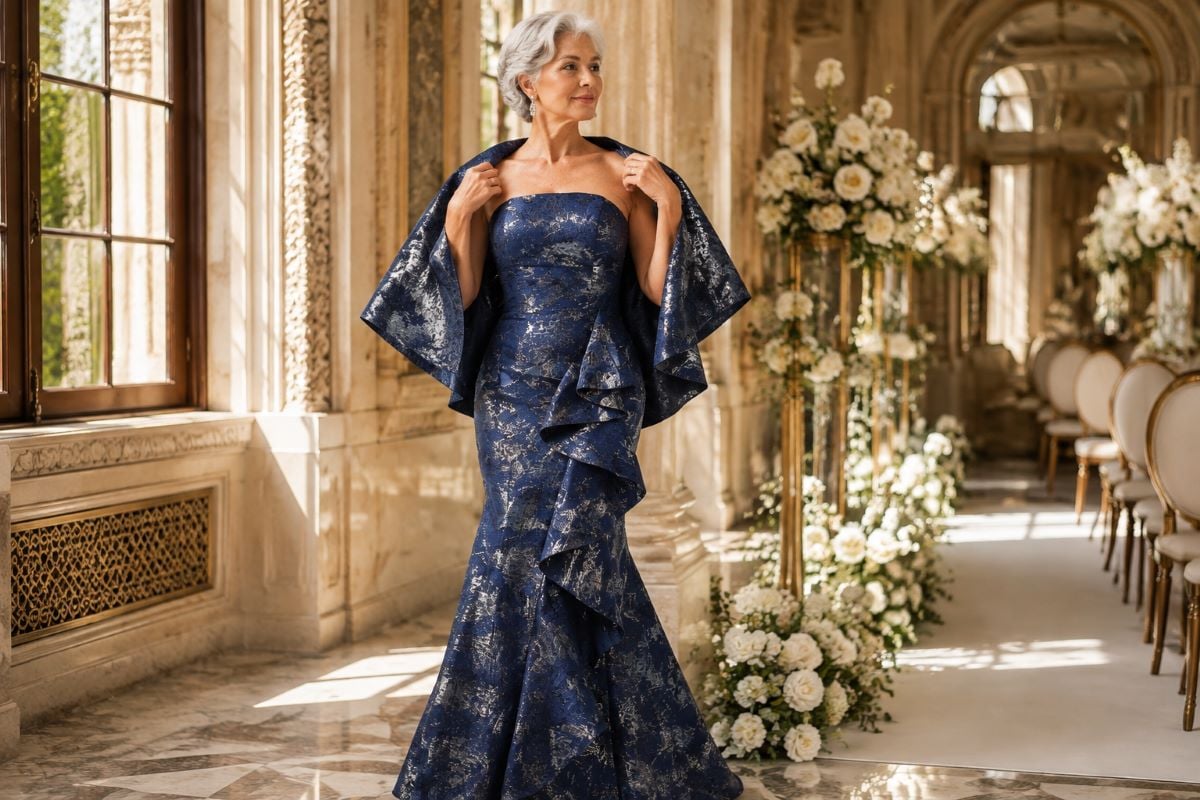
How to Choose a Color
There is no required grandmother color family. Navy, blue, green, plum, burgundy, black, metallics, prints, pastels, and brighter colors can all be appropriate when they fit the event and the wearer’s preference. Terms such as “timeless,” “soft,” or “age appropriate” should not be used to restrict someone to beige, gray, or muted shades.

White and white-adjacent colors
For many Western weddings, guests avoid white, ivory, and outfits that could reasonably appear bridal unless the couple has requested an all-white or otherwise specific dress code. Very pale champagne, silver, blush, or blue may also look close to white in certain fabrics and lighting. When the color is borderline, compare it in daylight and a phone photo and ask the couple if necessary.
The concern is the appearance of the actual outfit, not the retail label. A clearly blue, silver, floral, or patterned garment may be easy to distinguish from bridal white, while a reflective pale fabric can look much lighter under direct sun or flash.
Wedding-party and family colors
Matching a family or wedding-party color is not automatically rude, especially when the couple has asked relatives to coordinate. If no matching look has been requested and the grandmother prefers to appear visually distinct, compare the actual garments rather than relying on color names. One brand’s “dusty blue” can be another brand’s slate, periwinkle, or silver-blue.
Exact matching is not required unless the couple wants it. Similar formality with different colors, textures, or silhouettes often creates a coordinated family portrait without making everyone look like part of the same uniform.
Fit Should Support the Whole Wedding Day
A formal outfit can look correct while standing still and become difficult during the event. Evaluate fit in the positions the wearer will actually use. New Mexico State University’s garment-fitting guidance describes good fit as neither too large nor too small and free from binding, pulling, sagging, straining, and unintended wrinkling. Those signs are more useful than a rule about which silhouette belongs to a particular body type.
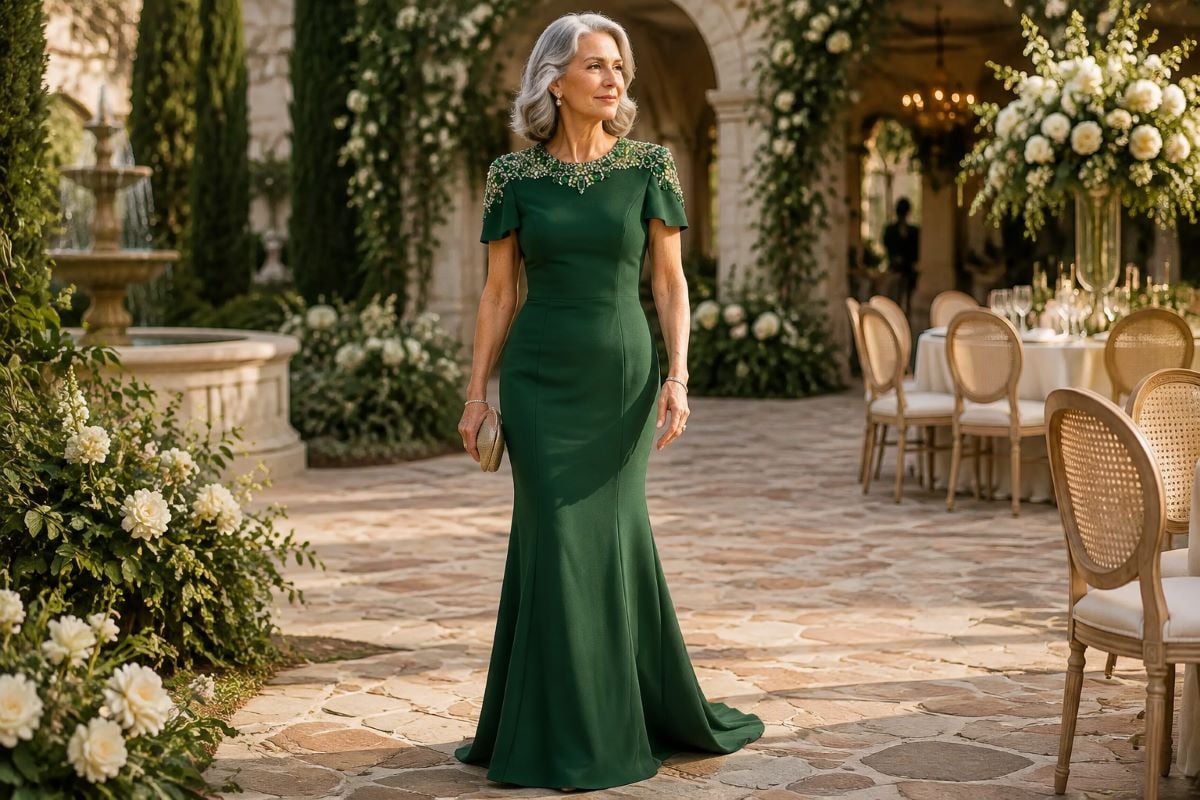
Use a full movement test
During a fitting, wear the planned undergarments and try the following:
- Sit in a dining chair for several minutes and check the waist, abdomen, neckline, back, and sleeve comfort.
- Stand, walk, and turn at a normal pace without holding the garment in place.
- Raise both arms to greeting and dancing height.
- Reach forward as if hugging someone and check the shoulders, back, armholes, and sleeves.
- Use stairs or a safe step while wearing the intended shoes.
- Bend slightly to pick up a bag and check neckline security and hem clearance.
- Test a slow turn and a few dance steps, then review a short phone video from the front, side, and back.
A dress that shifts, twists, rides up, falls from the shoulders, restricts breathing, or requires repeated adjustment needs a different size, different construction, or professional alteration. Buying smaller is not a reliable way to create support.
Plan for mobility aids and assistance
A cane, walker, wheelchair, or companion’s arm should be included in the fitting rather than treated as an afterthought. Check that sleeves, capes, skirts, and long jackets do not catch on handles or wheels. Confirm that the hem clears footrests and that the wearer can sit without fabric pulling under the body. A two-piece look or dress with a jacket may be easier to manage than a single heavy gown, but the actual fit should decide.
Fabric Name Is Only the Beginning
A fabric name does not predict the total weight, warmth, stretch, opacity, or comfort of a formal outfit. Fiber content, weave or knit, fabric weight, lining, underlayers, embellishment, and fit all contribute. Compare the actual garment and do not assume that every chiffon dress is cool, every crepe dress stretches, or every satin dress is heavy.
| Fabric or construction | Possible advantage | What to test on the actual outfit |
|---|---|---|
| Chiffon or georgette | Can create fluid layers and soft movement | Number of layers, lining opacity, static, snagging, wind behavior, and hem control |
| Crepe | May offer a matte surface and controlled drape | Fiber content, stretch and recovery, seam impressions, lining, and whether the weight suits the venue |
| Satin | Can provide sheen, structure, or fluid drape depending on weight | Pulling at seams, surface snagging, visible undergarment lines, wrinkles, and flash reflection |
| Lace or illusion mesh | Can add texture or visual coverage | Actual opacity, skin-tone match, seam placement, scratchiness, snagging, and whether edges irritate the neck or arms |
| Jersey or stretch construction | May allow easier movement | Recovery after sitting, cling, support, lining, and whether the fabric becomes transparent under tension |
| Beading, sequins, brocade, or layered skirts | Can increase visual formality and presence | Total weight, sharp edges, underarm friction, sitting comfort, repair risk, and alteration complexity |
Coverage should be checked, not assumed
Long sleeves can be sheer. A high neckline can contain transparent mesh. Lace may be lined in one area and unlined in another. The modest mother of the bride collection can help identify designs with greater coverage, but the wearer should still inspect the exact garment in daylight, indoor light, and flash. Coverage is a property of the complete construction, not the product label alone.
Choose Length, Shoes, and Layers as One System
Length should work with the dress code, venue surface, movement needs, and final footwear. A tea-length or midi design may be easier on stairs and grass. A floor-length gown can suit formal events, but the hem should not require the wearer to lift it during every step.
Compare the long mother of the bride dresses and short mom of the groom gowns only after deciding which length works for the invitation and venue. Bring the final shoes to every hem fitting. Changing from a heel to a flat can leave a long dress dragging, while switching to a higher heel can make an already finished hem look shorter than intended.
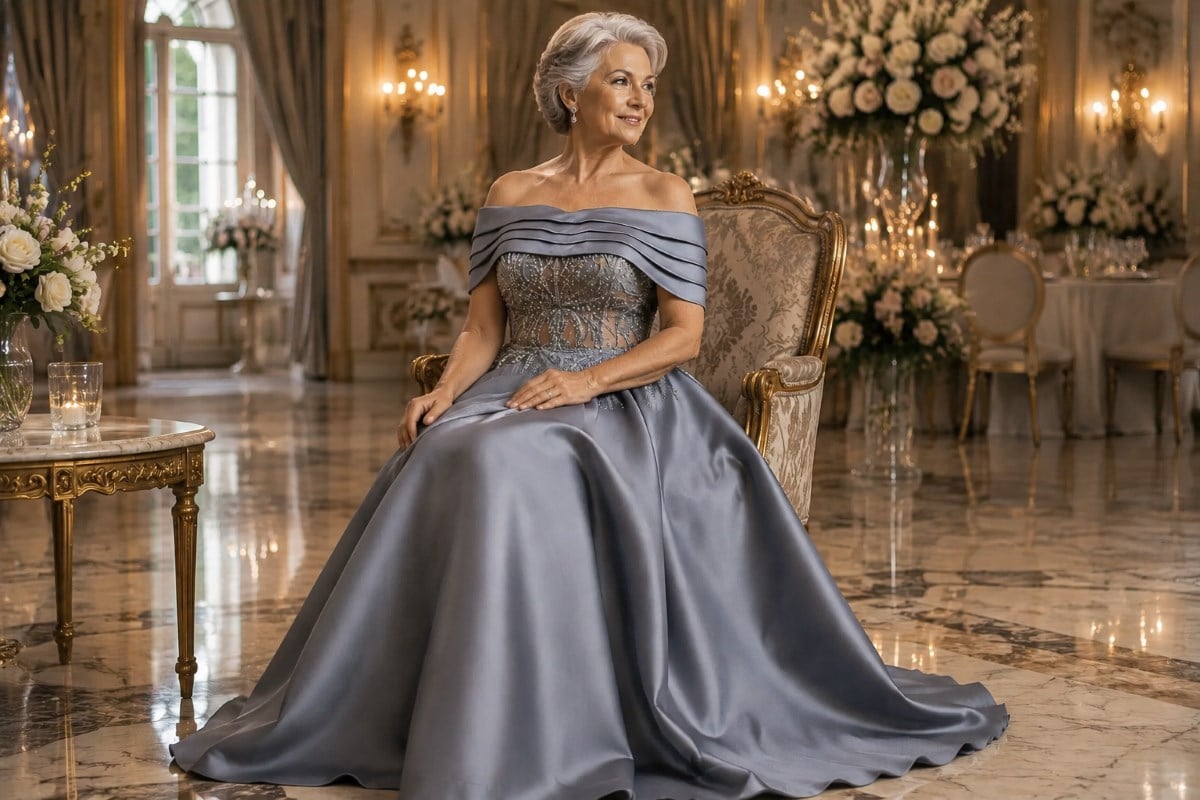
Footwear is a safety and preference decision
Shoes should be chosen for fit, stability, venue surface, and the wearer’s preference rather than a rule that grandmothers must wear low heels. Test them for the longest expected walking and standing period. If a second pair is planned for dancing, check both pairs against the hem before alterations are approved.
Use layers for changing conditions
A jacket, bolero, wrap, shawl, or coat can solve changing temperatures or ceremony coverage without requiring the base outfit to do everything. Put the layer on during the fitting. Check shoulder mobility, sleeve bulk, closure placement, and whether it catches beading or lace. A layer that is comfortable over a sleeveless dress may bind over a full or embellished sleeve.
For built-in coverage, the long-sleeve mother of the bride collection provides useful comparisons, but sleeve length alone does not predict warmth, opacity, or ease of movement.
Plan Alterations Before Committing
There is no reliable universal promise that a formal dress will need two fittings, that sleeves are easy to shorten, or that every order should be placed a fixed number of months before the wedding. Timing depends on stock, special-order lead time, shipping, the alterations professional’s schedule, design complexity, and how much work is required.
Before purchasing, ask an alterations professional about:
- hemming layered, scalloped, beaded, pleated, or high-low skirts;
- changing sleeves with lace borders, cuffs, zippers, or bead patterns;
- adjusting a neckline without changing its support or symmetry;
- taking in or letting out the bodice and whether usable seam allowance exists;
- moving cups, boning, appliques, or waist seams;
- whether a jacket or two-piece outfit must be altered as a coordinated set;
- how the final shoes and undergarments affect the fit.
Get a garment-specific estimate for major changes. Adding sleeves, substantially changing a neckline, or rebuilding an embellished bodice may be possible, but should not be assumed to be simple or economical.
Travel, Wrinkle Removal, and Care
Do not assume every formal dress can be steamed, ironed, rolled, hung for long periods, washed, or dry-cleaned in the same way. The U.S. Federal Trade Commission’s Care Labeling Rule guidance explains that care instructions must account for the entire garment, including non-detachable linings, trim, buttons, zippers, and other components. A method that is safe for the outer fabric may still damage beads, glue, interfacing, lining, or surface finishes.
Read the label before planning travel or wrinkle removal. Ask the retailer or manufacturer when instructions are unclear. For a destination wedding, confirm how the garment should be packed, whether it can remain on a hanger, and what professional care is available at the destination. Carry essential accessories and the outfit itself in cabin baggage when practical, but follow airline limits and use packaging that supports the garment rather than crushing embellishment.
Grandmother of the Bride Shopping Checklist
- Read the invitation and wedding website before shopping.
- Ask only for family color or coverage instructions the couple actually wants followed.
- Confirm ceremony, reception, and transportation conditions.
- Choose a formality level before choosing a color or silhouette.
- Compare pale or family-palette colors in person and in a phone photo.
- Wear the planned undergarments, shoes, and mobility aid during fittings.
- Complete the sitting, walking, reaching, stair, and dancing tests.
- Inspect opacity, lining, seams, closures, embellishment, and snag risk.
- Get a garment-specific alterations estimate before relying on major changes.
- Read the care label before planning cleaning, steaming, travel, or storage.
Grandmother of the Bride Dress FAQ
What color should the grandmother of the bride wear?
There is no required color. Follow any palette the couple has requested, avoid a bridal-looking white or ivory outfit unless invited to wear it, and choose a color the wearer likes. When coordination matters, compare the actual garments rather than color names.
Can the grandmother of the bride wear black?
Yes, black can work at many weddings, especially formal or evening events. Check the invitation, couple’s preferences, and cultural context. The complete outfit matters more than a rule that black must be softened with a particular accessory.
Should the grandmother match the mother of the bride?
Not unless the couple wants a matching family look. Similar formality with distinct colors or designs is often easier to coordinate, but exact matching is a family choice rather than an etiquette requirement.
Can the grandmother wear the bridesmaid color?
She can when the couple has requested a coordinated palette. If no match is intended and she wants to appear distinct from the wedding party, choose a visibly different hue, depth, print, or texture and compare the garments in person.
Are pantsuits or jumpsuits appropriate?
Yes, when their fabric, tailoring, and details match the dress code. For black tie or a very formal family role, confirm the host’s expectations and choose an appropriately elevated design.
Does the grandmother of the bride have to wear a long dress?
No. A long gown is a traditional option for black tie and formal evening weddings, but cocktail, semi-formal, and daytime events allow other lengths. Even at black tie, some etiquette guidance accepts a dressy cocktail dress. Follow the invitation and host.
What should the grandmother of the groom wear?
Use the same process: follow the dress code, ask about family colors and ceremony expectations, choose a secure fit, and test the complete outfit. There is no need for the two grandmothers to dress alike unless the family wants that effect.
When should a grandmother buy her wedding outfit?
Start early enough for the exact retailer’s order lead time and the alterations professional’s schedule. In-stock simple styles may need less time than special-order, beaded, layered, or extensively altered outfits. Confirm dates before purchase rather than assuming one timeline fits every garment.
The best grandmother of the bride dress is not the one that follows the most age-based rules. It is the outfit that respects the wedding, fits securely, supports the wearer’s movement and preferences, and remains manageable for the entire celebration. Narrow the requirements first, compare suitable styles online, and then use an authorized Jovani retailer to inspect the actual color, construction, and fit.