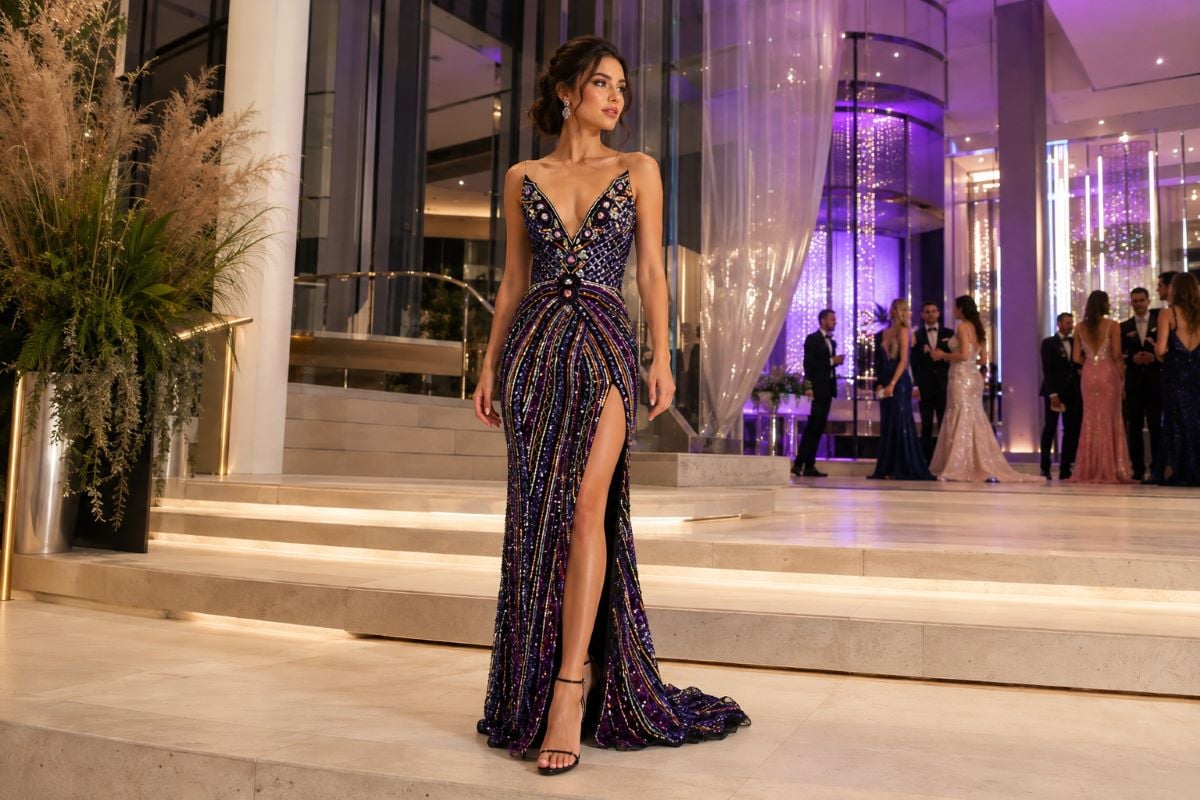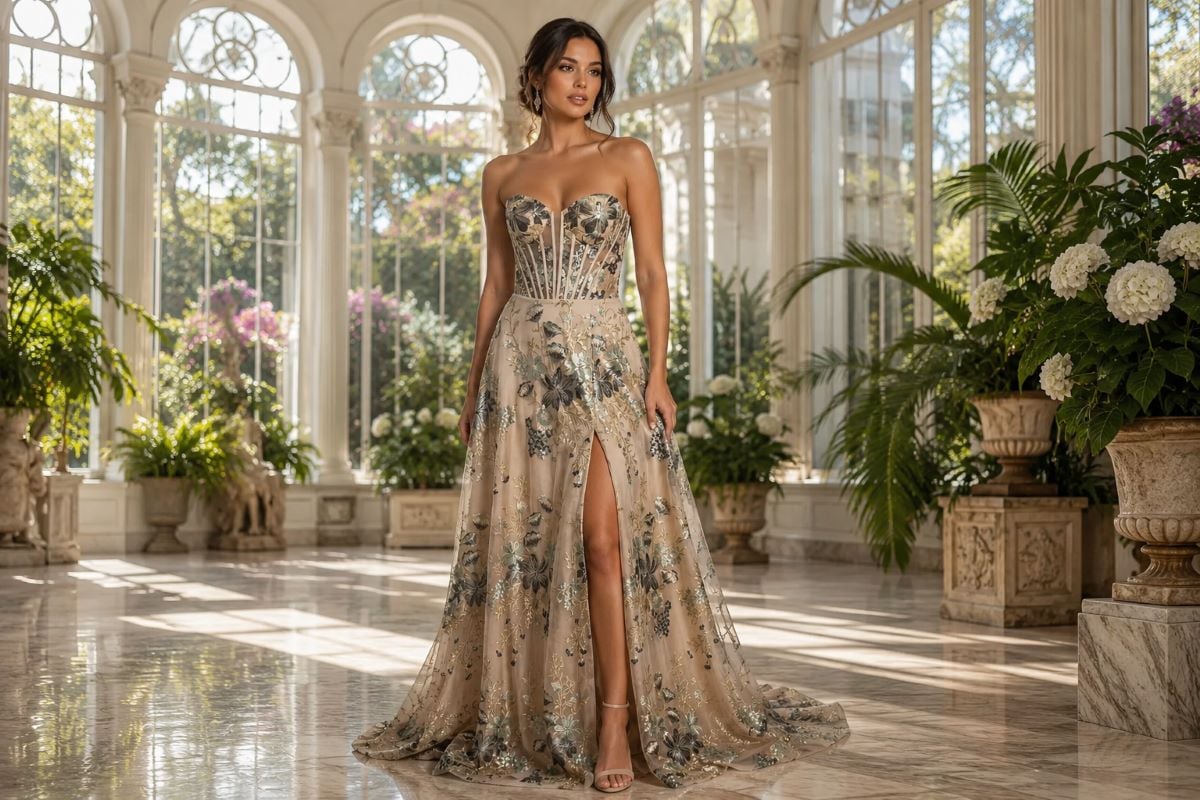

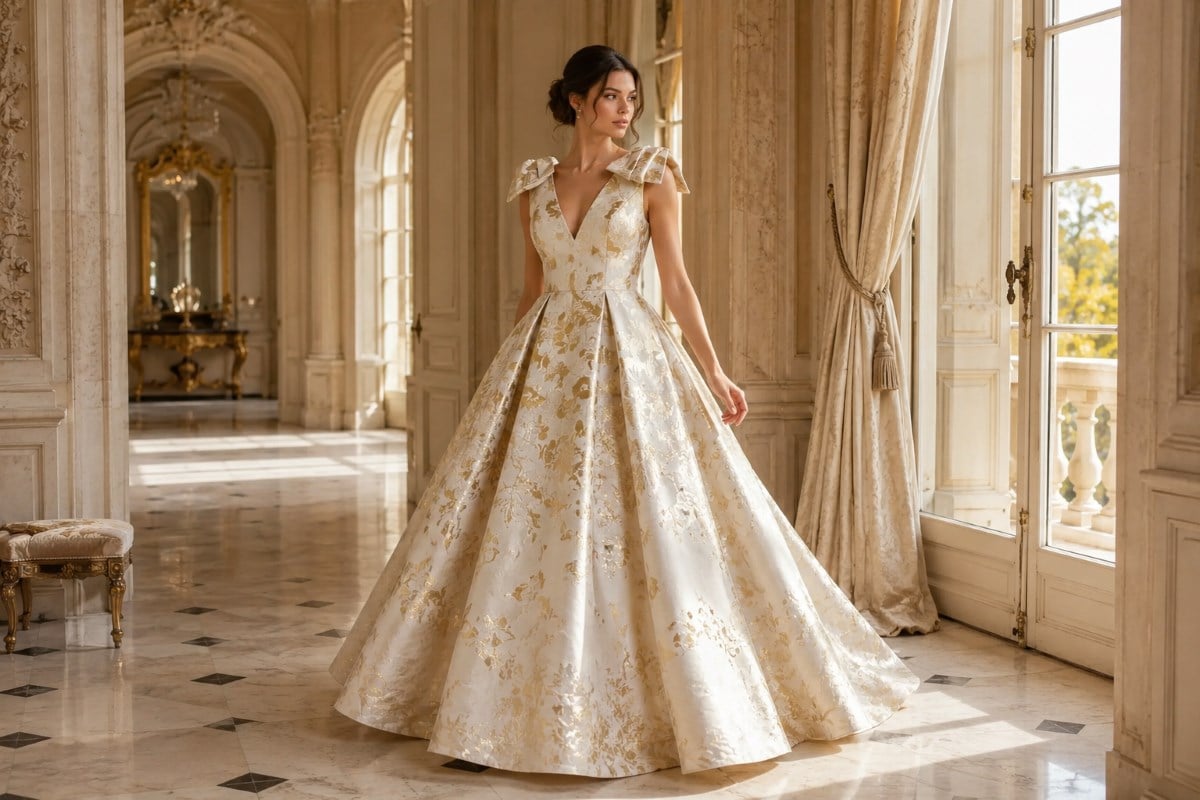
A brocade dress does something almost no other formal fabric manages. It carries an ornate, dimensional pattern without a single sequin, crystal, or bead attached to it, because the pattern is part of the cloth itself rather than something applied to the surface. Run your hand across a good brocade and you feel the design rise under your fingers. That is the whole appeal, and it is also why brocade reads as expensive from across a room in a way that printed fabric never quite does. This guide covers what brocade actually is, how it differs from jacquard and damask, which silhouettes suit a fabric this structured, how to style a dress where the fabric is already the statement, and the honest drawbacks worth knowing before you commit to one.
What brocade actually is
Brocade is a decorative woven fabric with raised, often floral or geometric patterns, traditionally made from silk and frequently incorporating metallic threads in gold or silver. It is substantial, structured, and noticeably weighty in the hand, and it has been associated with formal and ceremonial dress across many cultures for centuries.
The pattern is woven in, not printed on
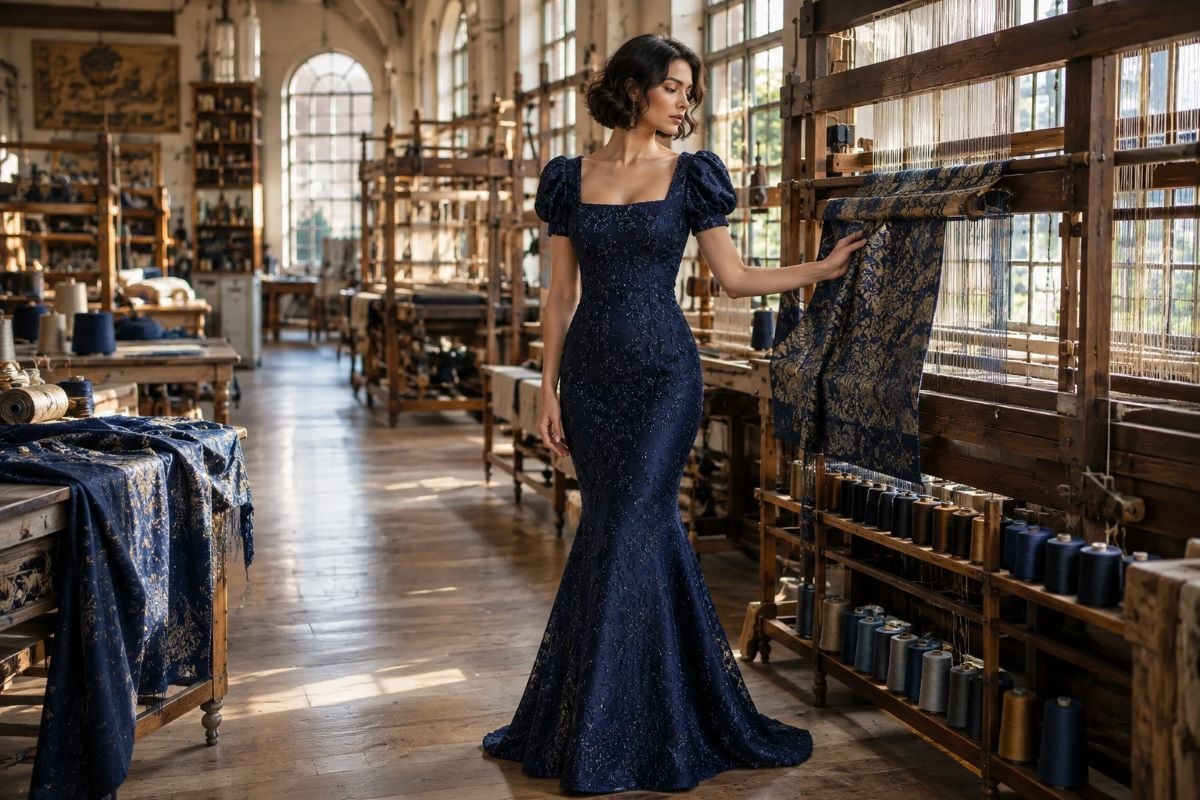
This is the single fact that explains everything else about brocade. The design is created during weaving, using supplementary weft threads that float across the surface of the base cloth and are caught into it at intervals to form the motif. The pattern is therefore built from the same threads as the fabric rather than stamped, embroidered, or glued onto it. That construction is why brocade has physical depth, why the pattern catches light along its raised edges, and why the design will never crack, peel, or wear away the way a printed or applied surface can. It also explains the fabric’s weight, since a brocade is effectively carrying more thread per square inch than a plain woven cloth of the same fiber.
Brocade, jacquard, and damask are not interchangeable
These three words get used as though they mean the same thing, and they do not. Jacquard is the broadest of the three and refers to the weaving technique, named for the loom mechanism that allows individual warp threads to be controlled and complex patterns to be woven directly into cloth. Brocade and damask are both made using that technique, so every brocade is a jacquard, but not every jacquard is a brocade. Damask is flat and reversible, with the pattern created by contrasting the direction of the weave, so the design appears in a satin sheen against a matte ground and reads clearly from either side. Brocade is neither flat nor reversible, since the supplementary threads sit raised on the face and leave loose floats across the back. If you turn a fabric over and the reverse is a tangle of loose threads, you are holding brocade rather than damask.
Why brocade reads as expensive
There is a reason brocade has been tied to ceremony and status for so long, and it is not marketing. Weaving a pattern into cloth is slower and more demanding than printing one onto it, and the fabric that results carries visible evidence of that process. The eye registers real texture and real dimension rather than a flat image of texture, and that distinction survives at a distance and under poor lighting.
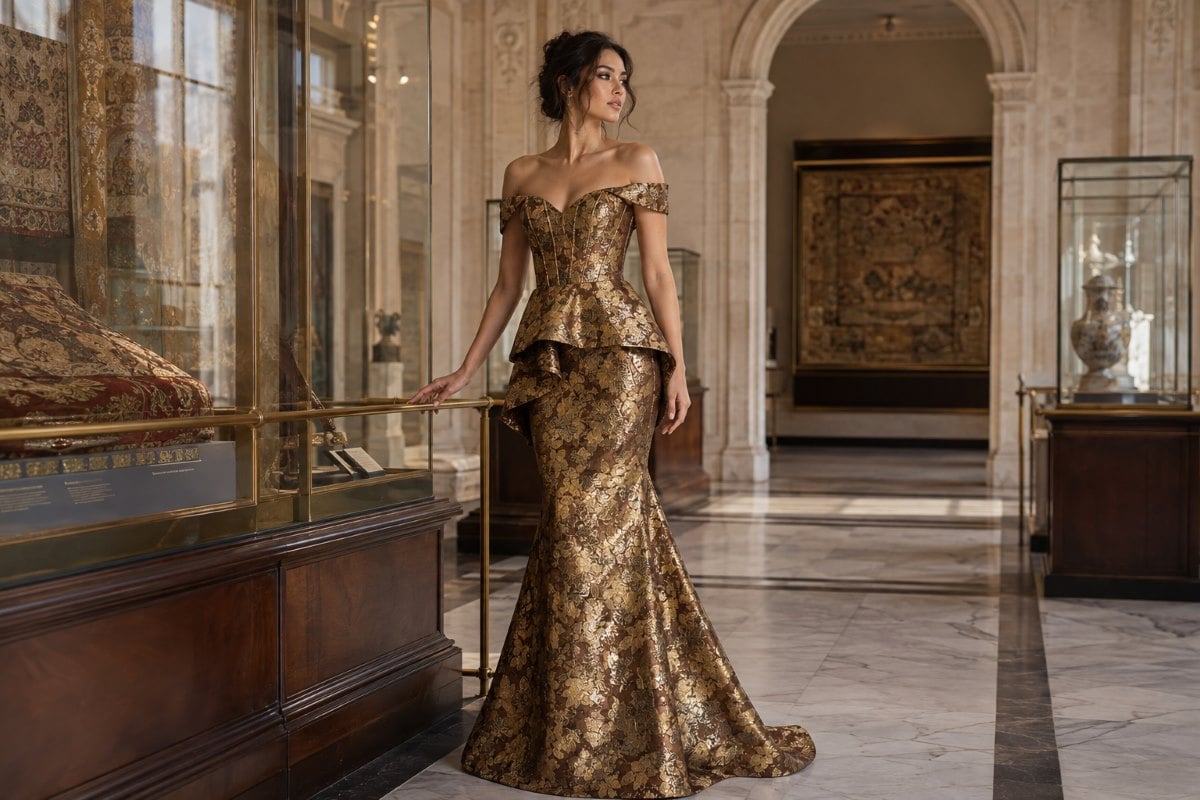
Metallic threads add to the effect without tipping into obvious sparkle. Where sequins throw hard points of reflected light, the metallic thread in a brocade produces a low, broken shimmer that follows the contours of the pattern. On camera this photographs with genuine depth rather than blowing out into white flare under a flash, which is a meaningful practical advantage at a heavily photographed event. The overview of the best fabrics for luxury evening dresses covers where brocade sits among the other formal materials.
The fabric also carries genuine history, having been used for ceremonial and court dress across Europe, Persia, India, China, and Japan long before mechanized looms existed. Traditions such as Banarasi brocade in India remain living crafts with their own techniques and cultural meaning. A brocade evening dress is a modern descendant of that lineage rather than an imitation of it, and part of the fabric’s presence comes from how long people have associated woven pattern with occasion. The styles among brocade evening dresses show how the fabric reads on a contemporary formal silhouette.
The silhouettes brocade suits
Brocade is heavy and stiff by design, with very little drape, and that single property decides which dresses it belongs in and which it does not.
Structure calls for clean, simple lines
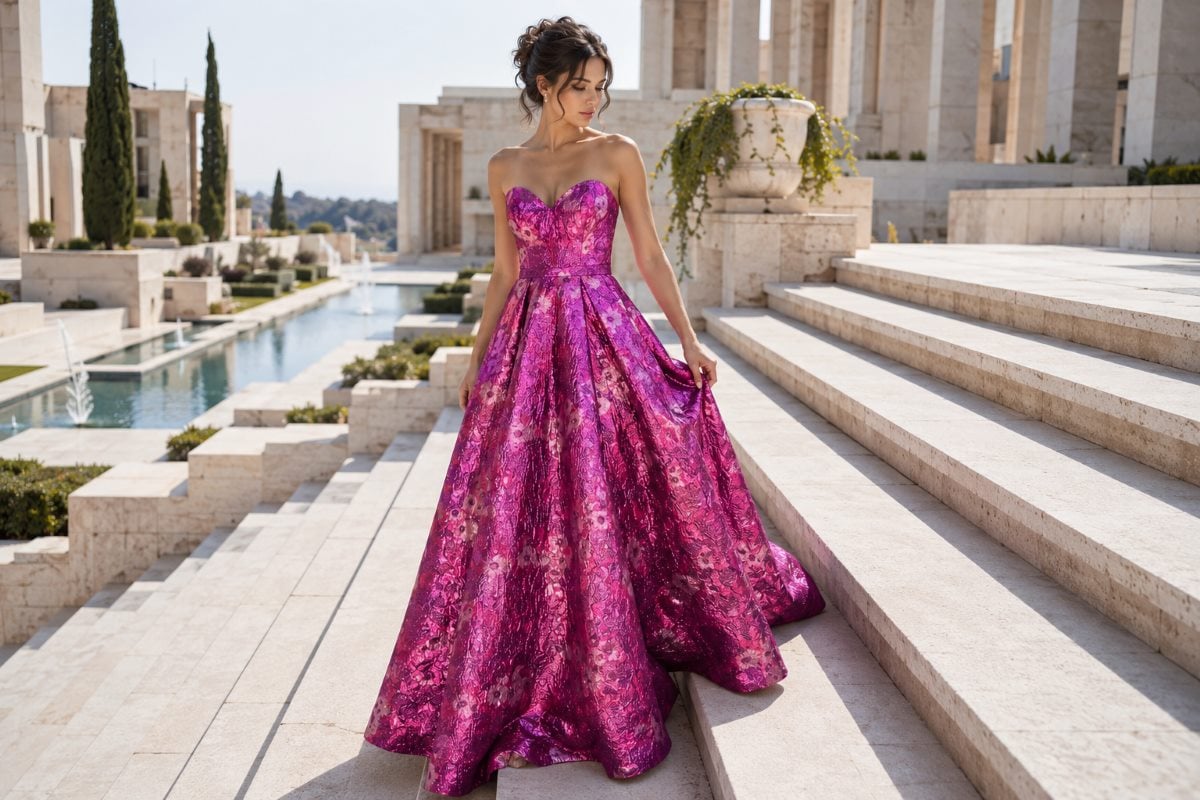
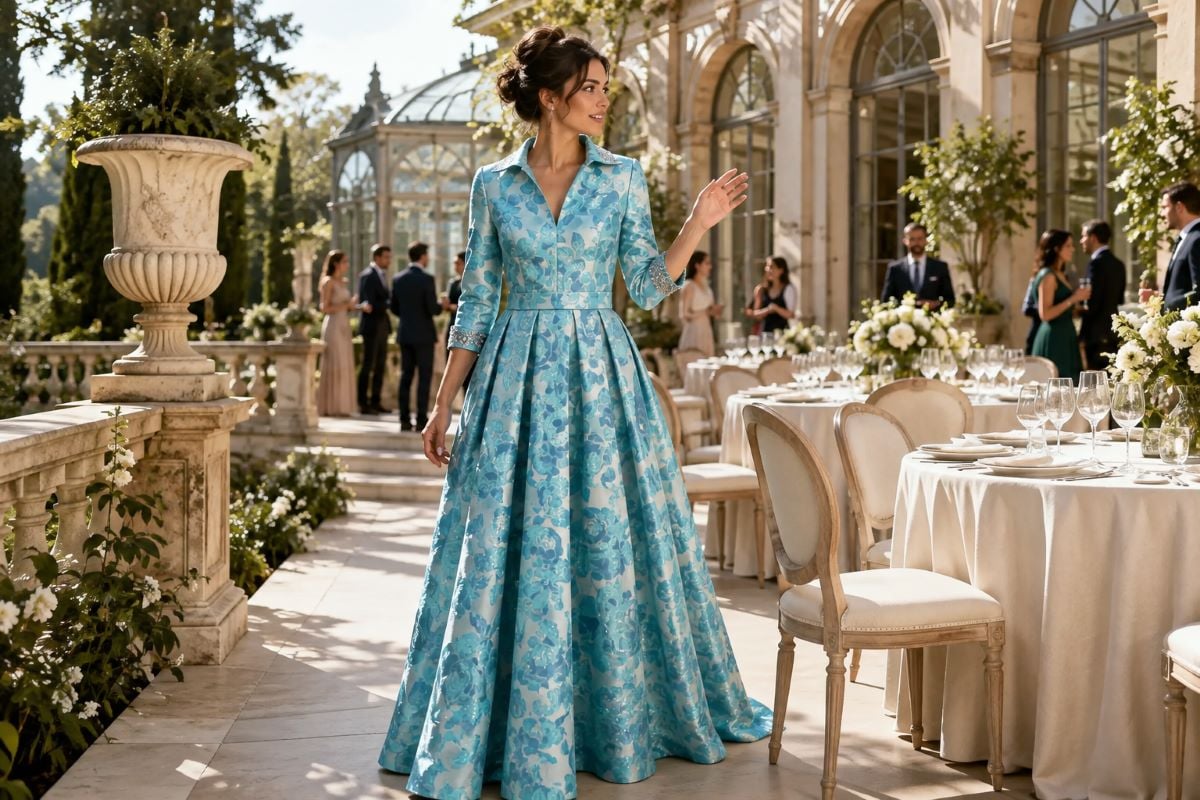
The reliable rule with brocade is that the fabric is the statement and the silhouette should stay out of its way. A sheath, a column, a clean A-line, or a structured fit-and-flare all give the pattern an uninterrupted surface to read across, and the fabric’s body holds those shapes crisply without additional support. A structured bodice in brocade holds its line all evening. A full skirt in brocade keeps its volume without heavy underlayers. What these silhouettes share is simplicity: no ruffles competing with the motif, no draping breaking the pattern into fragments, no applied embellishment fighting a surface that is already ornate. The sheath styles among sheath mother of the bride dresses show the kind of clean line that lets a patterned fabric lead.
Where brocade struggles
Anything that depends on softness will fight this fabric. A bias-cut slip, a gathered or ruched design, a dress meant to float, or a deeply draped neckline will all read as stiff and slightly wrong in brocade, because the fabric refuses to collapse into soft folds. Brocade also creases sharply where it is forced to bend, so a design with a lot of gathering will show hard, unattractive breaks rather than gentle ones. If soft movement is what you want from a dress, brocade is the wrong starting point regardless of how beautiful the pattern is.
Styling a brocade dress
Styling brocade is mostly an exercise in restraint, and this is where people most often go wrong. The dress already carries pattern, texture, dimension, and usually a metallic element. Adding a heavily beaded clutch, a statement necklace, and patterned shoes on top of that produces visual noise rather than a look.
The approach that works is to let the fabric hold the attention and keep everything else quiet. Simple metal jewelry in a tone that picks up the metallic thread of the weave reads as deliberate. A clutch in a solid color drawn from the brocade, or in a plain metallic, finishes the look without competing. Shoes should be simple, and a color already present in the pattern is usually the safest choice.
Neckline and hair follow the same logic. If the dress has a high or detailed neckline, skip the necklace and let earrings do the work. An updo gives a patterned bodice room to be seen. The one place a little extra is welcome is a solid outer layer, since a plain wrap or a simple coat over brocade creates a moment of contrast that makes the pattern look richer when revealed. For a sense of how surface finish changes a look, the comparison of matte and shiny fabrics covers how different surfaces behave together.
Colors and metallic threads
Brocade behaves differently from a solid fabric when it comes to color, because most brocades carry at least two tones: the ground and the pattern. That built-in contrast is what gives the fabric its depth, and it also means a brocade dress is rarely a single color in practice.
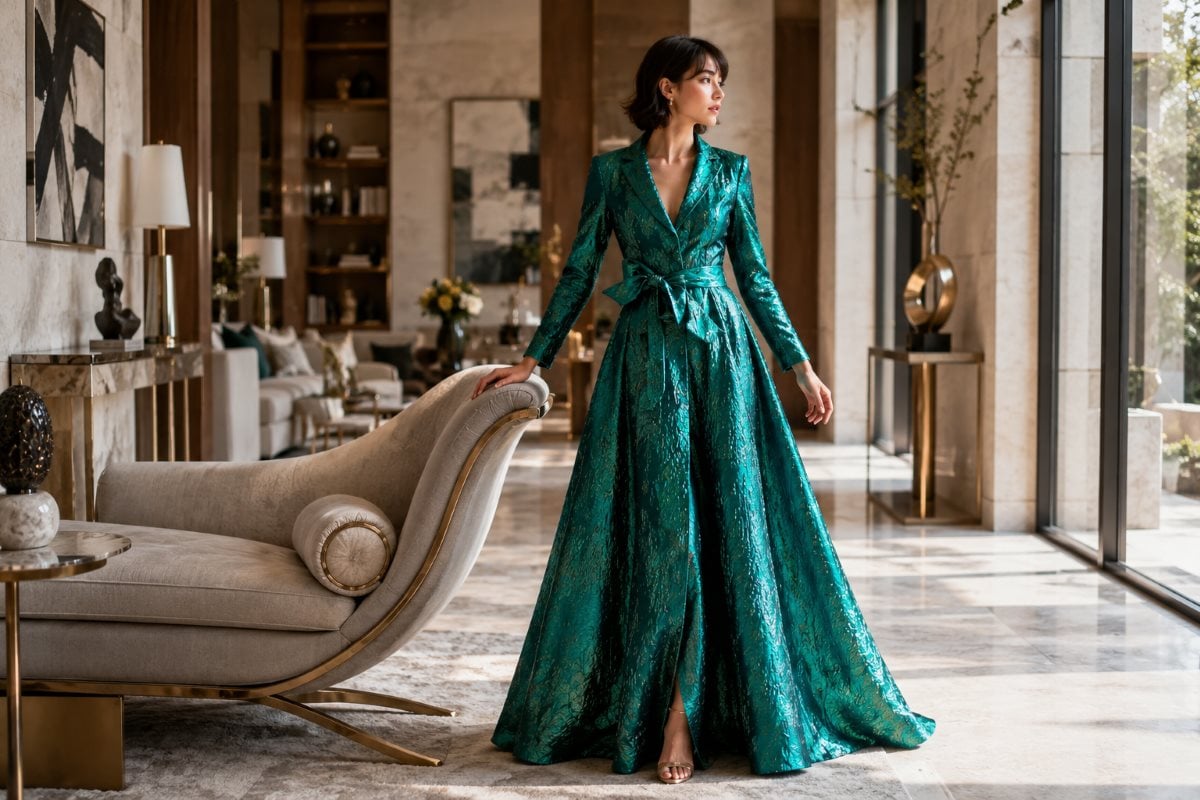
The most traditional combinations pair a rich ground with a metallic motif, such as black with gold, deep red with gold, or navy with silver. These read as formal and hold up under evening lighting, where the metallic pattern catches the light and the dark ground recedes. Jewel-toned brocades in emerald, sapphire, and plum give the same richness with more color, and the pattern within them tends to read as tonal rather than sharply contrasting.
Lighter brocades work too, with ivory, champagne, and blush grounds carrying tonal or metallic patterns that read as soft rather than dramatic. These suit a daytime formal event or a mother of the bride looking for presence without weight of color. Whichever direction you go, remember that the pattern scale matters as much as the color, since a large-scale motif reads as bold and modern while a fine, dense pattern reads as classic and lets the fabric behave almost like a texture. The styles among brocade prom dresses show how pattern scale changes the character of a formal gown.
Across occasions, the fabric behaves the same way: it supplies the interest so the design does not have to. The range of formal gowns shows how a patterned fabric reads against plain alternatives at full length.
At cocktail length the effect is sharper still, since a shorter dress gives the pattern less surface and more edge. The styles among cocktail and party dresses show where a woven pattern sits in a semi-formal look.
Where a brocade dress belongs
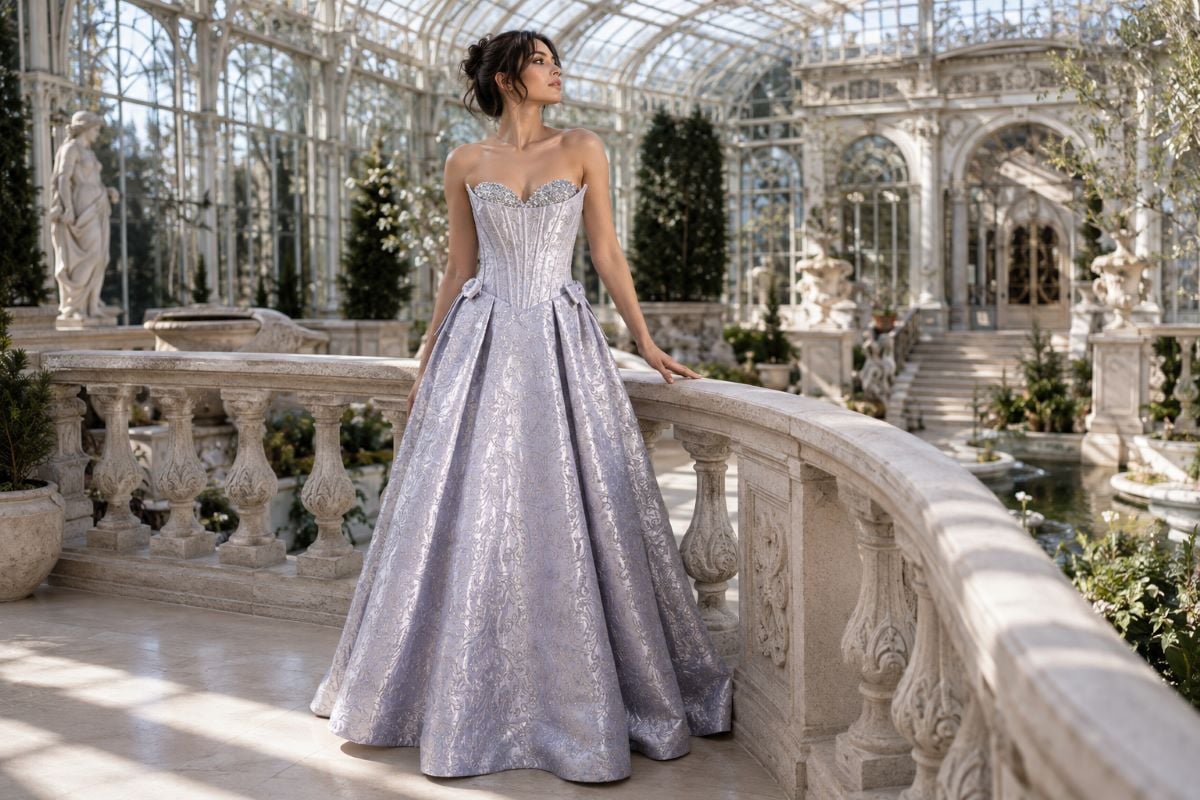
Brocade is a formal fabric by temperament, and it suits occasions where a little ceremony is appropriate. A black-tie evening, a gala, an opera or theater night, and a formal winter wedding all sit comfortably in its range, since the weight and the woven pattern read as serious rather than casual.
For the mother of the bride or groom it is a particularly strong choice, because it provides presence and interest without embellishment that might compete with the wedding party, and it photographs with depth in family portraits where several people are in plain fabrics.
As a wedding guest, brocade works well provided the color is clearly not bridal, and a metallic-threaded brocade in a deep shade reads as dressed rather than showy. Where it works least well is a daytime celebration in warm weather, an outdoor event on grass, or anything with a relaxed dress code, since the fabric’s formality will sit awkwardly against the setting no matter how beautiful the dress is.
The honest drawbacks of brocade
Brocade has real limitations and it would be dishonest to recommend it without naming them. The first is weight and warmth. A dense woven fabric with extra thread carried across its surface does not breathe freely, and a full-length brocade gown is a genuinely heavy garment to wear for six hours. In a cool room this is pleasant. At a warm or outdoor event it is worth thinking about carefully.
The second is the reverse side. Those loose supplementary threads floating across the back of the fabric are exactly what create the raised pattern, and they are also what snag. A brocade dress needs a proper lining between the fabric and your skin, both for comfort and to stop rings, bracelets, and zippers from catching the floats. A cheap brocade dress with a thin or missing lining will pull and pucker within a season.
The third is alteration. Brocade is one of the harder formal fabrics to adjust, for two reasons that compound each other. The tight weave shows needle marks where a seam has been moved, and the woven pattern has to be matched across any seam that is opened, which is skilled work. This means getting close to the right size from the start matters more than usual, and it is worth asking about alteration limits before you buy rather than after.
Caring for a brocade dress
Care for brocade is mostly about protecting the surface and the floats on the reverse. Store the dress hanging on a sturdy padded hanger in a breathable garment bag, since the fabric is heavy and a thin wire hanger will distort the shoulders over time. Give it room rather than compressing it between other garments, because pressure flattens the raised pattern.
Steam rather than pressing directly. Direct heat from an iron will crush the raised motif permanently, which is the one damage to brocade that cannot be undone. If pressing is unavoidable, work from the reverse with a pressing cloth and a low setting, and never press the pattern face down onto a hard board. Handle the reverse side gently, since pulling a snagged float can distort the pattern on the face.
Cleaning should always be professional, and it is worth telling the cleaner both the fiber content and that the fabric is brocade, so they avoid processes that would flatten the surface. The practical routines in the guide to caring for delicate evening dress fabrics apply directly to a brocade gown.
How to spot a well-made brocade
When you are looking at a specific brocade dress, a few checks tell you most of what you need to know. Feel the weight and look at how the pattern sits, because a quality brocade has genuine dimension you can feel with your fingertips, while a poor one has a pattern so shallow it may as well be printed. Turn back a hem or a facing if you can and look at the reverse, since the presence of those floating threads confirms you are looking at real brocade rather than a jacquard imitating it.
Check the lining next, because with this fabric a good lining is not a luxury but a requirement. Then look at how the pattern falls across the body, since a well-cut brocade dress places the motif deliberately rather than letting a large repeat land awkwardly, and pattern placement is one of the clearest signs of careful construction.
Finally, match the fabric to the event honestly. Brocade is the right answer for a formal evening where you want presence, texture, and a dress that photographs with depth. It is the wrong answer for a long warm day outdoors or for a look that depends on soft movement. Chosen for the right occasion and styled with restraint, a brocade dress delivers ornate richness without a single applied embellishment, which is a rare thing in formalwear. To see how woven pattern, metallic thread, and structured silhouettes come together, explore the current styles through an authorized Jovani retailer.
Brocade, Explained for Anyone Buying One
What is brocade fabric?
Brocade is a decorative woven fabric with raised patterns, traditionally made from silk and often incorporating metallic threads. The pattern is created during weaving using supplementary weft threads that float across the base cloth and are caught into it to form the motif, which means the design is part of the fabric rather than printed or embroidered onto it. The result is a substantial, structured cloth with genuine physical depth and very little drape.
What is the difference between brocade and jacquard?
Jacquard is the broader term and refers to the weaving technique, named after the loom mechanism that allows complex patterns to be woven directly into cloth. Brocade is one specific type of jacquard fabric, distinguished by supplementary threads that sit raised on the face and leave loose floats across the reverse. So every brocade is a jacquard, but most jacquards are not brocade. The simplest test is to look at the back: loose floating threads mean brocade.
How is brocade different from damask?
Both are woven on a jacquard loom, but they behave very differently. Damask is flat and reversible, with the pattern formed by contrasting the direction of the weave so it appears as a satin sheen against a matte ground and reads from either side. Brocade is raised and not reversible, since the supplementary threads sit on the face and leave a messy reverse. In short, damask is smooth and two-sided while brocade has physical texture and a definite right side.
What silhouettes work best in brocade?
Brocade suits clean, structured shapes that give the pattern an uninterrupted surface. A sheath, a column, a clean A-line, or a structured fit-and-flare all work well, and the fabric’s body holds those shapes without extra support. What these have in common is simplicity, since ruffles, heavy draping, and applied embellishment all compete with a fabric that is already ornate. Brocade suits soft, fluid, or heavily gathered designs poorly, because it refuses to fall into gentle folds and creases sharply where forced to bend.
Is a brocade dress heavy or warm to wear?
Yes, noticeably so. A dense weave carrying extra thread across its surface does not breathe freely, and a full-length brocade gown is a really substantial garment to wear for a long evening. In an air-conditioned venue this is comfortable and even welcome, since the structure means the fabric stands away from the body rather than clinging. For a warm or outdoor event it deserves real consideration, and a shorter length or a lighter-weight brocade is the sensible compromise.
How do you care for a brocade dress?
Hang it on a sturdy padded hanger in a breathable garment bag with room around it, since pressure flattens the raised pattern and a thin hanger distorts the shoulders under the fabric’s weight. Steam rather than pressing, because direct heat from an iron crushes the raised motif permanently and that damage cannot be reversed. Be gentle with the reverse side, where the floating threads can snag. Cleaning should always be professional, and telling the cleaner the fabric is brocade helps them avoid flattening the surface.