
How to Coordinate Your Prom Dress with Your Date’s Outfit
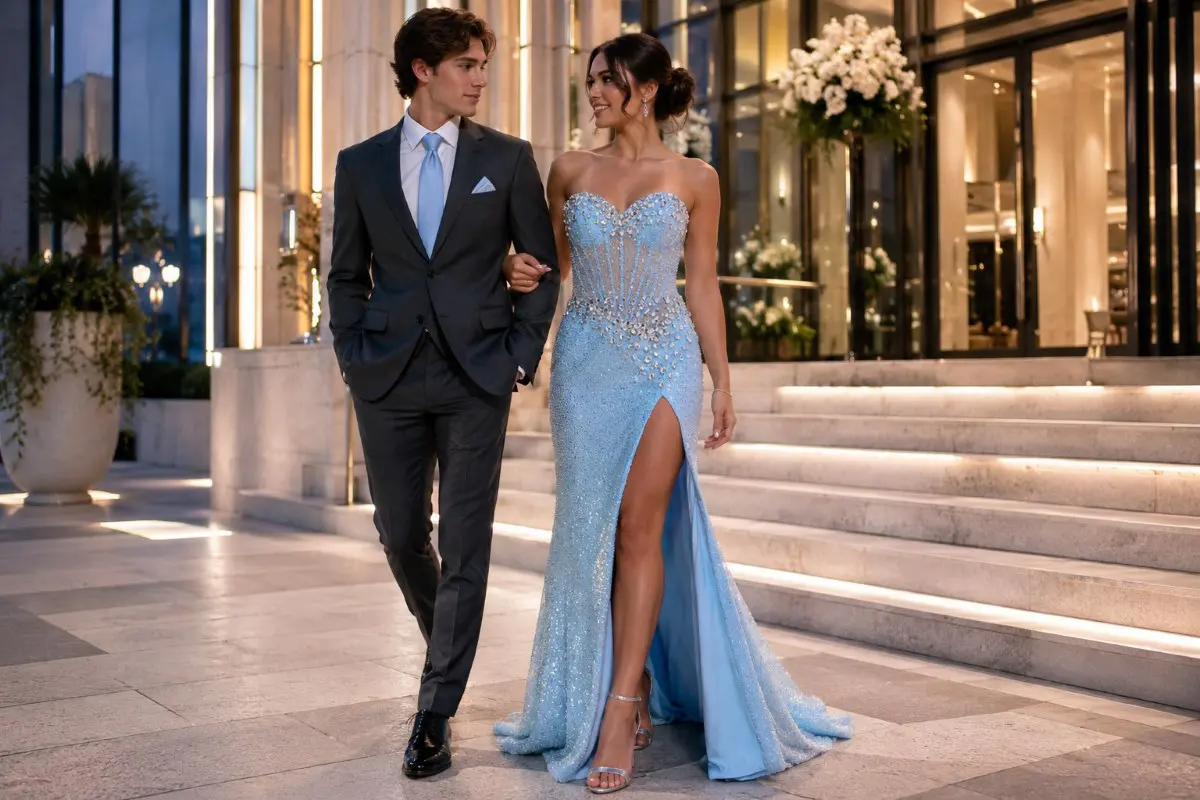
Imagine. You’ve found it, the most beautiful prom dress you could have hoped for. It flatters your complexion and body type, it’s comfortable and high-quality, and you have the perfect pair of shoes to go with it. Exciting, right? But your date shows up to your doorstep in a suit that clashes with it. Side by side in photos the two of you look unconnected, and that is the one part of the evening nobody can fix afterwards.
To help prevent all future prom attendees from any fashion disasters like that, Jovani has put together this guide to help you figure out how to match your prom dress with your date’s outfit so the two of you look like you planned the evening together. By considering these three simple aspects, you and your date can absolutely turn heads.
Colors
Color is a deceptively complex topic, but to make it a little easier, it’s best to divide colors according to temperature, so warm, cool or neutral.
Warm colors are reds, pinks, oranges, earthy browns and beiges, and yellows. Cool colors are blues, purples, greens, teals, and indigos. White, black, and gray are neutral and can be paired with colors of any temperature. In general, warm colors will always match best with other warm colors, as will cool with cool, though this is not a hard and fast rule.
Choosing one or two colors of the same temperature to base your outfits on makes things easier, especially when you use a neutral color like white or black dress as a canvas. If you already have a particular color in mind, then it’s pretty simple to find outfits that match from there, either by finding something that matches exactly or otherwise complements it.
Whatever colors you choose, they should be used in both your dress and your date’s outfit. If your dress is a pearly pink, then his tie could match. If your dress is green and yellow, then your date could wear a yellow vest and pocket square, and as long as one color is present the outfits read as a pair.
If you don’t want to match colors, you could try to mix pastels or jewel tones. You could wear a gown in deep red velvet and your date could wear one of dark green velvet. That kind of pairing works well.
Oh, and try to get your colors as close in shade as possible, if you want to match them, since there is a big difference between light lavender and deep plum, even if they’re both purple. If your dress is sparkly or multi-colored, you may want to explore matching in ways other than color.
Fabrics & Textures
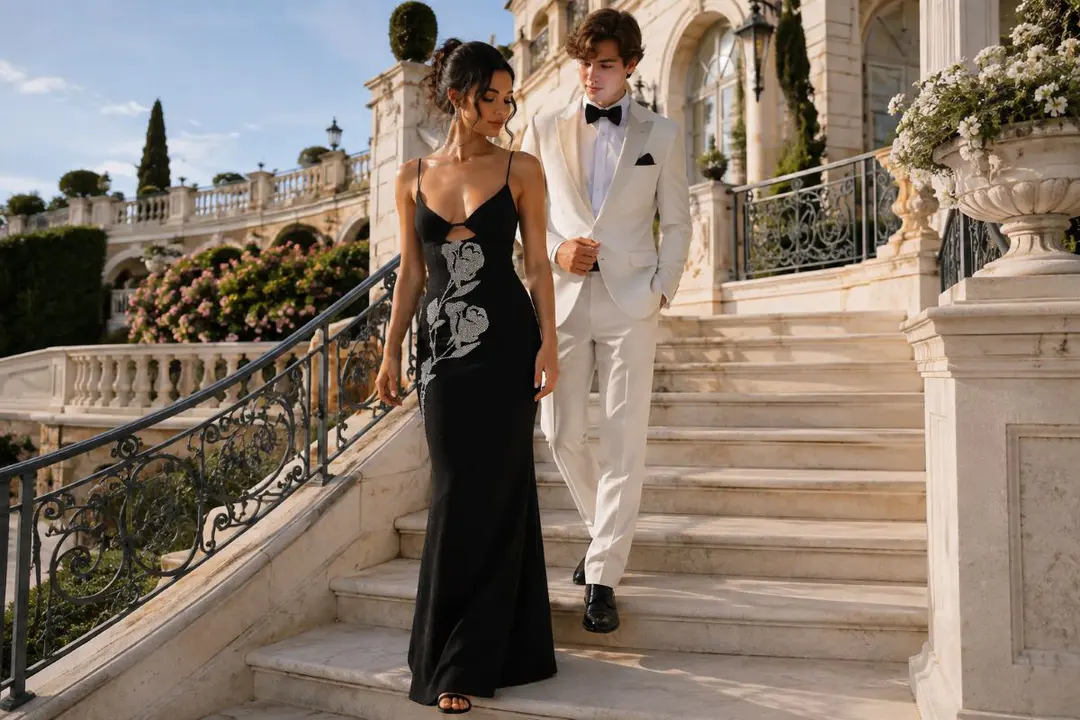
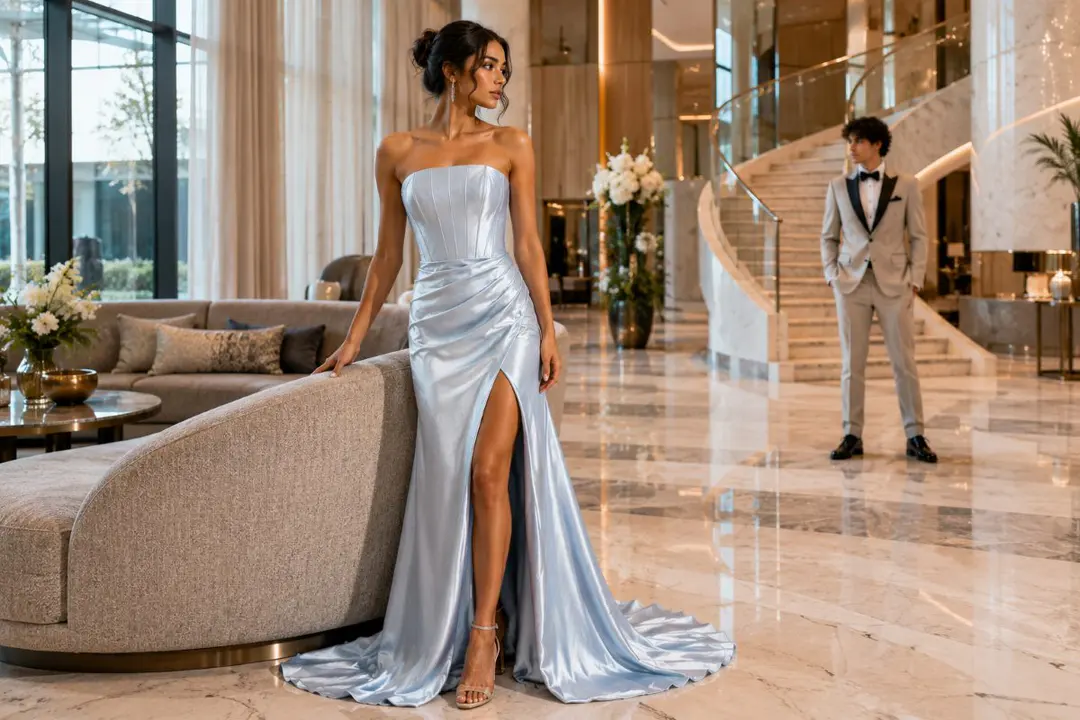
The fabric of your dress is hugely important. Prom dresses can be made from any number of materials, including velvet, silk satin, polyester/rayon, chiffon, tulle, and beaded/sequined fabrics. Tuxedos and suits are equally diverse, being made of wool, tweed, velvet, and silk satin, all in a different array of weaves.
If your date is wearing a tuxedo or suit, don’t feel limited to just selecting a fancy necktie to match your textured dress. Blazers, vests, and pants come in a huge array of textures, from crushed velvet to tweed. Tuxedo lapels are occasionally made of shiny satin, which goes nicely with satin gowns.
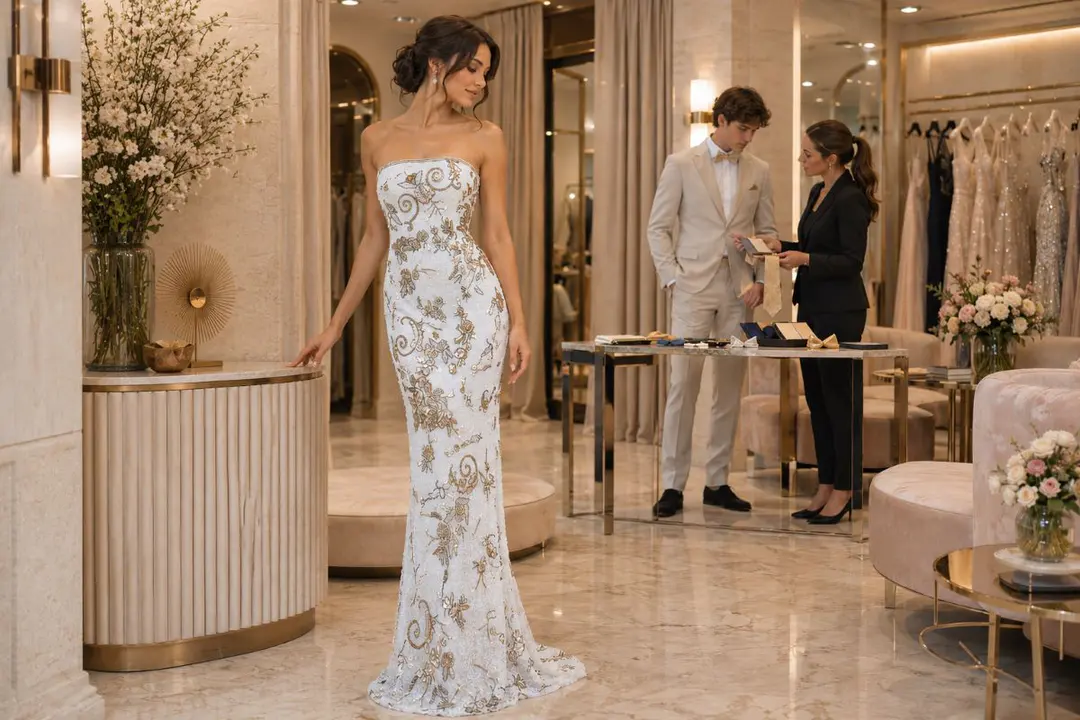
If you and your date are both wearing dresses, then it’s simple to choose complimenting fabrics and textures, even if the styles or cuts are different. If you choose dresses that are the same style or material, you can also try to select colors that go well together, like black and white or peach and powder blue. If your dress has nice embroidery or sequins, your date can wear another dress with a similar pattern.
All of these fabrics mentioned have very different textures and weights to them, and lots of dresses and suits will use multiple fabrics together. You don’t necessarily want outfits made out of identical fabrics, but it’s important to keep them in mind when coordinating. Just selecting textures that complement each other is enough. Sometimes elements of your dress can only be subtly incorporated into your date’s outfit, which is okay.
Accessories
Once you’ve decided on colors and fabrics, it’s time to choose accessories. Most people have a love or hate relationship with them. On the one hand, it’s fun because there’s so much opportunity for variety and uniqueness; on the other, the number of choices available to you may feel overwhelming. Thankfully, accessories need only be as complicated as you make them.
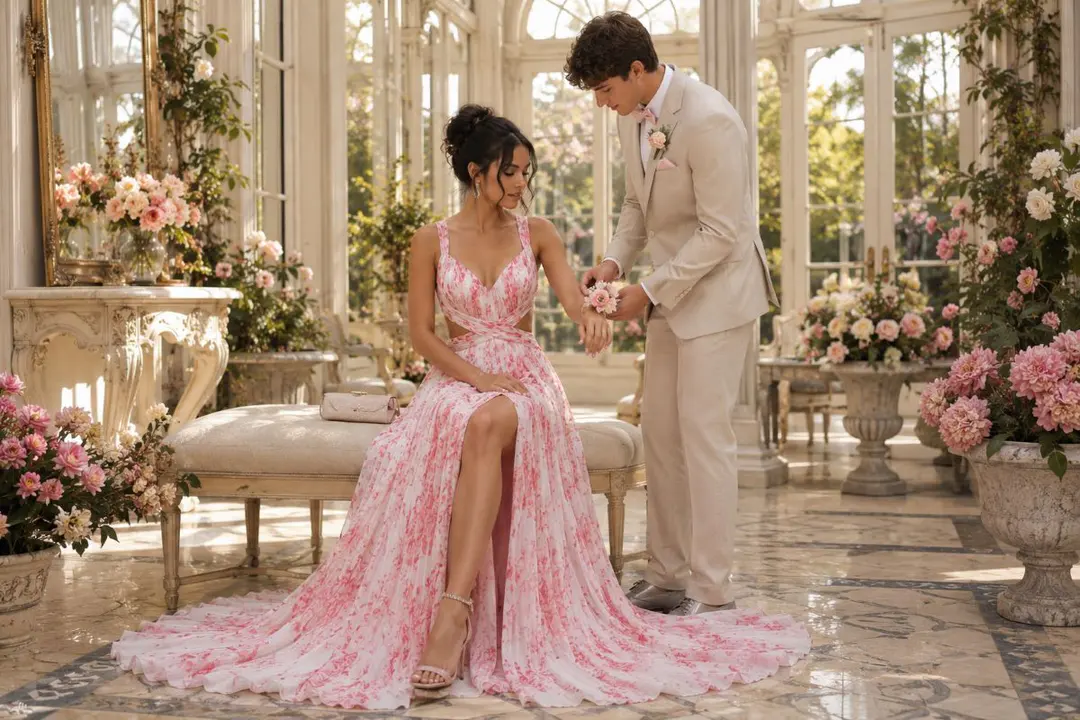
First, let’s go over some common types. A corsage and boutonnière (the former is the tiny bouquet a girl wears around her wrist, given by the date; the latter is the matching decoration on a suit) are probably the only traditional prom ‘requirements,’ so everything else is up to your own tastes. Examples of other accessories include:
Earrings, necklaces, bracelets, and rings
Hair decorations (combs, headbands, clips, etc.)
Purses
Cufflinks and buttons
Neckties (standard, bowties, ascots, etc.)
Pocket squares and handkerchiefs
Scarves
Shoes
As for deciding precisely how accessories are going to factor into your outfits, you have three paths:
You do it old school, which means merely matching his tie with your dress
Your outfits are both neutral colors and you both use bling as the primary way to match
You leave accessories behind entirely
There’s really no right or wrong to do it. The most common outfit pairing would be the first option, meaning your date wears a standard tux and a tie in the same color as your dress. This leaves you room to wear whatever jewelry or shoes you want because there’s no worry about harmonizing.
The second option means you both go hard on the embellishments, perhaps matching scarves worn in different ways, shoes in the same color and style, or you two just wear exclusively neon orange accessories over black clothing. This path requires a little planning and making sure you’re both on the same page with what you’ll want to wear, but the end result can be unbelievably fun and unique, even if your base outfits are on the plain side.
As for the third option? You’re certainly free to take a minimalist approach and forgo accessories entirely. If the fabrics and patterns of your clothes stand out enough or you’re both looking for a sleek, subdued look, this route is for you.
But no matter what you choose, the color of the accessories you two wear should match as well, even if they’re metals like gold or silver. The same guidelines for color and fabric apply here just as they did for your base outfits.
Talk About It
You may think it’s a faux pas to discuss things like corsages and coordinating beforehand, but there’s really no reason you can’t.
Think about what you want to wear. Ask your date about their outfit preferences and what they want. From there, you can pick out styles, colors, and accessories together, or decide to come up with one outfit and design the second one around it. If your date is okay with leaving all the decisions to you, it’s still good to ask for input from time to time to make sure you choose something they’re comfortable with.
And remember, there is no need to stress about matching every single detail of each outfit. It’s not the end of the world if his shoes are brown and yours are black. Prom is meant to be a fun, memorable experience for the both of you, so it is worth enjoying rather than managing.
Prom Coordination Questions
How do you match a prom dress to a date's outfit?
Pick one or two colors of the same temperature and make sure at least one appears in both outfits. A tie, vest or pocket square picking up a shade from the dress is enough. An exact match across two different fabrics rarely works, so echoing a color reads better than copying it.
Should the tie match the dress exactly?
Usually not. Dye lots differ and the same shade reads differently in satin and in silk, so a near match looks like a mistake while a clear echo looks deliberate. Match the shade family rather than the exact color, and keep light and deep versions of the same color apart.
What if the dress is patterned or multi-colored?
Pull one secondary color out of the pattern rather than trying to match the whole thing. A print with several shades gives you a choice, and picking the least dominant one usually works better than the loudest.
How do two people in dresses coordinate?
The same way, through color family and texture rather than identical styles. Choosing shades that sit well together, such as black and white or peach and powder blue, works even when the cuts are completely different. Matching embroidery or beading is another route.
Who arranges the corsage and boutonniere?
Traditionally the date arranges the corsage and the wearer of the suit gets the boutonniere, but this varies and is worth agreeing rather than assuming. Confirm the dress color first so the flowers can be chosen to match rather than clash.
How much should match?
Less than people think. One shared color or one shared texture is enough to read as coordinated in photographs. Trying to match every element, down to shoes and accessories, usually looks staged rather than planned.
Choosing the dress first
Coordination is far easier in one direction than the other, since a tie or a pocket square can be matched to a gown while a gown cannot easily be matched to a suit already bought.
Settle the dress first at an authorized Jovani retailer, then take a photograph of the exact shade with you when the suit is chosen.