


Two gowns can look almost identical on a hanger and behave like completely different garments after one evening, because only one of them is a couture gown in any meaningful sense. One holds its shape through six hours of wear, comes back from the cleaner looking the way it went in, and can be altered for someone else a decade later. The other loses its structure by midnight, shows seams that were meant to stay hidden, and cannot be let out because there is no fabric inside it to work with. The difference is entirely in construction, most of which is invisible when you are looking at the outside of a dress. This guide explains what is actually inside a well-made gown, why those things matter to how it wears, and how to assess them in a fitting room.
What holds a gown’s shape
The most important parts of a formal gown are the ones you cannot see from the outside. A bodice that stays smooth against the body, a neckline that does not gape, and a skirt that keeps its line are all doing work through internal structure rather than through the outer fabric.

Boning and what it actually does
Boning is the clearest example. Strips of steel or plastic sewn into channels inside the bodice hold the garment’s shape independently of the body, which is what allows a strapless gown to stay up without gripping. Spiral steel boning flexes with movement and returns to shape; cheaper plastic boning bends and stays bent, which is why an inexpensive strapless dress often looks fine in the shop and buckled by the end of an evening.
The layers underneath
Underlining, interfacing, and a proper lining do the rest. Underlining gives a light fabric enough body to hang correctly, interfacing stabilizes areas that would otherwise stretch, and a full lining lets the dress move over the body rather than clinging to it. Skirt structure such as horsehair braid at a hem or a built-in crinoline keeps volume without weight. The gowns among long evening dresses show where internal structure does the most visible work, since a floor-length skirt depends on it entirely.
Why seam allowance decides a dress’s future
This is the single most consequential difference between a well-made gown and a cheap one, and it is completely invisible until someone tries to alter the dress.

What seam allowance actually is
Seam allowance is the extra fabric left inside a seam beyond the stitching line. A garment made to a price is cut with the minimum, often a centimeter or less, because fabric is the largest cost in production and trimming it saves money on every unit. A quality gown is cut with generous allowance, sometimes several centimeters at the side seams, specifically so it can be let out later.
The consequence is straightforward. A dress with generous allowance can be taken in and let out repeatedly across changes in size, across a decade, and for a different person entirely. A dress cut to the minimum can only ever be taken in. Once it is too small, it is finished, regardless of how beautiful the fabric is or how much it cost.
The other alteration limits
Hems follow the same logic. A deep hem allowance means a gown can be shortened and later lengthened; a narrow overlocked hem means the length is permanent. Straps and shoulders behave similarly, since a quality bodice is built so the shoulder seam can be lifted, while a fused or bonded construction usually cannot be opened without damage. When you are assessing a gown, turning it inside out and looking at the seams tells you more about its future than anything on the outside does.
Fabric quality and how it ages
Fabric is the part buyers do look at, but the quality difference shows over time rather than on the rail.
Natural fibers and high-grade synthetics behave differently as they age. Silk, fine wool, and quality viscose develop a softness with wear and recover their shape after being sat in. Cheap polyester holds its shape indefinitely in one sense, since it does not relax, but it also pills, develops a shine at friction points, and takes on a permanently crushed appearance where it has been pressed or folded.
Weight is the most reliable proxy for quality in formalwear, since a heavier fabric of the same type generally has more thread in it and drapes better. This is why a substantial crepe hangs in a clean column while a thin one clings, and why a good satin falls in fluid folds while a poor one creases into hard lines. The overview of the best fabrics for luxury evening dresses covers how each material behaves over time.
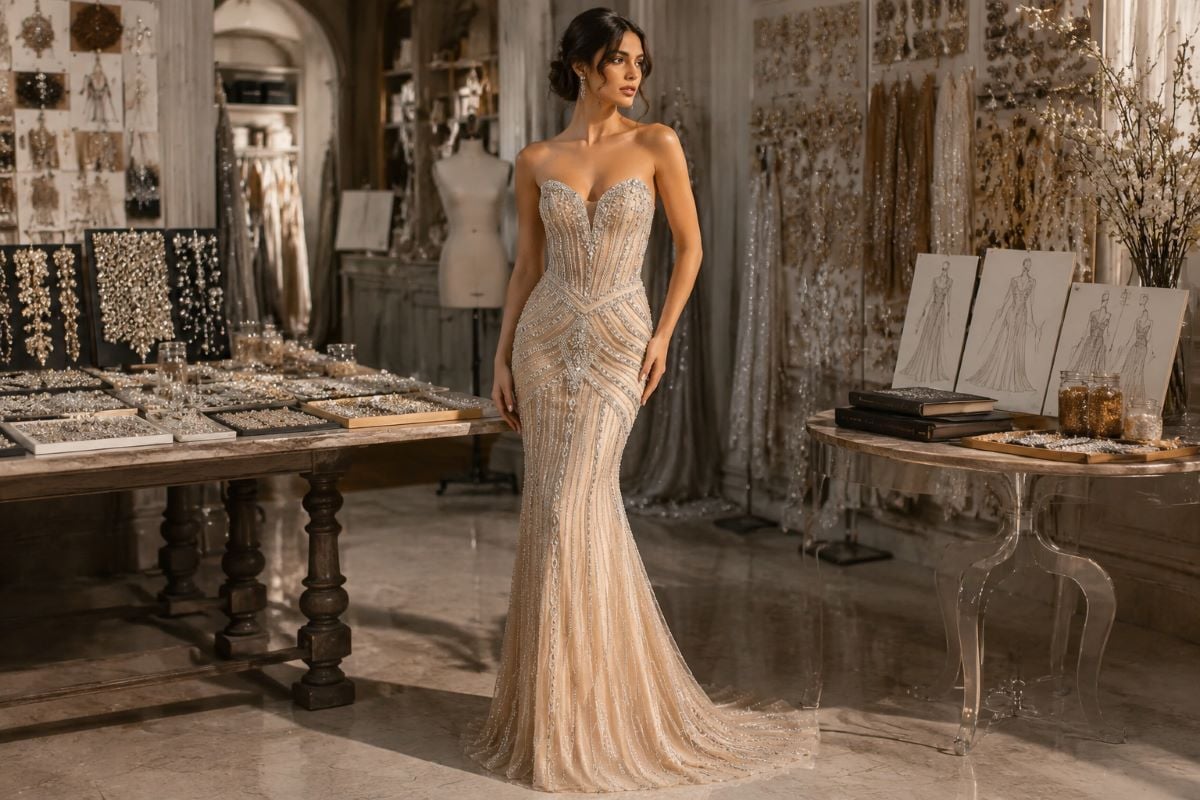
How embellishment is attached
Beading and embroidery are where the difference between construction methods becomes most visible, and most expensive to get wrong.
Hand-applied beading is stitched individually, which means each bead is secured on its own thread. If one comes loose, one bead is lost. Machine-applied beading is frequently chain-stitched, where a single continuous thread carries many beads, so one break can unravel a whole section. Glued embellishment, which appears on cheaper garments, fails predictably: the adhesive yellows, stiffens, and eventually releases, usually after cleaning.
The practical test is to look at the reverse of a beaded panel. Hand beading shows individual knots and secured threads on the back. A glued application shows adhesive marks and nothing else. This one check tells you a great deal about how the dress will look after its second wearing. The detail in the piece on couture beading techniques covers the methods involved.
What quality construction does across an evening
All of this matters because a formal event is long, and a couture gown earns its price during the last two hours rather than the first two.
A well-built garment is judged by how it behaves at the end of a night, and a gown that performs on a hanger is not the same as one that performs at midnight.
A well-built bodice stays where it is put. You are not adjusting a neckline, pulling up a strapless top, or holding a wrap closed, which is a difference you notice most at the moment you stop noticing it. A properly structured skirt keeps its intended shape after you have been seated through a long dinner, while an unstructured one arrives at the dance floor visibly crushed.
Lining matters here more than people expect. A fully lined gown moves over the body and over whatever is underneath it, which keeps the outer fabric from riding, clinging, or showing every line. An unlined or half-lined dress in the same fabric behaves completely differently after two hours.
The photographic consequence is real too. Structure holds a clean line, and a clean line is what reads in a photograph taken at the end of an evening rather than the start. The range of couture gowns shows the level of construction that produces that.
The same logic applies at every level of formalwear, not only at the top of the range. A well-constructed cocktail dress outperforms a poorly built one over an evening in exactly the same way. The range of formal dresses shows where construction quality becomes visible across different price points.

Assessing a gown in the fitting room
Five checks tell you most of what you need, and none of them take long.
Turn the dress inside out and look at the seam allowances, since generous allowance means the gown has a future and minimal allowance means it does not. Feel the weight of the fabric between your fingers, because weight is the most reliable indicator of quality within any given fabric type.
Check whether the dress is fully lined by looking at the inside of the skirt rather than just the bodice, since half-lined skirts are a common economy. Look at the reverse of any beading for individual securing threads rather than adhesive. And press gently on the boning channels in a fitted bodice: steel boning flexes and springs back, plastic boning bends and stays.
Then sit down in it. A gown reveals its construction problems in a chair rather than in a mirror, and two minutes seated tells you what an hour standing will not. The styles built around the little black dress are a useful test case, since a plain dark dress has no pattern or embellishment to hide poor construction behind.
Caring for a gown that was built to last
Construction quality only pays off if the garment is looked after, and formal gowns are damaged more often by storage than by wear.
Hang a structured gown on a padded hanger, or better, on a hanger with waist loops that take the weight of a heavy skirt off the shoulders. Store it in a breathable garment bag rather than plastic, which traps moisture and yellows fabric over time. Give it room, since compression flattens raised beading and sets creases in structured fabrics.
Clean it before storing rather than after, because invisible marks such as perspiration and clear drinks oxidize into visible stains over months. Tell the cleaner what the fabric is and where the beading is, since a general process can lift embellishment. Handled this way, a couture gown stays wearable for decades rather than seasons. The practical routines in the guide to caring for delicate evening fabrics cover the specifics.

What you are actually paying for
The price difference between a well-made gown and a cheap one is mostly invisible, which is why it feels difficult to justify at the point of purchase. It sits in the seam allowance you cannot see, the steel boning you cannot feel through the fabric, the full lining, the individually secured beads, and the extra fabric weight.
What a couture gown buys with those things is not luxury in the abstract. They buy a dress that behaves the same at midnight as it did at seven, that survives cleaning, that can be altered when your size changes, and that can be worn again in five years rather than once. Whether that is worth it depends entirely on how you plan to use the dress, and there is no shame in a single-occasion garment for a single occasion. The wider discussion in the piece on whether cost dictates quality covers that question directly. To see how construction quality shows in a formal gown, explore the current styles through an authorized Jovani retailer.
What Makes a Gown Last
What makes a formal gown well made?
Mostly things you cannot see from the outside: internal boning that holds the bodice shape independently of the body, underlining and interfacing that give fabric structure, a full lining that lets the dress move over you rather than cling, and generous seam allowance that allows future alterations. Skirt structure such as horsehair braid or a built-in crinoline creates volume without weight. The outer fabric is what you notice, but the interior is what determines how the gown behaves.
Why does seam allowance matter so much?
Because it decides whether a gown can ever be let out. A dress cut with minimal allowance, often a centimeter or less, can only be taken in, so once it is too small it is finished no matter how expensive the fabric was. A gown cut with generous allowance can be taken in and let out repeatedly, across changes in size, across years, and for a different wearer. Turning a dress inside out reveals this in seconds.
How can you tell if beading is well attached?
Look at the reverse of a beaded panel. Hand-applied beading shows individual knots and secured threads, so if one bead comes loose you lose one bead. Machine chain-stitching uses a continuous thread carrying many beads, meaning one break can unravel a whole section. Glued embellishment shows adhesive marks and nothing else, and it fails predictably as the adhesive yellows, stiffens, and releases, usually after cleaning.
Does fabric weight indicate quality?
Within a given fabric type, generally yes. A heavier crepe, satin, or silk has more thread in it and drapes better, which is why a substantial crepe hangs in a clean column while a thin one clings, and why good satin falls in fluid folds while poor satin creases into hard lines. Weight is not a universal rule across different fabrics, since chiffon is meant to be light, but it is a reliable comparison within the same material.
How do you check construction in a fitting room?
Five quick checks. Turn the dress inside out and look at seam allowances. Feel the fabric weight. Check the skirt is lined, not just the bodice, since half-lined skirts are a common economy. Look at the reverse of beading for securing threads rather than adhesive. Press the boning channels, since steel flexes and springs back while plastic bends and stays bent. Then sit down in it, because a gown shows its problems in a chair.
How should a quality gown be stored?
Hang it on a padded hanger, or ideally one with waist loops so a heavy skirt does not pull on the shoulders. Use a breathable garment bag rather than plastic, which traps moisture and yellows fabric over time. Give it room, since compression flattens raised beading. Clean it before storing rather than after, because invisible marks such as perspiration and clear drinks oxidize into visible stains over the following months.