
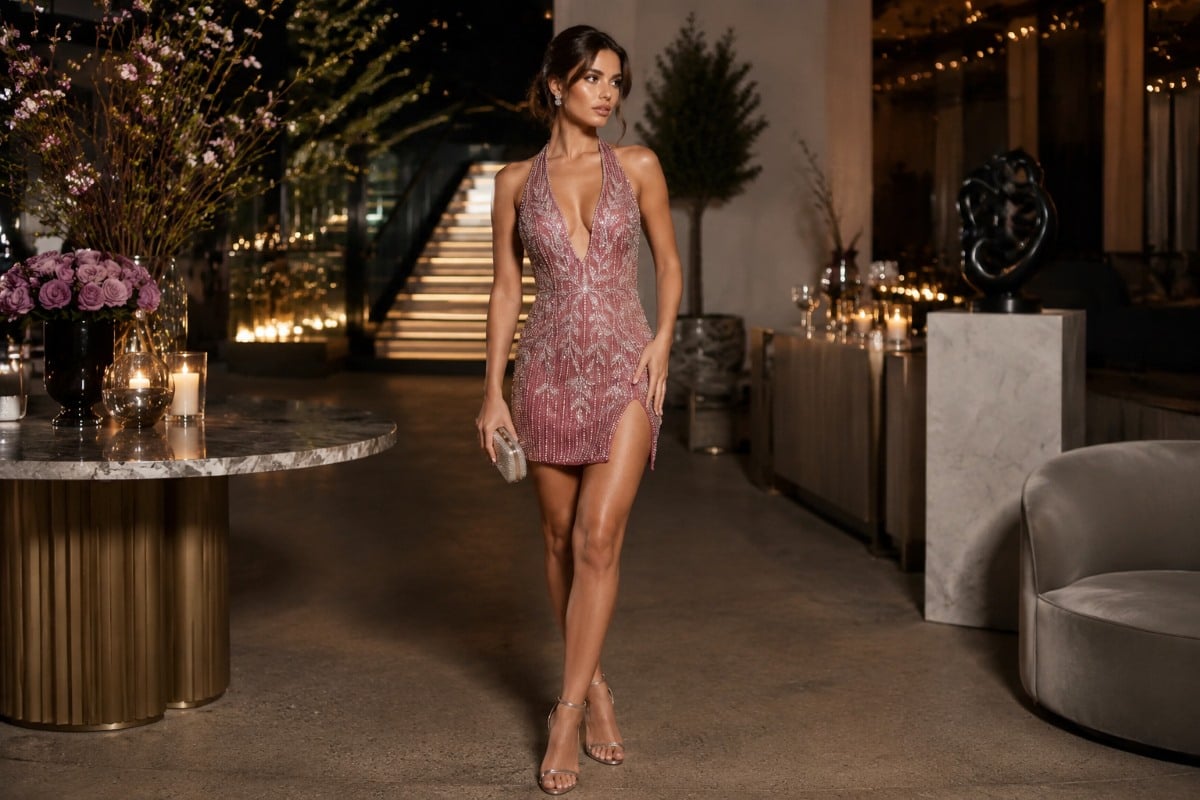
Quick answer: Choose a V-neck cocktail dress by checking the actual neckline depth, width, coverage, bodice fit, internal construction, back and strap design, and event requirements. A V-neck is simply a V-shaped garment opening; the label alone does not determine how revealing, supportive, flattering, or formal a dress will be.
When comparing V-neck cocktail dresses, start with the complete dress rather than a rule about body shape. The same neckline can be shallow or plunging, narrow or wide, wrapped or fixed, opaque or supported by illusion mesh. This guide explains those differences and gives you a practical fitting test.
What Is a V-Neckline?
Merriam-Webster defines a V-neck as a V-shaped neck of a garment. The definition describes the outline, not a standard measurement. Retailers may call a neckline subtle, classic, low, deep, or plunging, but those labels are not universal sizing standards.
Two V-neck dresses with the same product description may differ in:
- the point where the two neckline edges meet;
- the width of the opening at the shoulders or bust;
- the angle and curvature of each edge;
- whether the bodice wraps, drapes, or closes at the center front;
- the presence of mesh, lace, a modesty panel, cups, lining, boning, or underwire;
- strap width, sleeve design, armhole height, and back depth;
- how the neckline changes when the dress is worn by an individual body.
Use front, side, and movement views to see what the neckline actually does. A product image taken from one angle cannot confirm coverage or security.
Common Types of V-Neck Cocktail Dresses
| Variation | How it is constructed | What to inspect |
|---|---|---|
| Shallow V | The point ends relatively high on the bodice | Whether the edge lies flat, the intended bra stays covered, and the opening suits the event |
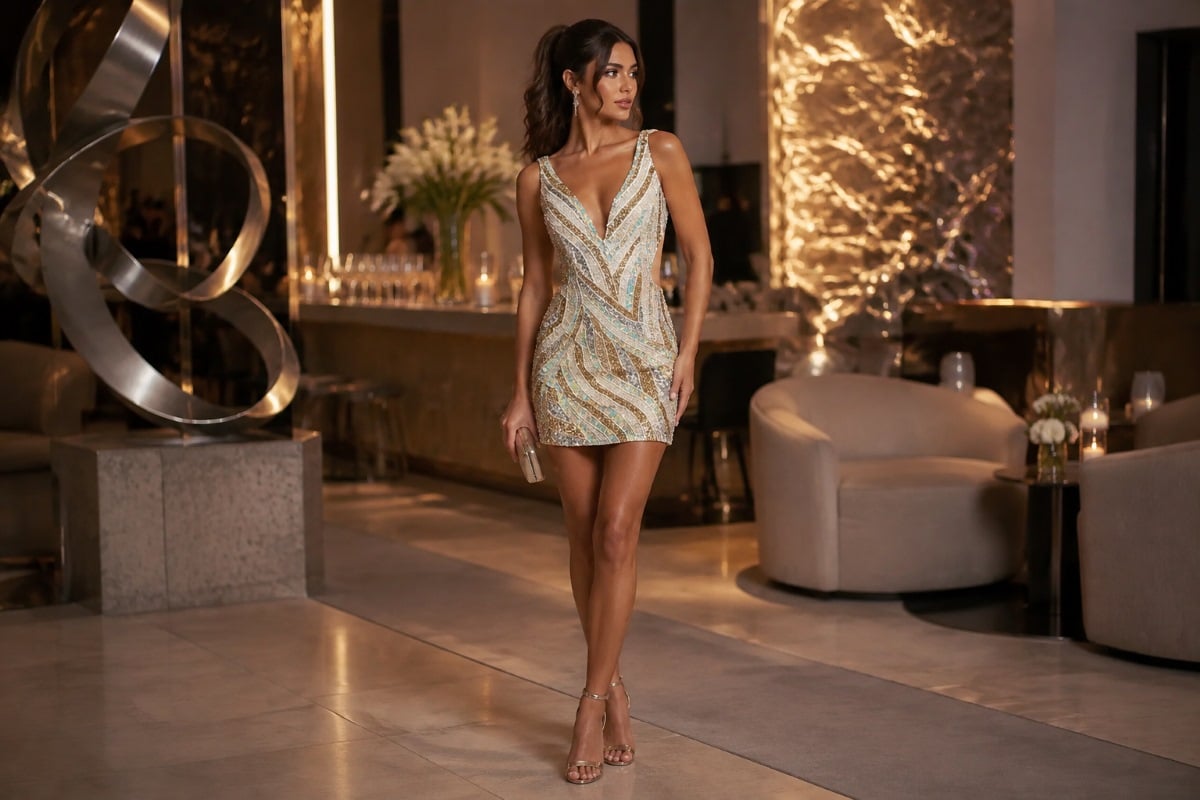
| Moderate V | The point extends farther down the center front without reaching a dramatic plunge | Coverage while sitting and leaning, bust seams, strap stability, and center alignment |
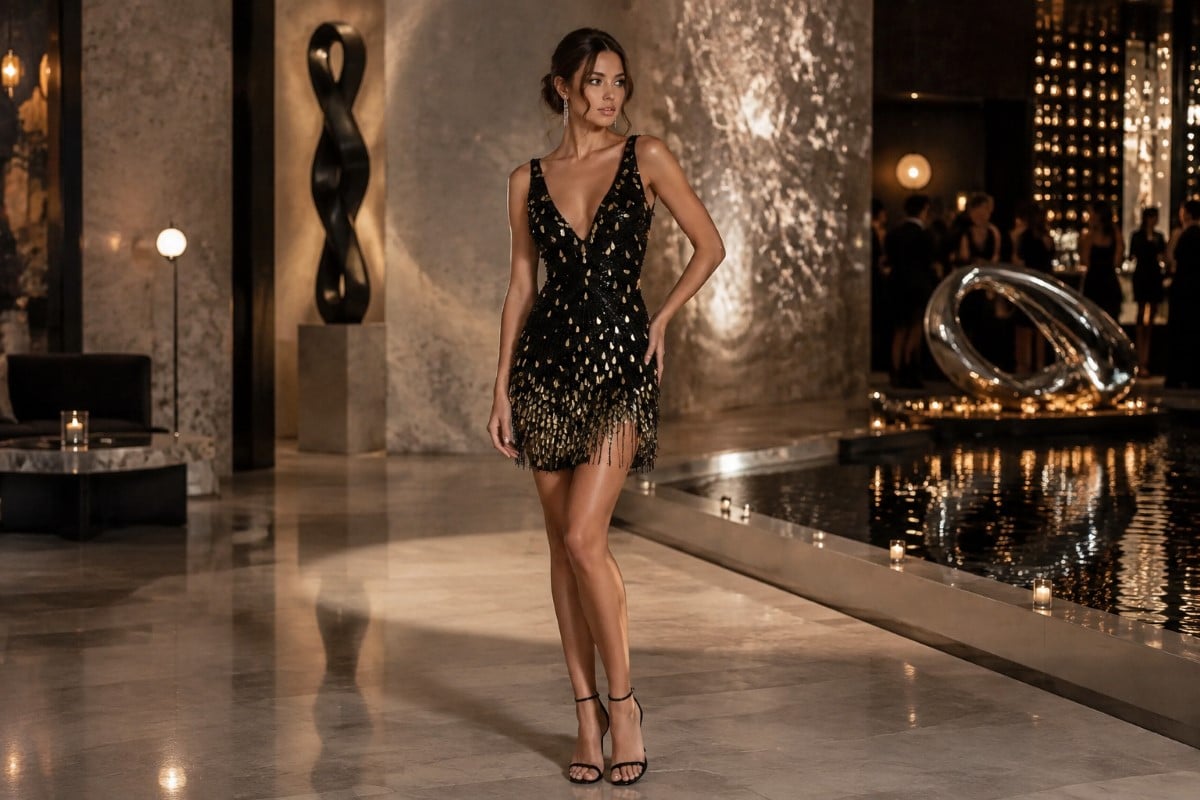
| Deep or plunging V | The point extends low on the torso | Mesh or other stabilization, side coverage, bust support, edge contact, and venue requirements |
| Wrap or surplice V | One bodice section crosses over the other | Overlap depth, gaping, closure security, drape, and whether the layers shift during movement |
| Illusion-inset V | A sheer mesh or lace panel fills part of the opening | Transparency, mesh tension, color match, scratches, puckering, and whether the inset provides the expected stability |
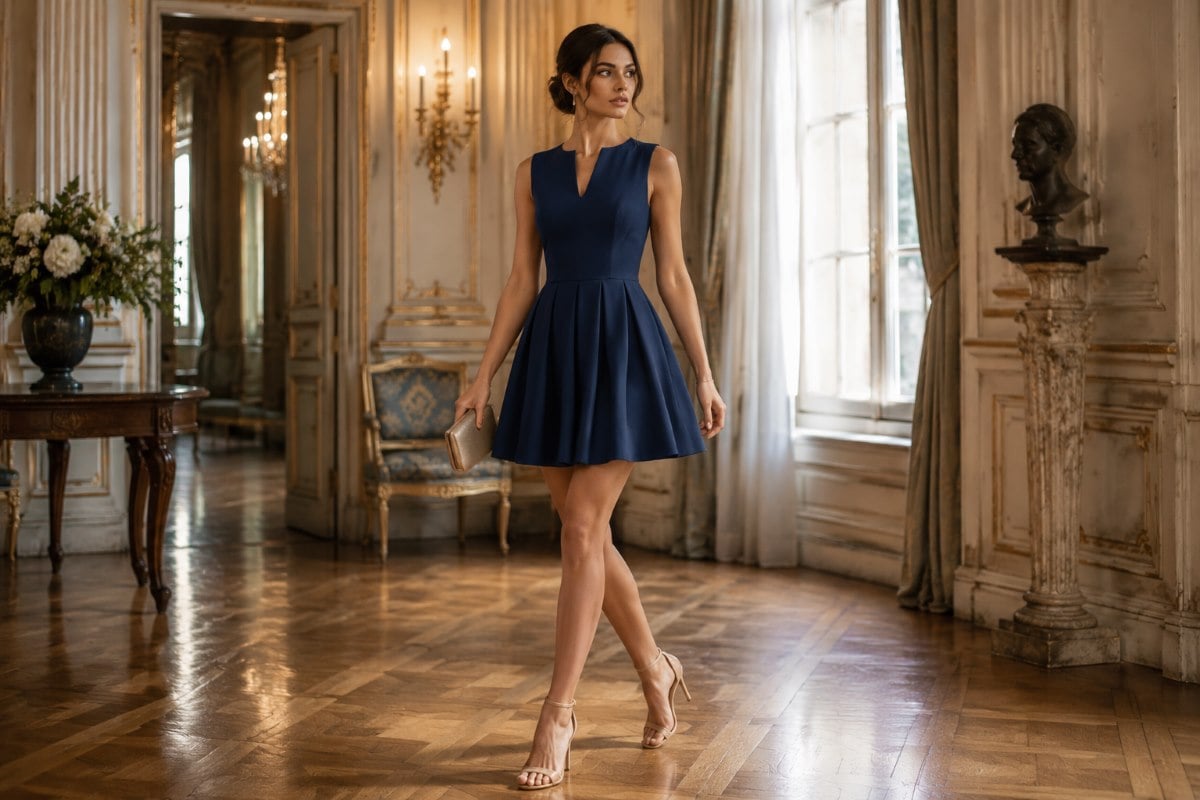
| V-neck with collar, lapel, or drape | The V is created or framed by folded or draped fabric | Symmetry, weight, fold placement, and whether the fabric remains arranged after sitting or dancing |
These categories are descriptive rather than prescriptive. A shallow V is not automatically conservative, and a deep V is not automatically secure or insecure. Sleeve length, dress length, cutouts, sheerness, fit, and styling all affect the finished level of coverage.
Do Not Choose Neckline Depth by a Fixed Body Measurement
Rules such as “a work event should end a few finger widths below the collarbone” or “an evening V should stop at the top of the bust” sound precise but do not account for different torsos, bust positions, garment sizes, pattern shapes, or event standards. A measurement that looks moderate on one person may look shallow or deep on another.
Choose depth by answering four questions:
- Coverage: Are you comfortable with the front and side view while standing, sitting, leaning, and raising your arms?
- Security: Does the neckline remain in place without repeated adjustment?
- Support: Does the complete bodice work with your preferred bra or built-in support?
- Context: Does the whole dress meet the invitation, venue, cultural or religious expectations, and any school or workplace rules?
There is no universally correct depth for a cocktail event. Decide from the wearer, the actual garment, and the actual occasion.
How Should a V-Neckline Fit?
New Mexico State University’s pattern-alteration guide describes a well-fitting garment as neither too large nor too small and free from binding, pulling, sagging, straining, or wrinkling. Apply that standard to the entire bodice.
- Center point: It should sit at the intended center front unless the design is deliberately asymmetric.
- Neckline edges: They should lie as designed rather than rolling outward, collapsing, or creating an unintended gap.
- Shoulders and straps: They should remain in position without digging, sliding, or carrying tension created by a too-tight bodice.
- Bust seams or cups: The bust should sit within the shaped area without compression, overflow, empty space, or a seam cutting across the fullest point incorrectly.
- Side seams: They should remain reasonably vertical and not pull toward the front or back.
- Waist and closure: The waistband, zipper, lacing, hooks, or back edge should stay level and secure.
- Armholes: They should not expose the planned bra, rub the underarm, or distort when the arms move.
Do not size down simply to make a neckline lie closer to the body. Excess tension may distort the V, pull the seams, strain the zipper, reduce cup capacity, and create gaping or wrinkling somewhere else.
Use a Movement and Coverage Test
Wear the planned undergarment and shoes, then perform the actions you expect at the event:
- Stand naturally and check the front, side, and back.
- Sit upright and then sit back in a chair.
- Lean forward as you might while greeting someone or reaching across a table.
- Raise both arms, reach forward, and place your hands at your waist.
- Walk, turn, and make several dance movements.
- Check the neckline again after each action without first readjusting it.
Photograph the dress in daylight, indoor lighting, and with flash. An illusion panel that appears nearly invisible in a fitting-room mirror may be more obvious in photographs, while a sheer section may reveal more than expected under bright light.
What Provides Support in a V-Neck Dress?
The V shape itself provides no guaranteed support. Stability can come from the full construction, including straps, shaped seams, darts, cups, boning, underwire, an inner band or waist stay, lining, fabric stretch and recovery, a back closure, or an illusion insert.
| Feature | Possible role | Limit to remember |
|---|---|---|
| Wide or well-placed straps | Can distribute tension and stabilize the shoulders | Straps cannot correct cups or a torso that is the wrong size or shape |
| Boning or structured seams | Can help the bodice keep its vertical form | Placement may be uncomfortable, and boning does not guarantee bust support |
| Built-in cups | Can provide shape, coverage, or padding | Cup width, depth, height, and position must fit the wearer |
| Inner band or waist stay | Can anchor part of the garment around the torso or waist | It must be secure and comfortable and is not present in every dress |
| Illusion mesh | Can connect the two sides and limit how far they separate | It may be transparent, visible in photos, fragile, or insufficient as the only support |
| Stretch fabric | Can allow movement and close body contact | Very soft stretch fabric may also collapse, grow, or reveal tension lines |
Evaluate these features together. A dress with boning may still need a bra, and a dress with cups may not have the right cup dimensions for you. Conversely, a well-fitted dress with straps and a stable band may work without separate support for a wearer who prefers that option.
Can Any Bust Size Wear a V-Neck?
Yes. There is no bust size that automatically requires or excludes a V-neck. The useful question is whether a specific V-neck dress fits and provides the desired support and coverage.
For a fuller bust, inspect cup depth and width, center-front stability, strap placement, side coverage, the band or waist, and the available support solution. A deep neckline with shallow cups may be difficult even when it includes mesh or boning.
For a smaller bust, check whether the edges lie flat and whether the cup or dart shape creates empty space. A deeper V, ruching, padding, drape, or embellishment may change the appearance, but none is required. Avoid universal claims that one neckline “balances,” “slims,” “adds curves,” or “elongates” every wearer in the same way. Width, depth, fabric, pattern, color contrast, sleeves, straps, posture, and personal perception all affect the visual result.
Choosing a Bra or Other Support
Select support after examining the actual front, sides, straps, and back. Possible options include a standard bra for a high V, a plunge bra, a low-back or convertible solution, adhesive cups, tape, cups added by an alterations professional, the dress’s own construction, or no separate bra when the wearer is comfortable and adequately supported.
No single option works “regardless” of neckline or body. Bring the intended support to the fitting because it can change bust height, cup fill, neckline contact, waist position, and strap placement. Check that no bra edge, center gore, band, or strap becomes visible during movement.
Adhesive products can help manage skin or fabric edges in some situations, but they do not repair a bodice that is too large, too small, or incorrectly shaped. Follow the product manufacturer’s skin-safety and garment instructions, avoid using adhesive on delicate fabric without approval, and test it before the event.
Dress Code: Judge the Whole Dress
A neckline alone does not determine formality or appropriateness. A restrained midi dress, a sequined mini, and a floor-length evening gown may all have a V-neck and serve different occasions.
For weddings, Emily Post advises using the invitation and event time as major formality clues while also considering the religious service, the couple’s culture, and local customs. Its wedding guest attire guide includes cocktail dresses for several formal and semiformal situations, but that does not make every cocktail dress suitable for every wedding.
Review:
- the stated dress code and the host’s specific instructions;
- dress length, fabric, sparkle, cutouts, sheerness, and back exposure;
- whether a ceremony location has coverage requirements;
- the event’s time, venue, and local custom;
- school, club, or workplace policies when relevant;
- whether a removable layer works without disturbing the neckline.
A deep V may suit one evening celebration and conflict with another venue’s expectations. A shallow V can also be too casual when the rest of the dress does not meet a formal dress code.
How Fabric and Embellishment Affect the Neckline
Fabric changes how a V-neck holds its edge and responds to movement:
- Soft draped fabrics: They may create a fluid wrap or cowl effect but can shift or gap if the overlap and bodice fit are insufficient.
- Structured woven fabrics: They can hold a defined edge, although an incorrect fit may produce visible pulling or standing away from the body.
- Stretch fabrics: They can follow the body but require enough recovery and support to avoid growing or collapsing.
- Lace or mesh: They can create transparency, texture, or an illusion boundary; check motif placement and opacity.
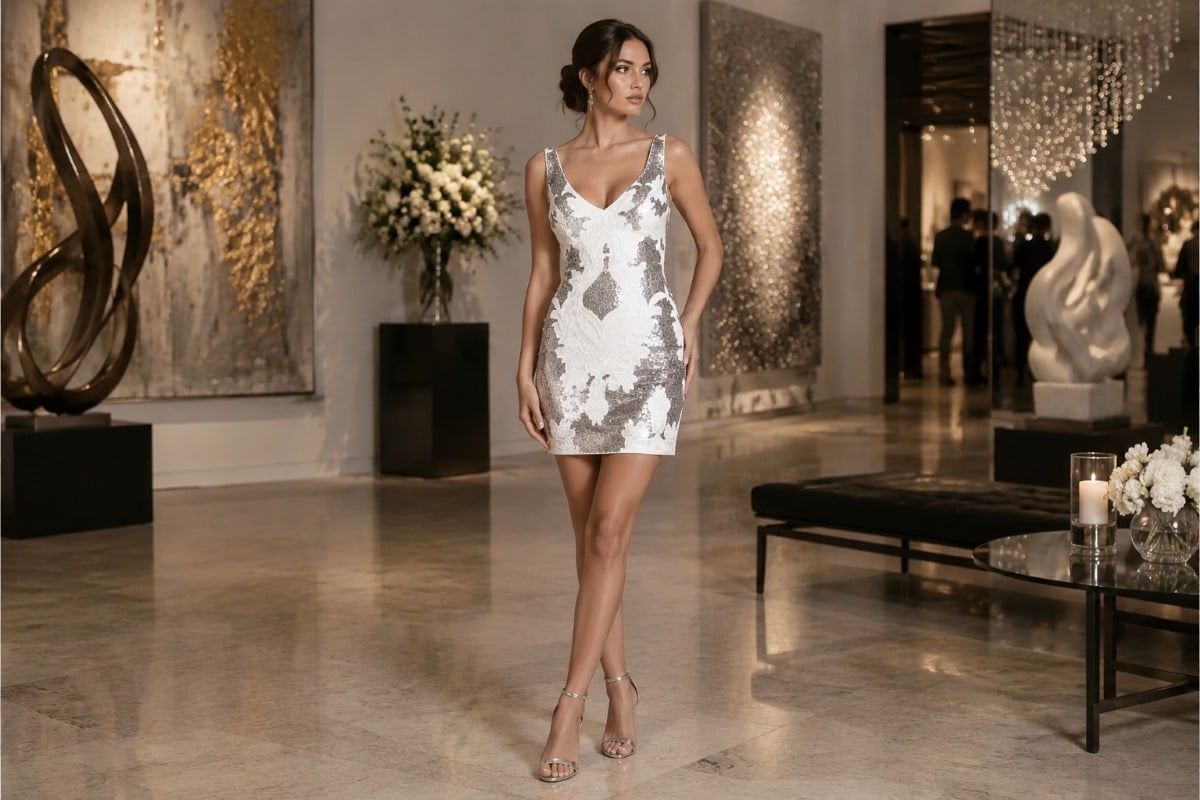
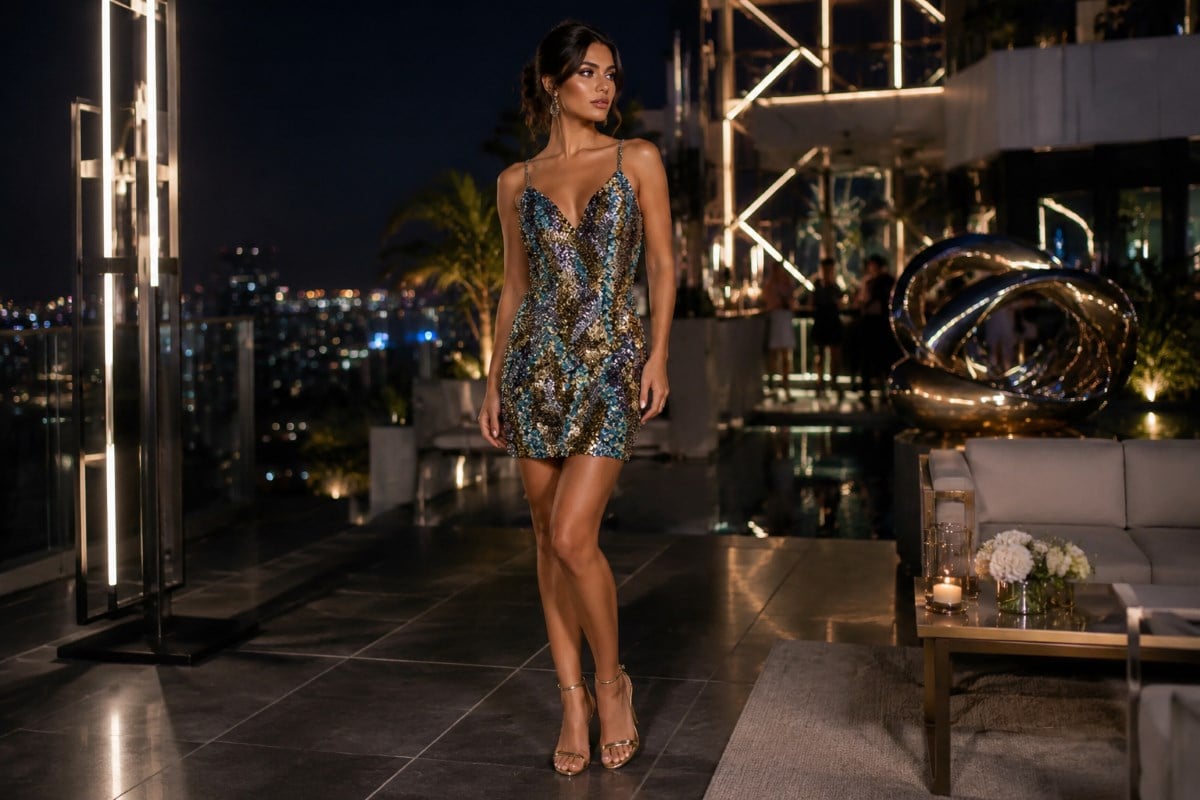
- Beading and sequins: They can add weight and abrasion, potentially pulling the edge outward or scratching the chest and underarm.
- Satin or other reflective surfaces: They can make seams, wrinkles, and tension lines more visible in direct light.
Inspect the neckline after the dress has been hanging and again after several minutes of wear. Heavy decoration and soft fabric can behave differently once gravity and body heat have affected the garment.
Jewelry, Hair, and Layers
There is no rule that every V-neck requires a V-shaped pendant or that a necklace must always sit inside the opening. The goal is to prevent visual crowding and physical snagging.
- No necklace: This can keep attention on an embellished or dramatic neckline while earrings or a bracelet add detail.
- Short chain or collar: It may sit above the neckline and work with a shallow or moderate V.
- Pendant: It can echo the vertical line, but check that it does not cross, catch on, or disappear beneath the fabric.
- Statement necklace: It may work with a simple dress if its lower edge and the V do not compete or tangle.
- Hair: Up, down, or side-swept styles can all work. Check for catching on beading, straps, mesh, or back closures.
- Wrap or jacket: Try it over the dress. Its lapels, closure, or weight may press or pull the neckline out of position.
Take a full-length photograph of the complete outfit. Jewelry that looks well placed in a close mirror may overlap the neckline or sit differently once you move.
Sizing and Alterations
Jovani states that its size guides are specific to each product. Use current bust, waist, and hip measurements, then ask the retailer about the chosen style’s fabric stretch, cups, straps, back, and seam allowance.
A gaping V-neck is not always corrected by pinching only the edge. NMSU’s pattern guide shows a gaping-neckline adjustment that extends from the neckline through the bust to the waist, illustrating that the source can involve the broader bodice pattern. On a finished cocktail dress, the appropriate solution may involve shoulders, straps, bust seams, darts, side seams, cups, or the waist.
Alteration limits can include:
- beading, sequins, lace motifs, piping, or trim along the neckline;
- illusion mesh that must remain smooth and symmetrical;
- cups, boning, underwire, or an inner corset;
- very narrow straps or a halter-style support path;
- a low or open back that limits anchoring options;
- wrap draping or pleats that would be disrupted by taking in the bodice;
- limited seam allowance or fragile fabric.
Ask a qualified alterations professional to inspect the dress before purchasing when you need a major change in depth, cup position, strap placement, or coverage. Adding a modesty panel may be possible, but the fabric match, attachment method, tension, and appearance must be assessed garment by garment.
Care the Complete Dress, Not Just the Neckline
Follow the sewn-in care label. The FTC’s care-label guidance explains that instructions must be supported for the entire garment, including its components. A V-neck cocktail dress may combine lining, mesh, cups, boning, adhesive trim, sequins, beads, satin, lace, or stretch fabric, so generic advice based on the outer material can be unsafe.
Protect the neckline from jewelry, hangers, makeup, self-tanner, perfume, and textured garment bags. Use heat, steam, washing, or dry cleaning only as directed for the specific dress.

V-Neck Cocktail Dress Checklist
- Choose the desired V depth and width from the actual dress, not a label.
- Check front, side, and back coverage in several lighting conditions.
- Confirm center alignment, edge contact, bust fit, straps, armholes, waist, and closure.
- Identify the real support features and test the preferred bra or alternative.
- Sit, lean, reach, raise your arms, walk, turn, and dance without readjusting first.
- Match the whole dress to the invitation, venue, and any cultural, religious, school, or workplace requirements.
- Check fabric recovery, mesh tension, bead weight, scratches, and transparency.
- Ask about alteration limits before buying a dress that gaps or needs a different depth.
- Read the care label and test all accessories against the neckline.
- Compare several neckline constructions within Jovani’s broader cocktail dress collection.
V-Neck Cocktail Dress FAQ
What is a V-neckline?
It is a garment neckline with two sides that form a V shape. The term does not establish a standard depth, width, level of coverage, or support system.
How deep should a V-neck cocktail dress be?
There is no universal measurement. Choose a depth that stays secure during movement, works with your preferred support, provides the coverage you want, and suits the event’s requirements.
Is a V-neck suitable for a large bust?
It can be. Check cup capacity, side coverage, straps, center-front stability, the waist or band, and the complete support system. The neckline label alone cannot predict the fit.
Does a V-neck work for a small bust?
Yes. Look for a bodice whose edges, darts, seams, or cups lie smoothly without empty space or gaping. Padding, ruching, drape, or embellishment is optional rather than required.
What bra works with a V-neck cocktail dress?
The answer depends on the front depth, side coverage, straps, back, cups, and wearer preference. A standard, plunge, convertible, low-back, adhesive, altered-in cup, or no separate bra may work. Test the final option with the dress.
Can fashion tape fix a gaping V-neck?
It may help hold an edge in a limited situation, but it cannot correct an incorrectly sized or shaped bodice. Follow the tape manufacturer’s safety directions and obtain an alteration assessment when the gap comes from fit.
Can a deep V-neck be made more covered?
Sometimes. An alterations professional may be able to add mesh, lace, a modesty panel, or adjust the bodice, but the result depends on seam access, fabric, trim, support, and the original design.
Should a necklace follow the V shape?
It can, but it does not have to. Choose no necklace, a short chain, a pendant, or another style according to the dress and your preference. Make sure the jewelry does not overlap, pull, or catch on the neckline.
The right V-neck cocktail dress is the one that remains smooth and secure, provides the support and coverage you want, and matches the complete event. Compare several depths and constructions at an authorized Jovani retailer, and bring the intended undergarments and accessories to the fitting.