
How to Choose a Blue Homecoming Dress: Shade, Fit and Photo Guide

Choose a blue homecoming dress in this order: confirm the school's written rules, find a secure fit, test movement, compare shades in consistent light, and then choose fabric and accessories. There is no universally best blue for a skin tone, camera, or venue. Light blue, periwinkle, royal, cobalt, teal, and navy can all work; the most reliable choice is the actual dress that fits well and still looks the way you want in daylight, indoor light, flash, and video.
Blue covers a wide visual range, which is why a single search can produce pale satin minis, royal sequin dresses, navy fitted styles, and layered blue-green designs. This guide helps you narrow that range without relying on rigid undertone charts or claims that one shade always photographs better. Use it to make the decision first, then compare the current range of blue homecoming dresses when you are ready to shop.
Start With the School's Rules, Not the Shade
Schools do not apply one universal homecoming standard, and published policies vary more than most shoppers expect. Some schools describe the event as semi-formal, permit several dress lengths, require footwear suitable for dancing, and restrict very short, backless, bare-midriff, or plunging designs. Others go further and prohibit exposed backs, midriffs, cleavage, and see-through fabric while requiring a jacket or shawl with any sleeveless dress. A third group allows strapless and spaghetti-strap dresses but applies detailed rules to hemlines, slits, backs, cutouts, and transparency.
Those patterns are evidence of variation, not templates for every student. They show why advice such as "short is always standard" or "strapless is always allowed" is unreliable. Before buying, find the current policy for your school and event. Check:
- minimum hem and slit length;
- rules for backs, necklines, cutouts, and midriffs;
- whether sheer panels or illusion mesh count as coverage;
- requirements for jackets, shawls, or straps;
- footwear restrictions;
- guest approval and dress-code enforcement procedures;
- any separate requirements for homecoming court participants.
If a design is close to a limit, show photos of the exact dress to the administrator who approves event attire. Product photos can hide how a dress changes when the wearer walks, sits, or raises her arms, so approval should account for movement as well as a standing front view.
Choose Fit Before You Choose the Exact Blue
A beautiful shade cannot compensate for a bodice that shifts, a hem that rides up, or a lining that twists. A properly fitted garment is neither too large nor too small, and it stays free from binding, pulling, sagging, straining, and unwanted wrinkling. Use those signs as a practical standard during the try-on.
Run a Full Movement Test
- Walk normally and take longer steps. Check whether the skirt restricts your stride, twists, or climbs.
- Sit in a low chair. Recheck the hem, neckline, side seams, back, cutouts, and lining.
- Raise both arms and reach forward. Watch for bodice lift, gaping, strap pressure, or exposed undergarments.
- Turn, bend, and climb a few steps. Confirm that the dress remains secure without constant adjustment.
- Dance for several minutes. Test the zipper, cups, boning, straps, sleeves, and any heavy embellishment under repeated movement.
- Record a short video. A moving view can reveal fit changes that a mirror pose does not show.
Do not buy a smaller size merely to make a strapless or low-backed dress feel secure. Support should come from the correct size and the garment's complete construction. When the bodice is too small, pressure, seam strain, restricted breathing, and unwanted movement can increase rather than improve.

Compare Blue Families Without Treating Them as Rules
Retail color names are not standardized. One brand's "ice blue" may resemble another brand's silver-blue, and a shade labeled royal may lean purple, green, bright, or dark. Compare the actual garment rather than relying on the product name alone.
| Shade family | Typical visual direction | What to inspect | Optional styling directions |
|---|---|---|---|
| Ice, powder, baby, or light blue | Pale and lower-contrast | Lining, transparency, makeup transfer, pale backgrounds, and whether the color shifts gray or green under indoor light | Silver, pearl, gold, clear stones, tonal accessories, or a deliberate contrasting accent |
| Aqua, turquoise, or teal-leaning blue | Blue-green and often more chromatic | How green the dress appears beside skin, school decor, flowers, and colored lighting | Gold, silver, pearl, neutral, blue-green, or a contrasting warm accent |
| Periwinkle or cornflower | Blue with violet or softened mid-blue notes | Whether the dress reads blue or lavender in person and in photographs | Either warm or cool metals, tonal blues, lilac, pearl, or neutral accessories |
| Royal, cobalt, or electric blue | Saturated and visually prominent | Color under flash, reflective surfaces, dye consistency, and whether the intensity suits your preference | Silver, gold, rhinestone, black, nude, tonal blue, or a restrained contrasting accent |
| Navy, midnight, or ink blue | Dark and lower in visible brightness | Whether it remains visibly blue in dim light, how lint shows, and whether details disappear against dark backgrounds | Gold, silver, pearl, black, nude, jewel tones, or high-contrast accessories |
Light Blue
Light blue can look crisp, delicate, cool, gray-blue, or almost silver depending on the dye, surface, lining, and lighting. Pale colors may reveal shadows from cups, seams, pockets, or undergarments more readily, so inspect the dress from front, side, and back in strong light. A light-blue satin dress and a layered light-blue tulle dress can look very different even when their product swatches appear similar.
Do not assume light blue automatically washes out fair skin or flatters only one complexion. Hold several nearby shades close to your face under the same lighting and compare unfiltered photos, and look at more than one dress inside a group of light blue homecoming dresses before ruling the family out. A slight change in value or saturation may matter more than the shade name.

Periwinkle, Cornflower, Aqua, and Teal
These labels cover a broad middle range. Periwinkle often contains a visible violet influence, while aqua and teal move toward green, but retailers may use the names differently. If the event has a strong blue, purple, or green decor palette, compare the dress beside those colors rather than assuming the label guarantees a match.
This middle range can be useful when you want color that is neither very pale nor very dark. The best accessory metal is not fixed. Look first at any visible zipper, crystals, beads, embroidery thread, or hardware, then decide whether you want the accessories to blend, repeat a finish, or create contrast.
Royal and Cobalt
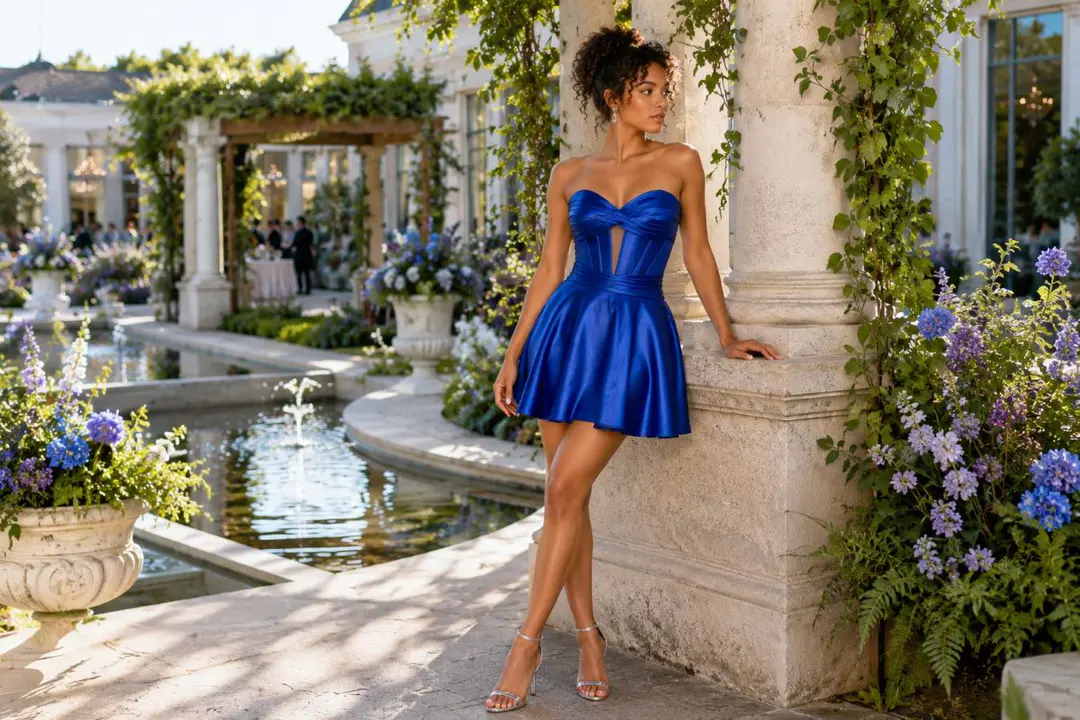
Royal and cobalt dresses are usually more saturated than powder or navy styles, but saturation alone does not guarantee that a dress will remain vivid in every photograph. Colored DJ lights can shift blue toward purple, green, or cyan, while direct flash can create bright highlights on satin, sequins, or crystals. Test the complete dress rather than assuming that "bold blue always photographs best."
If you prefer this color family, compare current royal blue homecoming dresses by construction as well as color. A fitted jersey dress, a sequin mini, and a structured satin style will differ in movement, support, reflection, and alteration options.

Navy and Midnight Blue
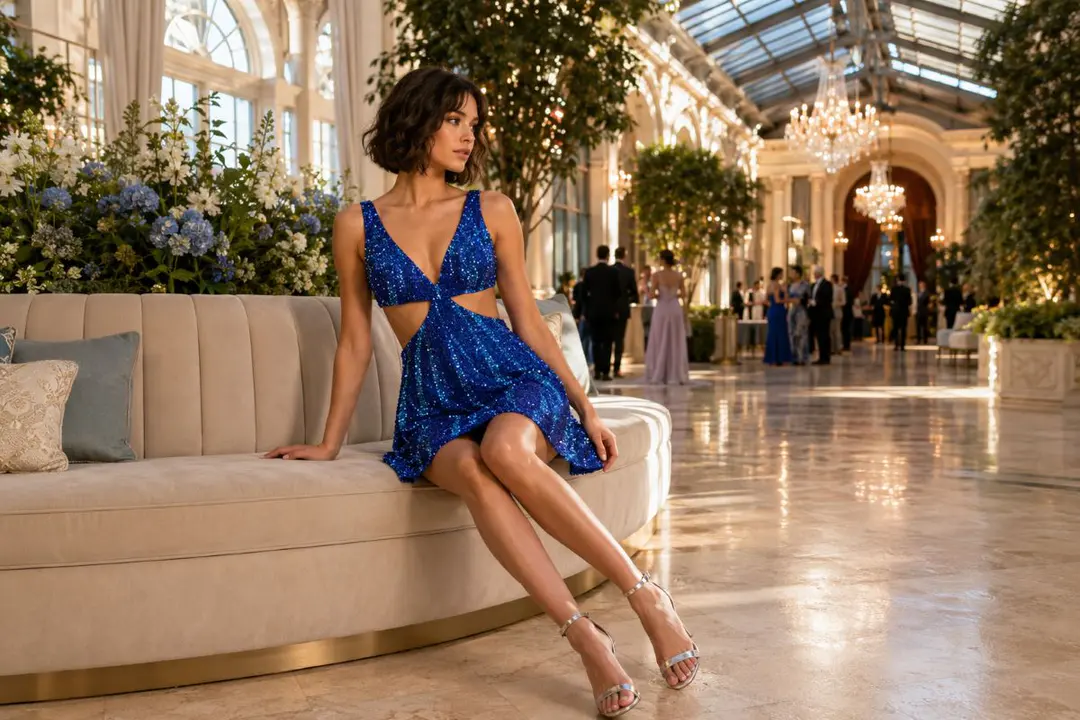
Navy can provide visible color in daylight while approaching black in darker exposures. That is not a flaw if you want a subtle result, but it should be intentional. Photograph the dress without flash and with flash against both light and dark backgrounds. Check whether the neckline, waist, ruching, pleats, or bead pattern remains visible.
Reflective texture may make parts of a dark dress easier to see, but more reflection is not automatically better. Sequins, beads, and satin highlights can also create glare or become the most prominent feature in a photo. When you compare navy blue homecoming dresses, choose the result you prefer rather than treating shine as a technical requirement.
Do Not Let an Undertone Chart Make the Decision
Warm/cool charts and vein-color tests can provide ideas, but they should not eliminate a shade before you try it. Skin appearance changes with daylight, fluorescent or LED lighting, makeup, hair color, camera processing, and surrounding colors. Personal preference also matters: some shoppers want close harmony, while others prefer strong contrast.
Use a controlled comparison:
- Try two to four blue families while wearing similar makeup and undergarments.
- Stand in indirect daylight, then move to the kind of indoor light expected at the dance.
- Take unfiltered front and side photos from the same distance.
- Compare the dress with and without the planned jewelry or wrap.
- Ask which dress keeps your attention on the complete person and outfit, not which chart says you qualify for the shade.
A guide to dress colors for your skin tone can be used as a try-on prompt, but the garment test should make the final decision.
Fabric Changes the Appearance and Performance of Blue
Color is only one part of the surface. Fiber, weave or knit structure, weight, finish, lining, embellishment, and cut all affect what you see and feel. Two dresses both labeled "blue satin" can still have different shine, thickness, stretch, drape, and snag resistance.
| Fabric or finish | Possible visual effect | Fit and quality checks |
|---|---|---|
| Satin | A continuous sheen that changes with folds, angle, and light | Seam puckering, pressure marks, lining, flash highlights, surface snags, stretch, and care instructions |
| Sequins, beads, or crystals | Point-by-point reflection and visible texture | Weight, abrasion under the arms, missing pieces, sharp edges, mesh recovery, loose threads, and alteration limits |
| Velvet | Depth created by a dense pile and changing nap direction | Crush marks, lint, pressure from sitting, nap consistency, temperature, and cleaning requirements |
| Tulle or chiffon layers | Transparency, softness, or color built through multiple layers | Actual lining coverage, number of layers, snags, hem edges, static, volume, and whether the top layer shifts |
| Jersey, crepe, or another matte surface | More even or restrained reflection, depending on the exact construction | Stretch and recovery, seam strain, cling, lining, wrinkles, and whether the fabric becomes sheer when stretched |
A satin weave uses long floats that reflect light and can also snag. Velvet is built from a dense cut pile. Chiffon is a sheer, lightweight plain weave, and tulle is a fine netting. Those descriptions cover structure, not the finished dress. Lining, layers, embellishment, and construction still determine opacity, weight, support, and comfort, which is why two sequin homecoming styles can differ in weight, scratchiness, and how far they can be altered.
Test the Blue in the Lighting That Matters
A phone screen, retailer image, and fitting-room mirror cannot guarantee the color seen at the event. An object's perceived color changes when the light source changes, even though the dye itself has not changed, and the color rendering of artificial lighting varies widely from one venue to another. Camera white balance, exposure, flash, screen settings, and later edits introduce additional variation.
Run this photo test before removing tags or approving alterations:
- Take a daylight photo near a window without a beauty filter.
- Take a photo under warm indoor light and another under cooler overhead light.
- Use direct flash from a normal social-photo distance.
- Record low-light video while walking and turning.
- Review the dress against a pale wall, a dark background, and skin.
- Zoom in for lining edges, cup outlines, wrinkles, loose beads, and transparent areas.
- Check whether navy remains visibly blue and whether pale blue shifts gray, green, or white.
The goal is not to make the dress look identical in every image. It is to understand the range of appearances before the event.
Match Length and Silhouette to Movement
Mini, above-knee, knee-length, midi, and long styles can all appear in the market, and short homecoming dresses are only one part of that range. The written school policy determines what is admissible. Then the actual garment determines whether it is practical.

Fitted and Bodycon Styles
Check whether the skirt rides upward as you walk or dance and whether the lining moves with the outer layer. Sit before judging the hem. Inspect seam strain at the hips, seat, zipper, and any cutout edge. Stretch alone does not guarantee recovery or support.
A-Line, Skater, and Full-Skirted Styles
These shapes may provide more room through the skirt, but fullness can lift the hem during turns or reveal a shorter lining underneath. Check the solid layer against the school's rule, not just the longest sheer layer. Make sure stiff tulle, horsehair braid, or a wide skirt does not catch on chairs or other dancers.
Long or High-Low Styles
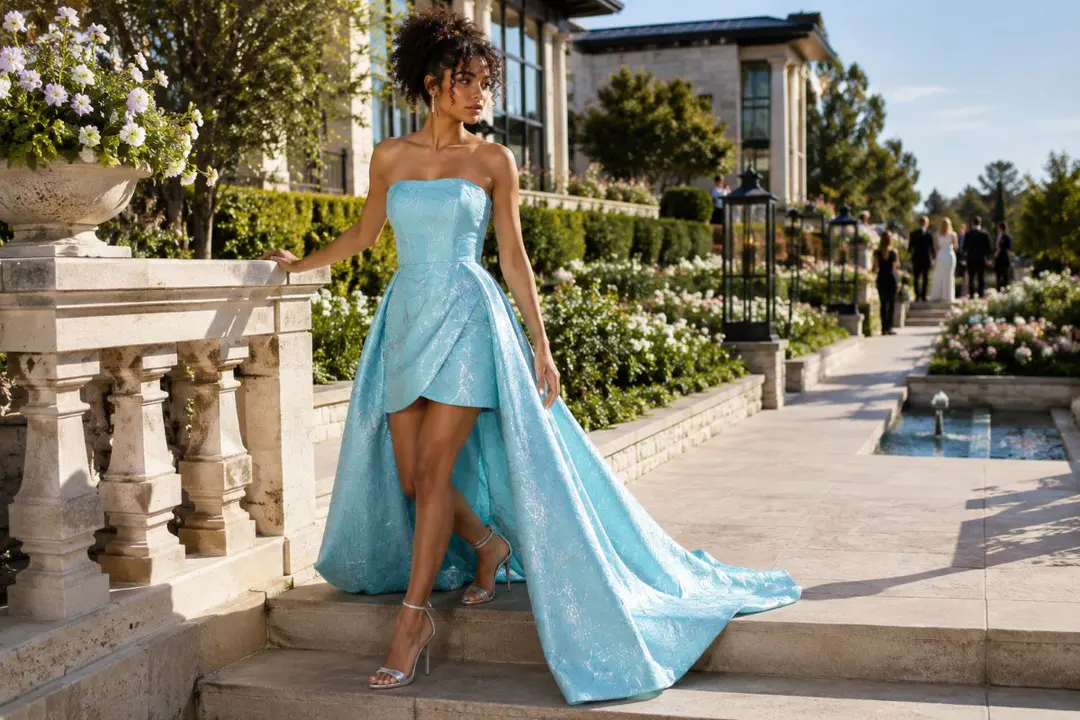
Test stairs, curbs, vehicle entry, and the dance floor. Put on the final shoes before approving the hem. Changing from a heel to a lower shoe can bring a long hem closer to the floor and create a tripping risk. For a detailed comparison, see the guide to picking a long or short hemline.
Choose Shoes and Accessories for the Dress You Bought
There is no required jewelry metal or shoe color for blue. Silver, gold, pearl, black, nude, clear, tonal blue, and contrasting colors can all work when they support the intended look. Use the following checks instead of a fixed formula:
- Repeat or intentionally contrast visible hardware, beading, or embroidery.
- Keep rough prongs, clasps, and chains away from tulle, chiffon, satin, and mesh.
- Make sure bracelets do not scratch the wearer or catch the dress during dancing.
- Test the bag against sequins and beadwork; two textured surfaces can snag each other.
- Choose shoes for the school's rules, the floor, walking distance, stability, and the hem.
- Break in footwear and test it for the length of time you expect to stand and dance.
White sneakers, flats, platforms, and heels may be accepted at some schools and prohibited or impractical at others. Comfort claims should never override the written event policy or the safety of the hem.
Plan Alterations and Care Around the Exact Garment
Use current body measurements and the size guide for the exact style. Do not rely on your everyday clothing size or assume that all dresses from one brand fit identically. When a dress needs substantial work, ask a formalwear alterations professional to inspect it before purchase.
Alteration complexity can increase when a dress includes:
- allover sequins, beads, crystals, embroidery, or appliques;
- boning, molded cups, corsetry, or a lace-up back;
- sheer panels or cutouts that cross a seam;
- multiple skirt and lining layers;
- scalloped, beaded, high-low, or horsehair-finished hems;
- prints, gradients, border designs, or directional motifs;
- fabric that retains visible needle or pressing marks.
Do not apply a universal steaming, washing, ironing, or storage instruction based only on the word satin, tulle, velvet, or chiffon. Care instructions are written for the entire garment, including non-detachable linings, trim, buttons, zippers, and other details, so one component can change the whole method. Follow the label on the finished dress and ask the retailer or manufacturer when an instruction is unclear.
Blue Homecoming Dress Shopping Checklist
- Read the current school and event dress code.
- Get administrator approval when the design is close to a stated limit.
- Use current measurements and the exact style's size guide.
- Walk, sit, reach, turn, climb steps, bend, and dance in the dress.
- Check the neckline, back, cutouts, slit, hem, and lining during movement.
- Compare several blue families in consistent daylight and indoor light.
- Take unfiltered flash photos and a low-light video.
- Inspect seams, zipper, cups, boning, straps, lining, and embellishment.
- Try the planned undergarments, shoes, jewelry, wrap, and bag.
- Get a garment-specific alteration estimate when major changes are needed.
- Read the care label before planning travel, wrinkle removal, or cleaning.
Blue Homecoming Dress FAQ
What is the best shade of blue for a homecoming dress?
There is no universal best shade. Compare light, blue-green, violet-blue, saturated, and dark-blue options under the same lighting. Choose the dress that fits securely, meets the school's rules, and produces the color and contrast you prefer in person and in photos.
Does light blue wash out fair skin?
Not automatically. The exact value and saturation, fabric surface, lighting, hair, makeup, and personal preference all affect the result. Compare nearby light blues and take unfiltered photos rather than rejecting the entire color family.
Will navy look black in homecoming photos?
It can appear very dark when exposure is low or the background is dark. Test the actual dress without flash and with flash. Decide whether the subtle result suits you; reflective trim is optional, not required.
What jewelry goes with a royal blue homecoming dress?
Silver, gold, rhinestone, pearl, black, tonal blue, and colored pieces can all work. Use the dress's visible hardware and embellishment as a reference, then choose whether you want harmony or contrast. Check every clasp and setting for snag risk.
What shoes go with a blue homecoming dress?
Choose based on the dress, school policy, floor, walking distance, stability, and hem. Metallic, neutral, black, white, clear, blue, or contrasting shoes are all possible. Put on the final pair before approving a long or high-low hem.
Can I wear blue if it is not a school color?
Usually, school colors for spirit activities do not create a general ban on other dress colors, but event and homecoming-court policies vary. Check the current written rules and ask the organizer when a special role has a coordinated palette.
Are short blue dresses appropriate for homecoming?
They may be, but the school's current rule controls. Some policies set a fingertip or other minimum length and also regulate slits and solid linings. Evaluate the hem while walking and sitting, not only while standing.
When should a blue homecoming dress be altered?
Arrange the assessment after you know the exact dress, intended undergarments, and final shoe height. Timing depends on the event date, tailor availability, design complexity, and number of fittings, so confirm a garment-specific schedule rather than relying on a fixed universal deadline.
A successful blue homecoming dress is not the shade that wins a generic color chart. It is the dress that follows the rules, stays secure in motion, feels comfortable for the complete event, and gives you a color result you understand before the dance. Compare shortlisted styles online, then use an authorized Jovani retailer to inspect the actual fit, construction, and color in person.