
Blog
Wedding Guest Dress Codes Explained

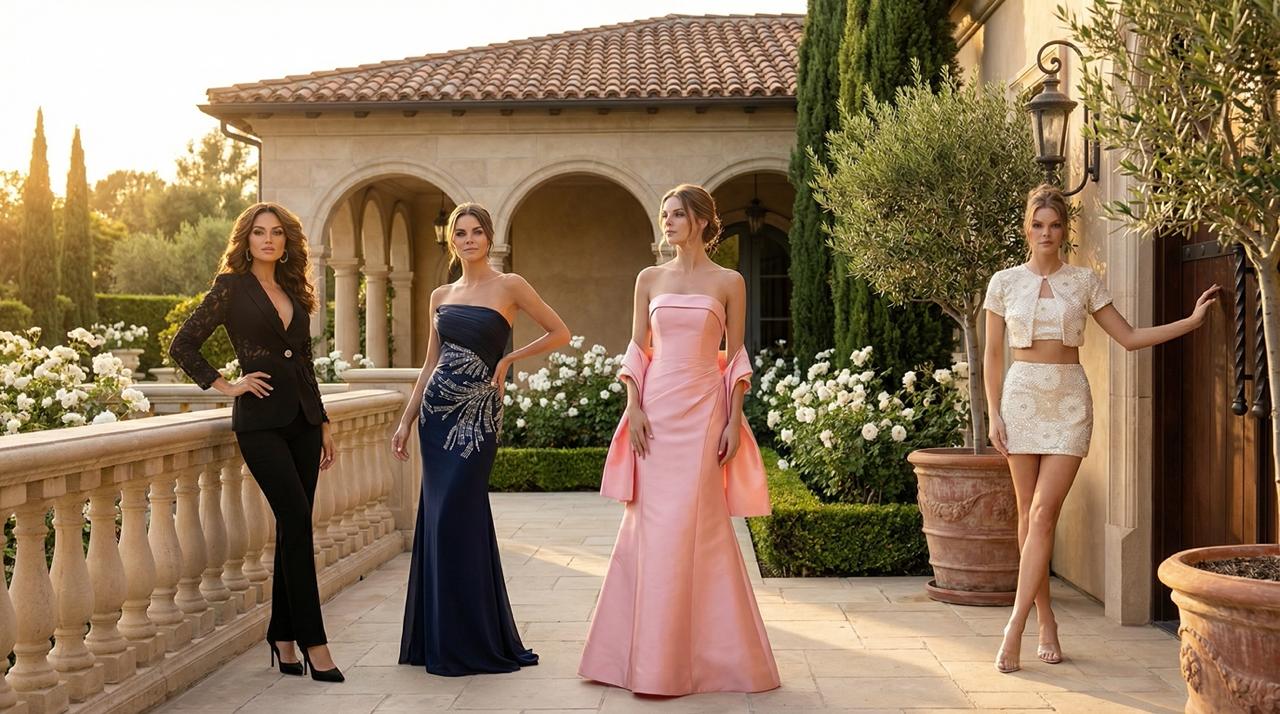
Consider three women in the same friend group, all with weddings on the same weekend in October.
The first received an invitation to an outdoor vineyard wedding. The dress code at the bottom of the card said “Garden Elegant.” She googled it. The first result said garden party attire means floral midi dress. The second said it means cocktail with sensible shoes. The third said it is essentially semi-formal but outdoors. She checked the couple’s wedding website. It said “we cannot wait to celebrate surrounded by the people we love most in one of our favorite places.” She closed her laptop and opened her phone. She texted the second woman.
The second woman had a different problem. Her invitation said “cocktail attire” but the venue was a grand hotel ballroom in the city that regularly hosts black tie galas. She had been to cocktail weddings before and worn a knee-length dress and been perfectly comfortable. Something about the venue felt different. She was not sure whether the dress code on the invitation or the formality of the venue was the more reliable guide. She texted the third woman.
The third woman had no dress code at all. Nothing on the invitation. Nothing on the wedding website. The wedding was at a private estate in Connecticut. She had no idea whether that meant the couple expected guests to show up in floor-length gowns because the venue was grand enough to warrant it, or whether the absence of a dress code meant they genuinely did not care and she could wear the wrap dress she already owned. She texted both women back. None of them had answers. All three of them ended up on different corners of the internet at eleven o’clock on a Tuesday night searching things like “what does garden elegant mean for a wedding” and “does venue formality override dress code” and “is a midi dress cocktail attire.”
This is not an unusual Saturday. This is wedding season in 2026.
The confusion around wedding dress codes has two distinct sources and understanding both makes the whole problem easier to solve. The first source is couples inventing their own dress codes. Garden elegant. Festive chic. Resort formal. Rustic glam. These terms feel descriptive but have no agreed-upon definition and mean something different to every guest who reads them. The second source is that even the standard codes, cocktail, semi-formal, formal, black tie optional, genuinely mean different things to different people even after years of attending weddings.
What follows is the guide all three of those women needed before they opened their laptops. Every code explained in plain language, with what it actually requires in practice, where the genuine flexibility exists, and where the lines are that are worth respecting.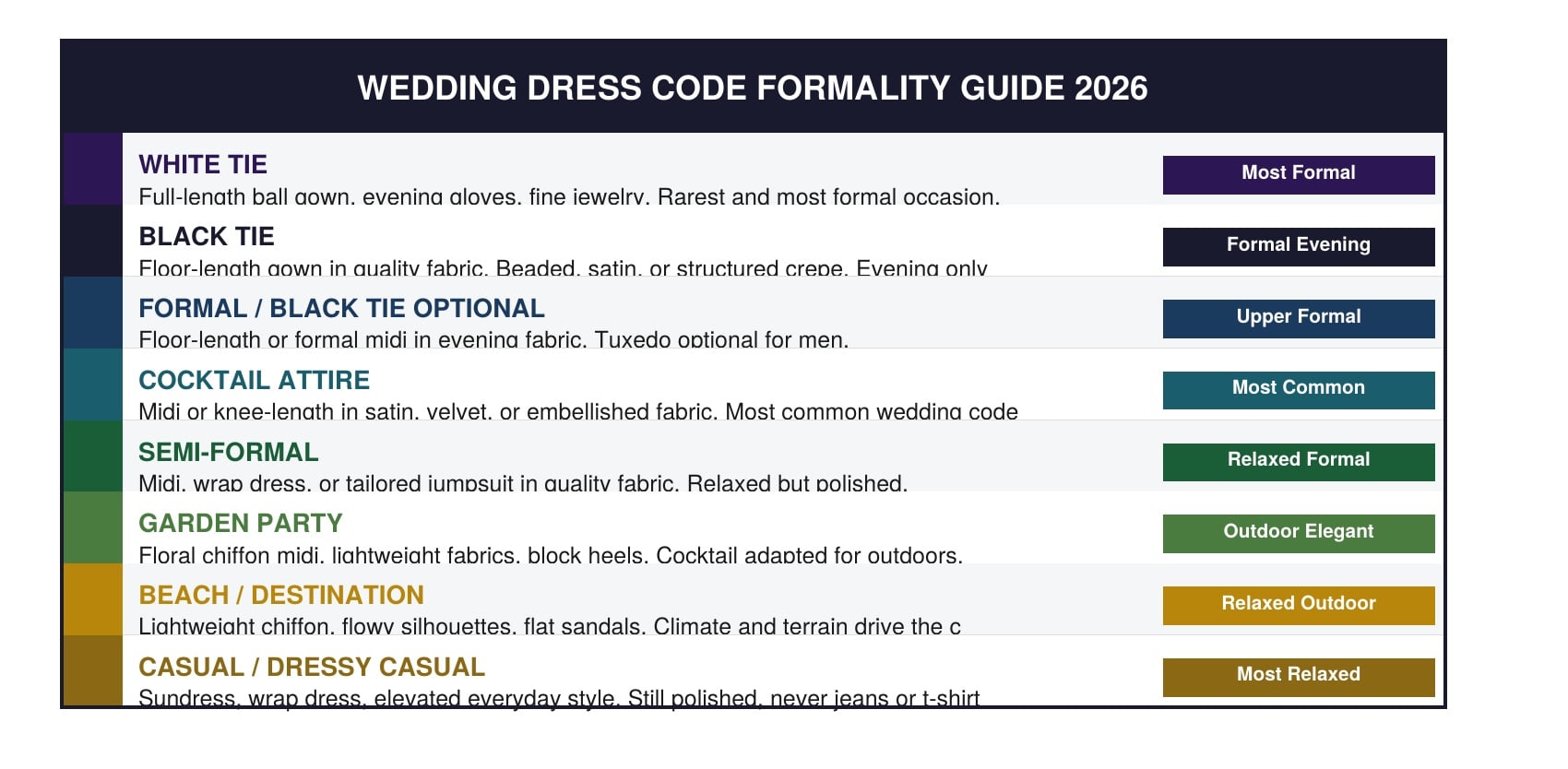
Black Tie and White Tie – The Most Formal Codes
White tie is the most formal dress code that exists in civilian life and the one most women will encounter only once or twice, if ever. It appears on invitations to state dinners, embassy events, charity galas of the highest order, and the most formal of formal weddings. For women, white tie means a full-length ball gown with volume and presence, fine jewelry, an upswept hairstyle, and evening gloves. This is not the occasion for the nice cocktail dress you love. It is not even the occasion for the floor-length gown you wore to your friend’s black tie wedding. White tie calls for a level of dressing that most women only encounter in photographs or films, and that level is entirely intentional. If you receive a white tie invitation and are uncertain, think of the most formal thing you have ever worn and go one level above it.
Black tie is the code most women will encounter at formal weddings and the one that generates the most anxiety, questions, and late-night googling. A floor-length gown in a quality fabric is the standard choice and the safest one. The silhouette, color, and personal style within that formality are entirely your own. For the full breakdown of black tie and all of its variations, including black tie optional, black tie preferred, and black tie invited, the complete guide is in our Blog 1: What to Wear to a Black Tie Wedding. The single most important thing to understand about black tie at a glance is this: the dress code is set by the couple, not the venue, not the other guests, and not how you personally define formal. When an invitation says black tie, that is the standard to meet.
Cocktail and Semi-Formal – The Most Common and Most Misunderstood
Cocktail and semi-formal are the two dress codes that generate the most questions for the simplest reason: they cover the same general territory, they are often used interchangeably, and the line between them is genuinely blurry. Most of the confusion dissolves once you understand that the difference is not really about length or color. It is about time of day and the overall formality of the celebration.
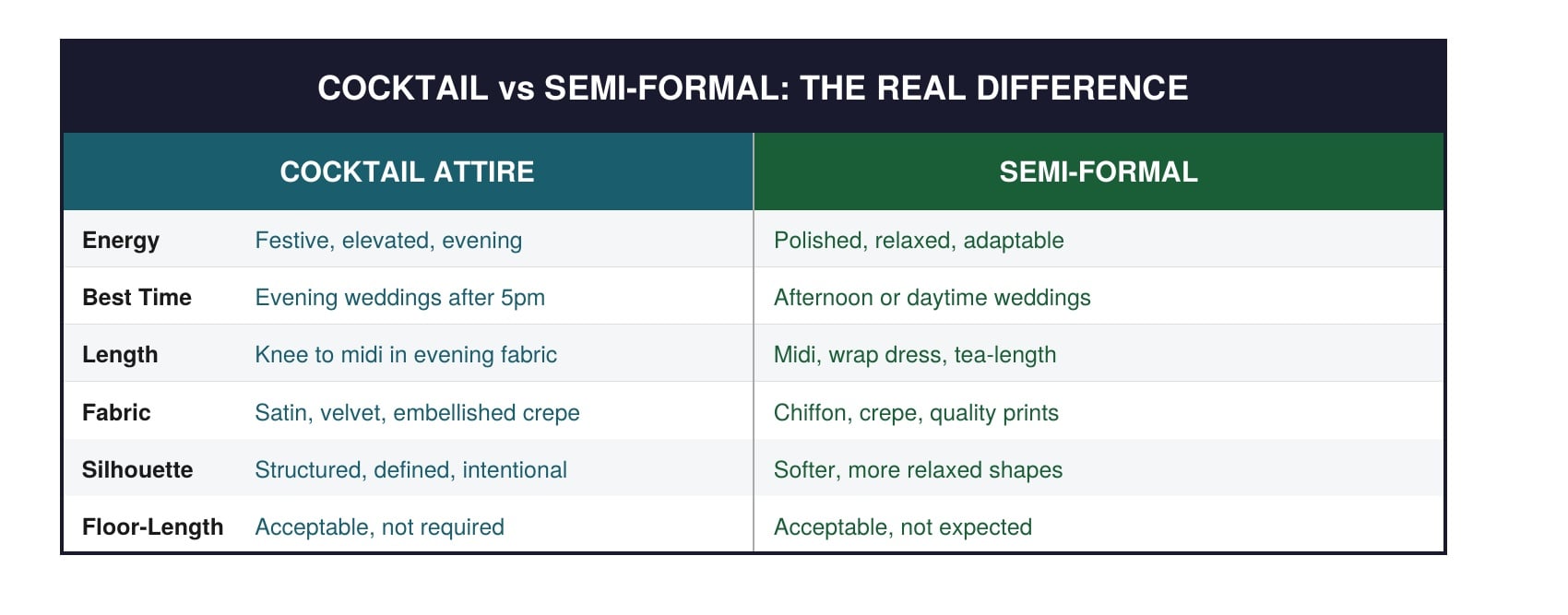
Cocktail attire signals a dressed-up occasion, typically an evening event, where the expectation is that guests look polished and intentional. For women, cocktail attire means a dress or jumpsuit that reads as occasion-appropriate rather than everyday. Knee-length, midi, and floor-length styles are all technically within range, but the fabric and silhouette matter as much as the length. A knee-length dress in structured satin or embellished crepe reads as cocktail appropriate. The same length in a casual jersey or a printed sundress fabric does not. The test is not the measurement from the floor. The test is whether the dress communicates that you understood this was a special occasion.
Semi-formal occupies almost the same territory but with slightly more flexibility and a slightly more relaxed energy. Where cocktail attire leans toward the higher end of occasion dressing, semi-formal allows for a bit more practicality. A flowier midi, a wrap dress in a quality print, a tailored jumpsuit in a neutral tone. Semi-formal is also the more natural code for daytime and afternoon weddings where the full formality of an evening cocktail standard would feel overdressed for the setting.
Garden Party and Outdoor Wedding Attire
Garden party attire is the dress code that has generated more confusion in recent years than almost any other, for one simple reason. Couples love the phrase but nobody has agreed on what it means. Garden party. Garden elegant. Garden chic. Garden formal. The most useful way to think about garden party attire is as cocktail attire adapted for the outdoors. The level of dressing is similar, but the setting changes several practical decisions that a hotel ballroom wedding would not require you to think about at all.
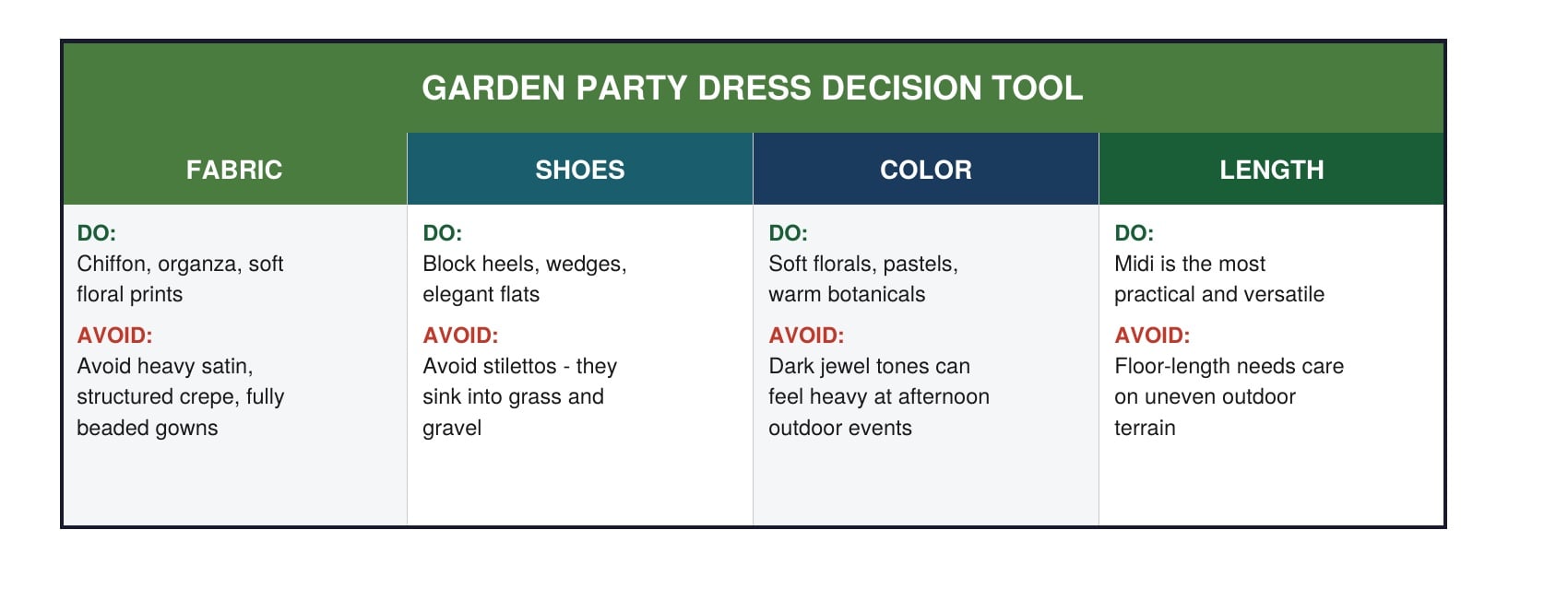
The most practical fabric choices for garden party occasions are lightweight chiffon, organza, and soft printed styles in floral or botanical patterns. These move naturally in outdoor settings, stay comfortable as the temperature shifts from afternoon to evening, and create exactly the kind of effortless, occasion-appropriate look that garden party dress codes are asking for. Jovani’s floral and flowy styles in lightweight chiffon and thin printed fabrics sit at exactly the intersection of dressed-up and setting-appropriate that garden elegant dress codes are looking for. A chiffon floral midi with a defined waist and soft movement reads as intentional and polished from across a garden without the heaviness of a formal ballroom gown.
Shoes matter more at garden party weddings than at any other dress code occasion. Stiletto heels on grass are a commitment to an uncomfortable afternoon. Block heels, wedges, and elegant flats work beautifully. If you are committed to a heel, choose a block heel with enough surface area that it does not sink into soft ground.
Beach and Destination Wedding Dress Codes
Beach and destination weddings operate under a different set of rules from every other wedding dress code because the environment itself becomes part of the decision. The question is not just what level of formality is appropriate. The question is what physically works in this setting, in this climate, on this terrain, across potentially multiple events over a full weekend.
On the Beach Itself
Stiletto heels and sand are genuinely incompatible. A stiletto heel sinks into sand with every step. Block heels with a wide base, elegant flat sandals, and wedges all work on sand. Lightweight breathable fabrics, chiffon, soft crepe, thin printed cotton blends, work with the breeze and the heat rather than against them. A heavily structured gown that holds its shape beautifully in an air-conditioned ballroom becomes uncomfortable and visually heavy at a daytime beach ceremony. Vibrant tropical prints, warm coral, aqua, bright florals, and bold saturated colors all work at tropical beach weddings where the natural light rewards color.
The Multi-Event Weekend
A destination wedding weekend typically involves three or four separate events across Friday through Sunday. A welcome dinner, the ceremony and reception, often a farewell brunch. Each has its own formality level and each requires a separate outfit. The guest is packing all of them in luggage she would prefer to keep to carry-on size. The most practical approach is choosing fabrics that travel well and silhouettes that serve multiple occasions with accessory changes. Chiffon and lightweight crepe fold without heavy creasing and recover their drape after hanging overnight. Jovani’s lightweight chiffon and flowy styles are well suited to destination wedding packing because the fabrics travel without requiring a garment bag and the silhouettes are versatile enough to carry across multiple events.
European vs Tropical Destinations
A wedding in Tuscany, the South of France, or a Greek island tends toward more elevated European dressing standards where guests dress formally even at outdoor venues. Treat the dress code on the invitation as your primary guide and dress toward the formal end of whatever it specifies. Tropical destination weddings in Mexico, the Caribbean, and Hawaii genuinely reward lighter, more relaxed dressing even at formally-coded events because the climate makes heavy formal construction physically uncomfortable. A floor-length gown in a lightweight chiffon or thin crepe is appropriate and practical. The same silhouette in a heavily structured or heat-absorbing fabric is genuinely difficult to wear through a two-hour outdoor ceremony in August humidity.
Festive, Creative, and Themed Dress Codes – The New Reality
The most significant shift in wedding dress codes over the last five years is not a change in what the standard codes mean. It is the proliferation of invented codes that couples create to reflect their personal aesthetic. Festive attire. Garden chic. Resort formal. Rustic glam. Coastal casual. Old Hollywood glamour. These phrases feel evocative and specific to the couple who invented them and genuinely unclear to most of the guests who receive them.
The good news is that invented dress codes are actually easier to decode than they appear, because every invented dress code is built from the same three components.
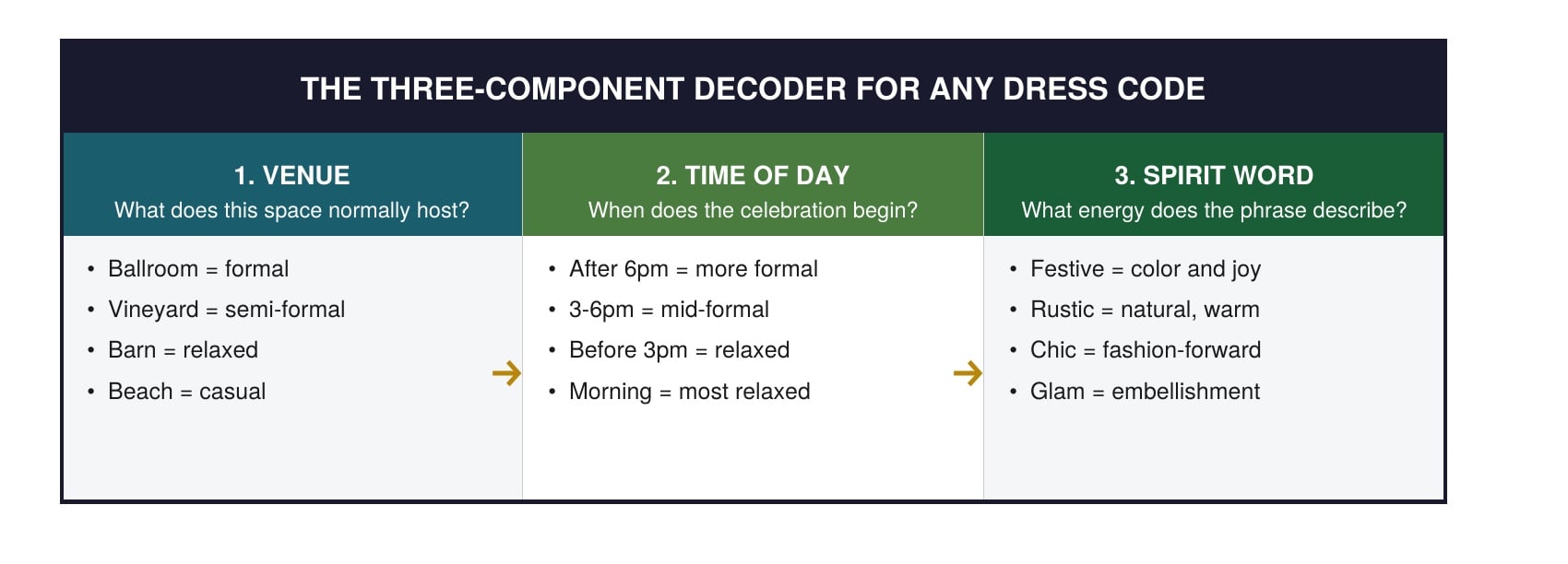
When you apply all three components together, most invented dress codes resolve themselves. “Rustic glam” at a barn venue at six in the evening means the setting is relaxed and natural, the time is evening, and the energy is embellished and celebratory. That translates to a sequined or embellished midi or a flowy gown with some sparkle. “Resort formal” at a beachfront hotel at sunset means the setting is warm weather, the time is evening, and the formality is real but not grand ballroom formal. That translates to a floor-length chiffon gown or a structured formal midi in a lightweight fabric.
When There Is No Dress Code on the Invitation
The absence of a dress code on a wedding invitation is not an instruction to wear whatever you want. It is an absence of information, which is a different problem entirely. No dress code listed almost never means the couple has no preference. It usually means they assumed guests would know from other signals, they did not want to make guests feel financially pressured, or they simply did not know they were supposed to include a dress code. In all three cases, the signals they did not put into words are still there.
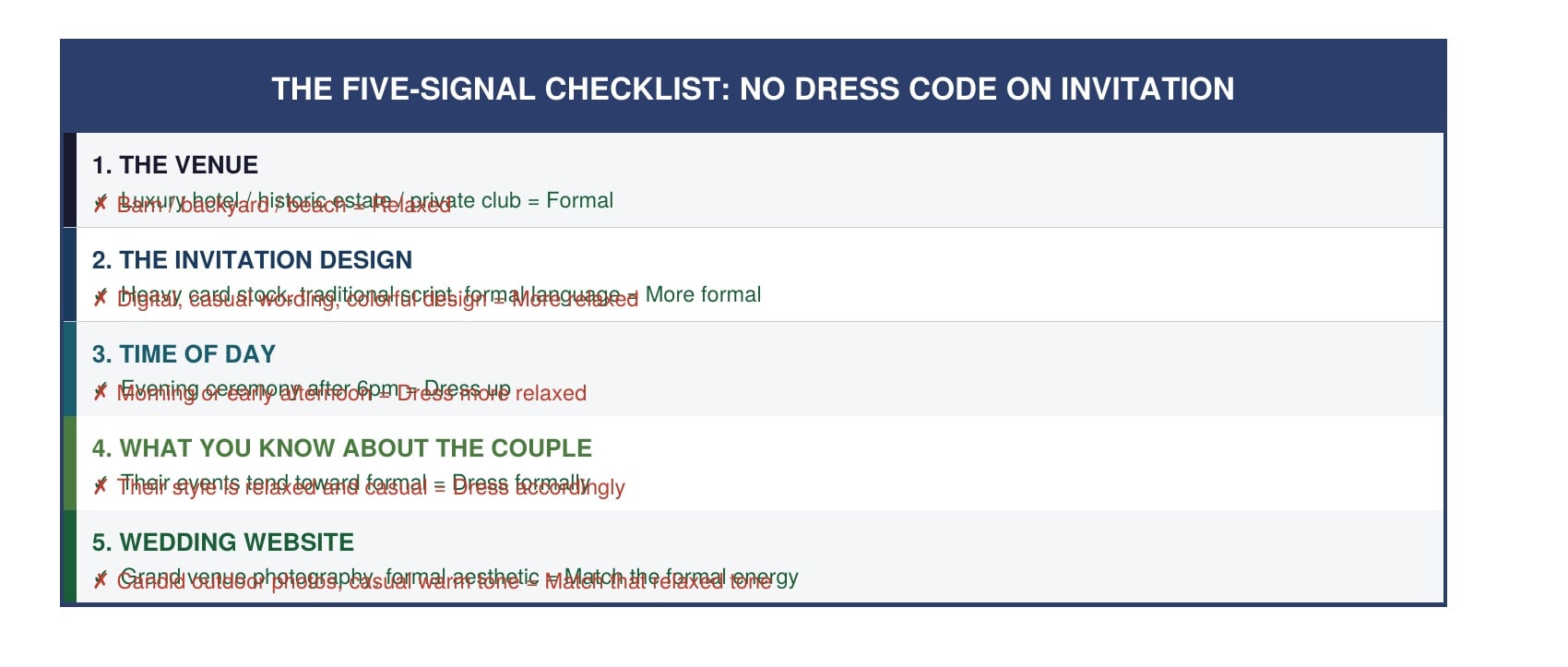
The venue is the strongest signal of all. A luxury hotel ballroom, a historic estate, a private club signals formal dressing. A barn, a backyard, or a beach signals relaxed dressing. The invitation design communicates formality before the dress code convention was invented and still works. A formally worded invitation on heavy cream card stock with engraved typography is telling you something about the expected formality. Time of day follows a convention so embedded in social dressing it functions as an unspoken dress code. Evening weddings are more formal than afternoon weddings. What you know about the couple is the signal most women underuse. The wedding website is the fifth signal, especially if it contains venue photography.
One consideration that applies across every dress code and deserves its own mention is religious venue requirements. Many couples marry in churches, cathedrals, synagogues, mosques, temples, and other houses of worship that have specific modesty requirements for attendees regardless of the stated dress code. Covered shoulders, sleeves, closed-toe shoes, and modest necklines may be required by the venue even when the invitation says cocktail or garden party. If the wedding ceremony is taking place in a religious venue, checking the couple’s wedding website or calling the venue directly is worth doing before finalizing your outfit.
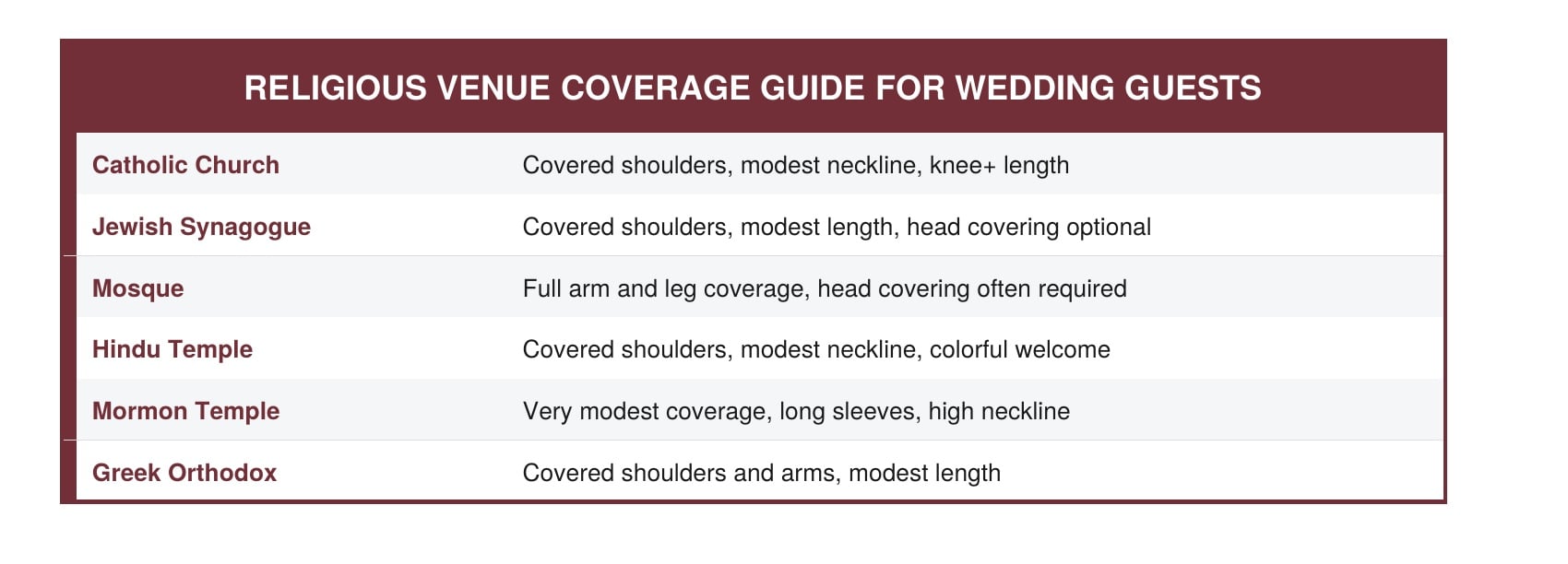
For women who need coverage for religious ceremonies or who simply prefer modest formal dressing, Jovani’s collection includes covered evening dresses and modest formal styles with long sleeves, high necklines, and closed backs across multiple silhouettes. These are not compromises on elegance. They are full evening gowns and formal styles built with the same quality and embellishment as every other style in the collection. The same applies to modest prom styles for younger guests attending formal events at religious venues or conservative family celebrations.
The One Rule That Never Changes
Every dress code in this guide has its own logic, its own range of acceptable choices, and its own level of flexibility. Black tie is clear and specific. Cocktail has genuine room for interpretation. Garden party adapts to the setting. Beach and destination follow the climate as much as the code. Invented dress codes reward the three-component framework. No dress code rewards the five-signal checklist.
But underneath all of it, one principle holds across every wedding, every venue, every season, and every level of confusion.
The couple who invited you chose to celebrate one of the most significant days of their lives with the people they love most. The dress code on the invitation, whatever form it takes, is their way of saying something about how they want that day to feel. Meeting that invitation with genuine effort, with a dress that fits, fabric that belongs in the setting, and a level of dressing that honors the occasion, is one of the simplest and most meaningful things a guest can do.
The three women from the opening of this guide all made it to their weddings. All three felt right when they arrived. Not because they found the perfect definition of garden elegant or decoded the cocktail dress code with mathematical precision. But because they thought carefully about what each occasion deserved, and they dressed accordingly.
That is the one rule that never changes. Dress as if the occasion deserves your full attention. Because it does.
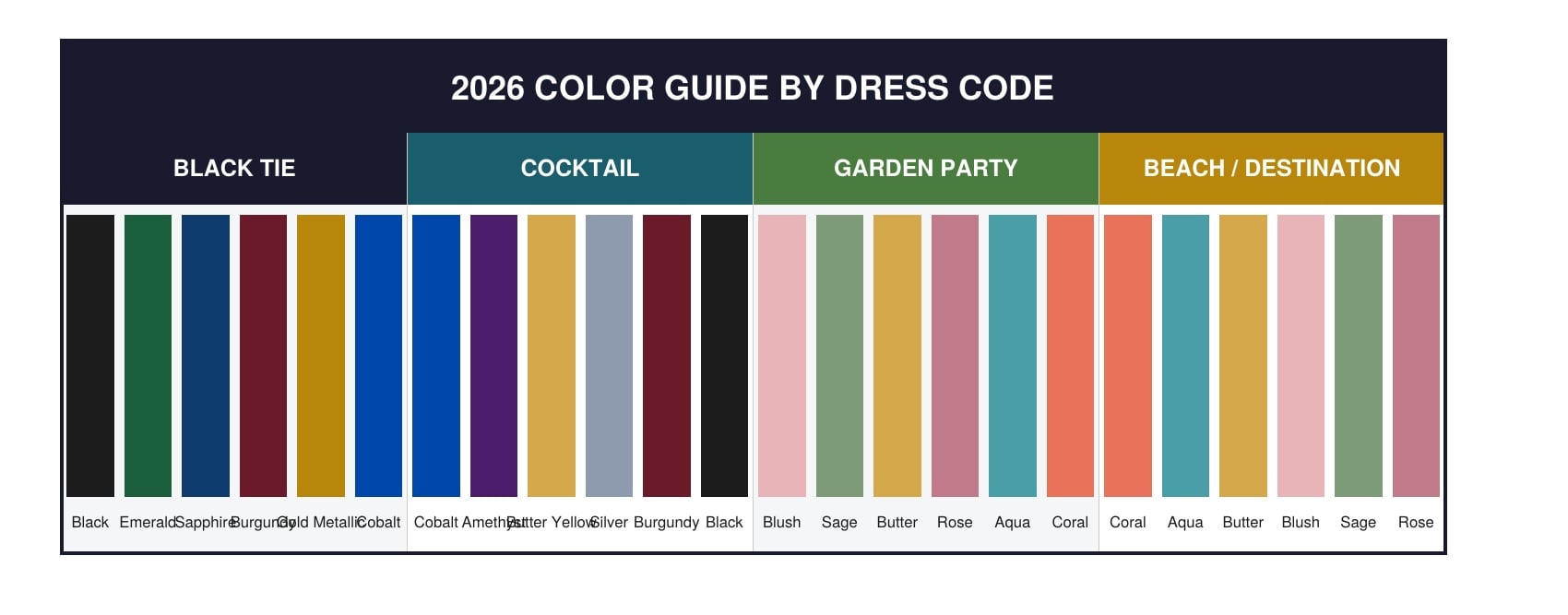
If you are looking for the dress that fits the code, the venue, and the moment, browse Jovani’s full collection of wedding guest dresses to find the style that gets you there.